Bank of America: To cope with geopolitical issues, "trade oil and hold gold"; the U.S. stock market needs "two major external shocks" to break free from its slump

Hartnett's latest report reveals the most awkward situation for U.S. stocks: the fundamentals are good but overcrowded, and the liquidity is starting to loosen and flow overseas. In the face of geopolitical fog and the high volatility of U.S. stocks, investors should "trade oil" in the short term and "hold gold" in the medium term; for U.S. stocks to break the current deadlock of "extremely bullish yet stagnant," it urgently needs two major "external shocks" to break the situation: a collapse in Middle Eastern oil prices or a easing of U.S.-China trade tensions
According to Michael Hartnett, Chief Strategist at Bank of America, the market logic for 2026 has fundamentally shifted: there is intense differentiation within the AI concept, and capital is flowing from the United States to Japan and South Korea.
In the face of geopolitical fog and the high volatility of the U.S. stock market, Hartnett believes that investors should "trade oil" in the short term and "hold gold" in the medium term; for the U.S. stock market to break the current deadlock of "extremely bullish yet stagnant," it urgently needs two external shocks: a collapse in Middle Eastern oil prices or a thaw in U.S.-China trade relations.
Has the Market Style Changed Dramatically?
In Hartnett's view, the market logic for 2026 is completely different from the previous two years.
If 2024 and 2025 are the solo acts of "AI leaders," then the market style in 2026 may undergo a dramatic change. Hartnett believes that the market is abandoning those "spenders" with huge capital expenditures (such as the Magnificent Seven tech giants) and embracing the "builders" of infrastructure (such as semiconductors and raw materials); capital is also flowing from the "disrupted" (software stocks) to the "applicators" of AI technology (banking stocks).
Of course, the intense sector rotation also brings risks. Currently, the technology, telecommunications, and financial sectors account for 56% of the S&P 500 index's weight. If the market capitalization of the leading laggards evaporates faster than that of the leading gainers rises, the market will face a risk of collapse.
Geopolitical Trading Rules: Short-term Oil Reigns, Medium-term Gold Prevails
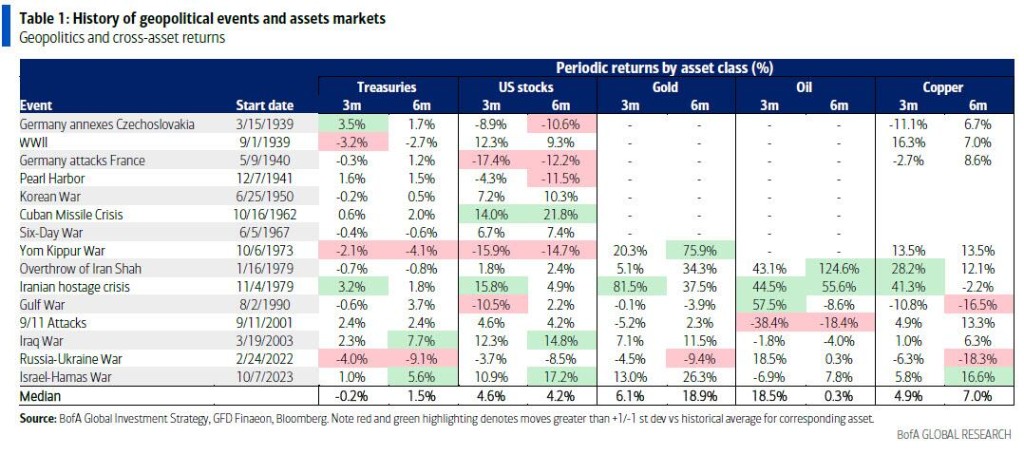
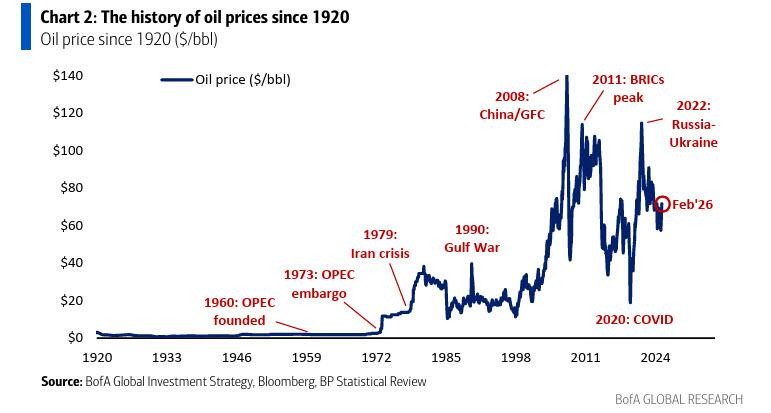
When discussing oil, gold, and geopolitical shocks, Hartnett believes that due to U.S.-Iran relations and geopolitical impacts, oil will be the best-performing asset in 2026.
However, this does not mean that investors can hold without thinking.
Based on historical data from the past 90 years, Bank of America provides the following reference: In the first three months after a geopolitical shock, oil is the absolute king, with an average increase of 18%, outperforming gold (+6%) and U.S. stocks (+4%). However, once the time frame extends to six months, the situation reverses—gold will continue to outperform, with an average increase expanding to 19%, U.S. stocks stagnate, and oil will give back all its gains.
Therefore, Hartnett's strategic maxim is succinct: "Leverage geopolitical turbulence = Trade Oil, Own Gold."
The former is a short-term tactical play, while the latter is a medium-term strategic allocation.
Breaking the Deadlock: U.S. Stocks Urgently Need Two Major "External Shocks"
Returning to the broader market, current investors are caught in a logical split "maze." On one hand, extremely bullish positions and prosperous profit expectations send a "sell" signal; on the other hand, tax incentives and interest rate cut expectations hint at "buying on dips." This contradiction has led the market into a chaotic high-level fluctuation.
Hartnett believes that for risk assets to further break through the current high levels, it is not enough to rely solely on endogenous momentum; two exogenous "shocks" must be relied upon to change the fundamental narrative.
The first is the change in Middle Eastern regimes ensuring a sufficient supply of oil in the future, which would lead to a collapse in oil prices, fundamentally alleviating inflationary pressures.
The second is a potential U.S.-China trade agreement that may be reached in April. He believes that the Trump administration urgently needs to alleviate inflation by cutting tariffs, thereby boosting its approval rating, which has fallen to a new low due to dissatisfaction with prices—currently, its approval rating is only 42%, and the support for handling inflation is even lower at 35%.
Capital Flow Warning
Deeper changes are occurring on the capital flow side, as the "American exceptionalism" seems to be retreating.
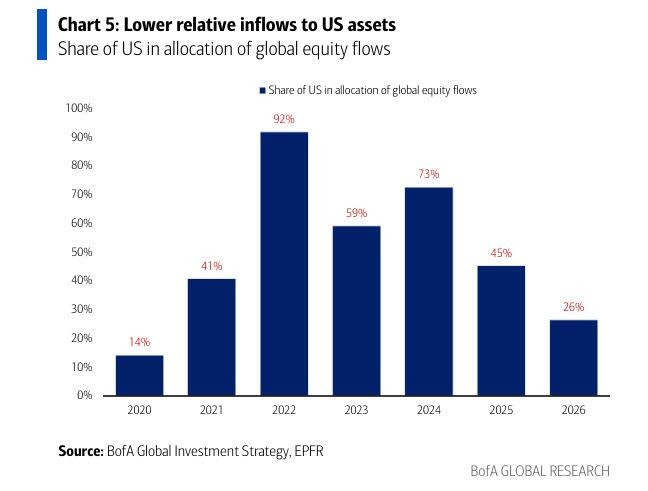
Hartnett predicts that by 2026, for every $100 flowing into global equity funds, only $26 will go to U.S. stocks, marking the lowest share since 2020, in stark contrast to the peak of $92 in 2022.
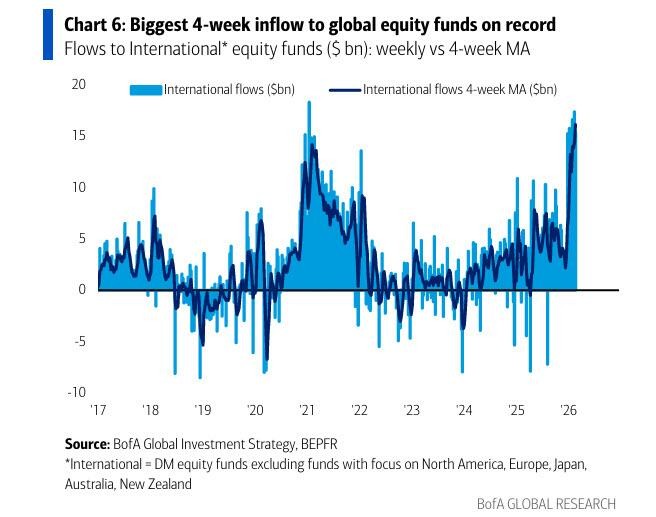
Data shows that international equity funds recorded a record net inflow of $64.6 billion over four weeks, primarily flowing into South Korea (storage chip concept) and Japan (re-inflation narrative). Among them, the South Korean stock market recorded the largest net inflow in history over six weeks, reaching $17.7 billion.
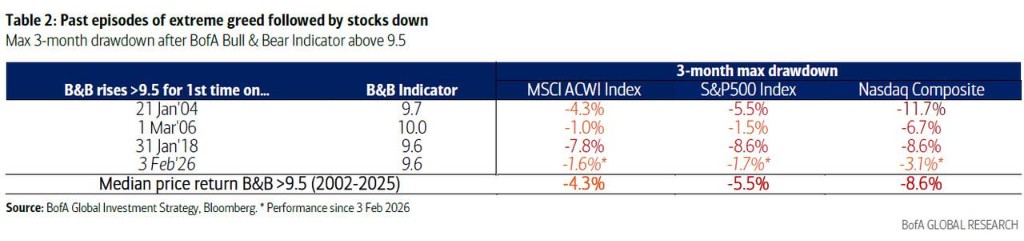
At the end of the report, Hartnett once again mentioned Bank of America's famous "Bull & Bear Indicator." The current reading of this indicator is 9.4, which is in the "extremely bullish" range, just slightly below the historical peak of 9.5.
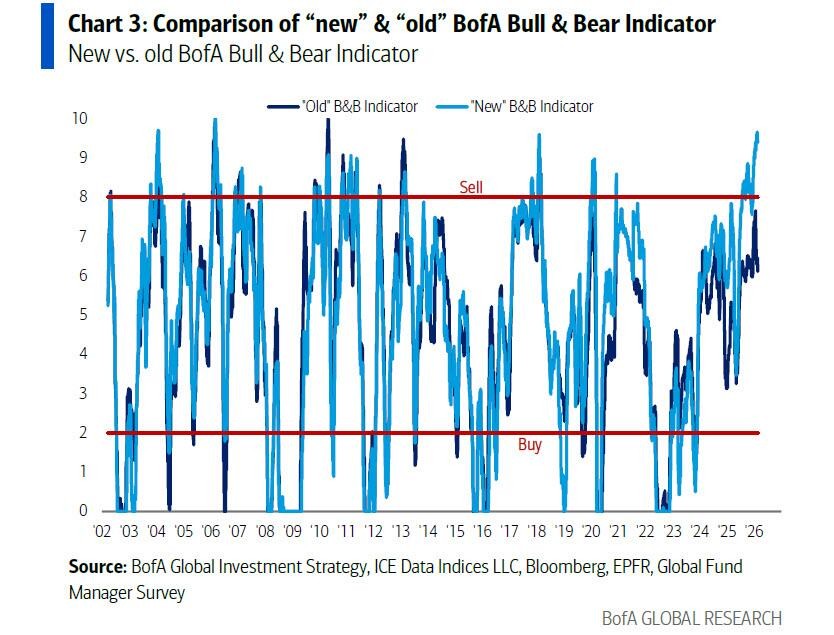
Historical backtesting shows that in the past 25 years, this indicator has only exceeded 9.5 three times, and after these extreme readings, the market typically experiences a significant correction within the following three months, with the average decline of the Nasdaq index reaching 8.6%.