


LME aluminum plummets! Report: The United States is considering partially lifting tariffs on aluminum and steel

To address inflation and midterm election pressures, the Trump administration plans to reduce steel and aluminum tariffs, exempt certain products, and stop expanding the scope of taxation. This move acknowledges that the cost of tariffs is primarily borne by American consumers, and the current mechanism is overly complex. As a result, London aluminum futures fell more than 1% in the short term. Previously, the Republican Party had turned against imposing tariffs on Canada, highlighting that the White House's trade protection policies are facing dual political backlash both internally and externally
According to media reports on Friday, in response to the increasingly severe inflation pressure and to salvage voter support ahead of the midterm elections, the Trump administration is planning to reduce tariffs on steel and aluminum products. This policy shift indicates that faced with voter anger over the cost of living crisis, the White House is attempting to recalibrate the intensity of its trade protectionist stance to mitigate the direct impact on American consumers.
According to CCTV News, U.S. President Trump signed an executive order on February 10, 2025, announcing a 25% tariff on all U.S. imports of steel and aluminum.
Media reports, citing three informed sources, state that the Trump administration is currently re-evaluating the list of products affected by tariffs, planning to exempt certain items and halt the expansion of the tax scope. Instead, the government will initiate a more targeted "national security investigation" to focus on specific goods rather than implementing broad tariff strikes. Officials from the U.S. Department of Commerce and the Office of the U.S. Trade Representative believe that broad tariffs have driven up prices for items such as pie plates, food, and beverage cans, harming consumer interests.
This reassessment marks a softening of the Trump administration's trade stance. Last summer, the U.S. President imposed tariffs of up to 50% on steel and aluminum imports and expanded the tax scope to downstream metal products such as washing machines and ovens, pushing U.S. tariff levels to their highest point since World War II. However, economists point out that it is actually Americans who are footing the bill for these tariffs, undermining the President's claim that foreign companies would bear the burden.
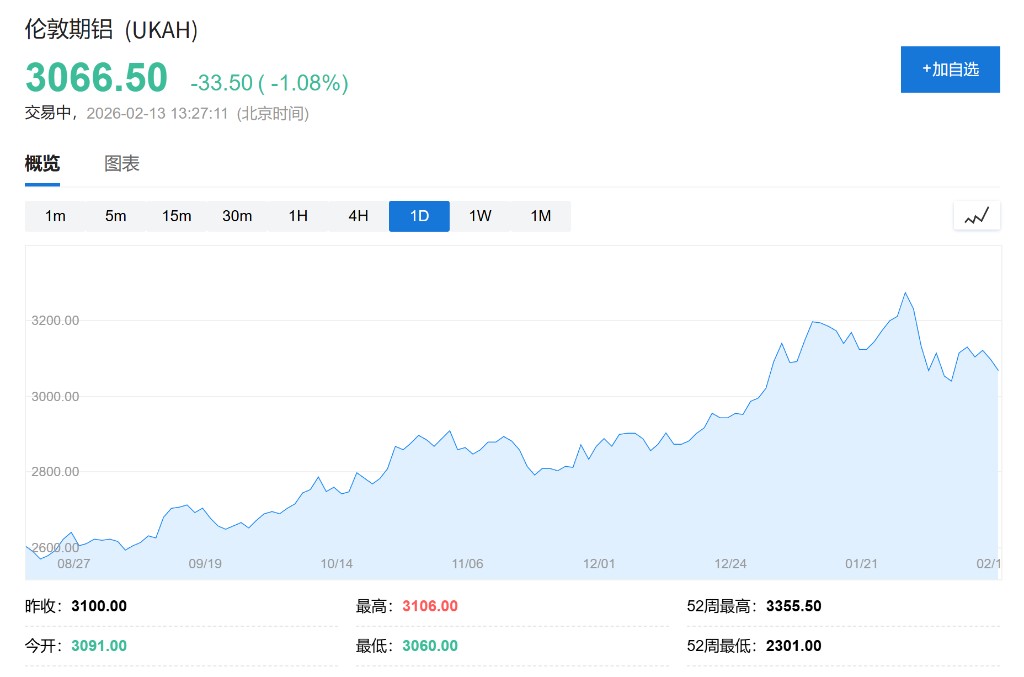
In response to this news, the market reacted swiftly. Aluminum futures prices on the London Metal Exchange (LME) fell sharply, dropping 1.08% during the day to report $3,066.5 per ton, reflecting market expectations that supply-side pressures may ease.
Addressing Inflation and Election Pressure
The adjustment of tariff policy comes at a time when the "affordability crisis" in the U.S. is intensifying. According to a poll released this month by the Pew Research Center, over 70% of American adults rate the economic situation as "fair" or "poor," and about 52% of Americans believe that Trump's economic policies have worsened the situation. To stabilize grocery price inflation for ordinary Americans, the government has previously provided exemptions for some popular food items and reached a trade truce with China after retaliatory tariffs were imposed in Beijing.
As the November midterm elections approach, several Republican lawmakers are facing tough battles in their respective states, with voter concerns about the impact of tariffs on small businesses and consumers becoming a focal point. This political backlash has even affected the Republican Party internally On Wednesday, House Republicans joined Democrats in voting against Trump's tariffs on Canada, which constitutes a significant rebuke of the government's trade war against the United States' second-largest trading partner. Although Trump is expected to veto the bill to maintain the tariffs, this highlights the increasing political isolation of the tariff policy.
Simplifying Complex Execution and Lobbying Mechanisms
In addition to political considerations, the chaos at the executive level is also a significant reason for this adjustment. Insiders revealed to the media that officials believe the current tariff system is "too complex to enforce" and urgently needs simplification. The current mechanism allows U.S. companies to lobby the government to impose tariffs on foreign products of competitors through a so-called "inclusion" process. This process is primarily run by the Department of Commerce and has approved numerous requests from domestic companies.
However, this mechanism has led to a convoluted list of household items being subjected to metal content tariffs as high as 50%, resulting in inconsistent enforcement standards. A European business leader disclosed that a certain company sent four containers with the same machinery to the U.S. but was charged different tax rates. The Department of Commerce had previously set a 60-day deadline to approve new tariff nominations but failed to meet it, indicating an overloaded administrative system.
Abuse and Generalization of National Security Reasons
The current lobbying process has sparked widespread controversy, with companies requesting tariffs on competing products under the guise of "national security." In nearly 100 documents, U.S. manufacturers have requested tariffs on foreign goods such as mattresses, cake molds, and bicycles. One company even argued in its application that "without bread, rolls, baguettes, crusty rolls, cakes, muffins, and similar items," U.S. military personnel would "not be able to maintain a healthy diet," thereby asserting that the relevant baking molds pose a national security risk.
This policy adjustment aims to bring clarity to Washington's increasingly complex lobbying procedures. If tariffs are relaxed, countries and exporters of related steel and aluminum products, including the UK, Mexico, Canada, and EU member states, will benefit. So far, the U.S. Department of Commerce, the Office of the U.S. Trade Representative, and the White House have declined to comment on this matter
