


Oracle's most pessimistic assumption: If all AI data center contracts are terminated

Bernstein's extreme stress test shows that even if AI clients like OpenAI completely withdraw their orders, Oracle can still support a valuation of $137 per share based solely on its core database and enterprise cloud business, with only a 15% downside from the current stock price, indicating a clear margin of safety. The research report also breaks down market concerns: the annual risk exposure of $248 billion in leasing contracts is only $13 billion to $16.5 billion, with flexible hardware procurement and strong asset versatility. With recent financing secured, if an AI winter does not occur, the risk-reward ratio is already highly attractive
In response to the market's ongoing concerns about customer concentration and capital expenditures, Bernstein conducted an extreme scenario stress test on Oracle in its latest research report: If AI customers like OpenAI completely withdraw their orders, what would the company's value be?
According to the Wind Trading Desk, the report's model constructed a "near worst-case" downside assumption: all AI contracts signed since the fourth quarter of fiscal year 2025, including OpenAI's substantial orders, cannot be converted into revenue, and customers neither fulfill nor renew their contracts. Meanwhile, core database, SaaS, and non-AI OCI businesses continue to grow normally.
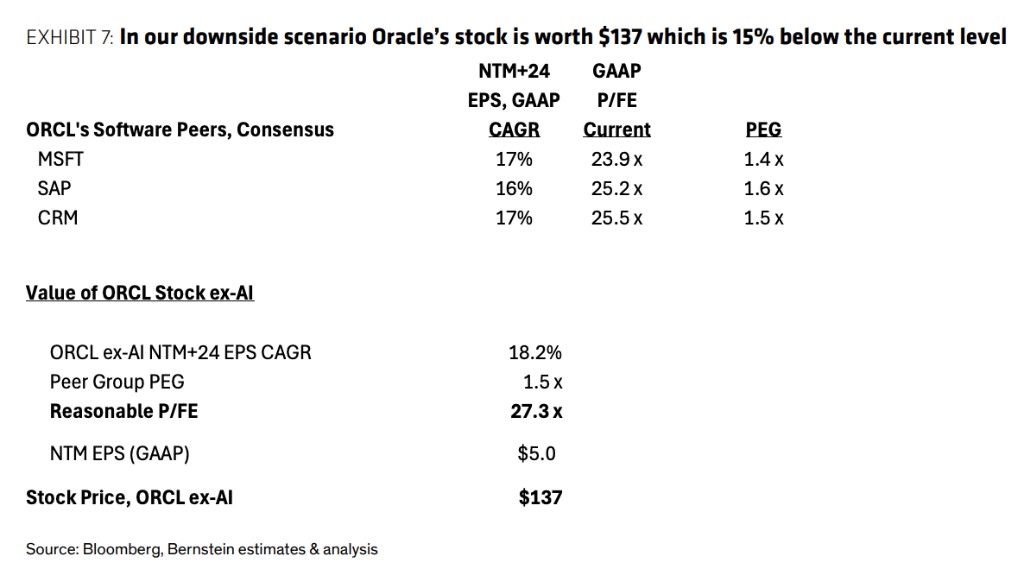
Under this extreme setting, Bernstein estimates Oracle's valuation floor at $137 per share, representing only a 15% downside from the current level of about $160, providing investors with a clear margin of safety. In an optimistic scenario, if execution goes smoothly, the target price could reach $313.
The conclusion presents a strong asymmetry. Even excluding all AI-related revenue, Oracle can still support a robust valuation based solely on its core enterprise business. Bernstein believes that the market's concerns about reliance on AI customers and capital expenditure pressures have been overvalued, and the current risk-reward ratio is attractive.
$248 billion lease liabilities are not an "unbearable burden"
Bernstein further dissected the market's concerns regarding Oracle's massive data center lease contracts. The scenario that investors fear the most is that if customers default, Oracle will be forced to bear up to $248 billion in idle costs. However, the report points out that this risk is significantly overestimated.
First, these lease contracts have terms of 15 to 19 years, with capacity coming online in batches until the fiscal year 2030. The annual maximum risk exposure is actually only $13 to $16.5 billion, and it won't peak until 2030. Second, as long as the global market does not fall into an "AI winter," demand for data centers will remain high, and Oracle is fully capable of utilizing or subleasing idle space.
More importantly, even excluding generative AI, the potential size of the global IaaS/PaaS market has reached $1.2 trillion to $1.4 trillion, and the data center capacity consumed by traditional enterprise cloud migration is sufficient to absorb this leased space. In other words, Oracle's long-term contract structure provides ample cushioning, and the market's panic over its capital commitments lacks substantial support.
Hardware risk is controllable and will not be "trapped" by GPU inventory
In response to market concerns about hardware capital expenditure risks, Bernstein pointed out that its actual exposure is quite limited. The procurement cycle for servers and GPUs typically occurs 3 to 6 months before capacity comes online; if customers cancel contracts, Oracle can flexibly cancel or postpone orders before delivery without incurring significant penalties.
Even if hardware has been delivered, most computing assets such as storage, networking, and memory devices remain highly versatile and can be seamlessly repurposed for traditional SaaS and OCI businesses. The report further estimates that every $1 of annual AI revenue corresponds to about $2 to $2.5 of computing assets, with an asset lifespan of 6 years, meaning that even if customer defaults occur, at most only 1 to 2 years of computing expenditures are at risk. Overall, the risk of capital expenditure in hardware has been significantly overestimated.
Strong Fundamentals of Core Business
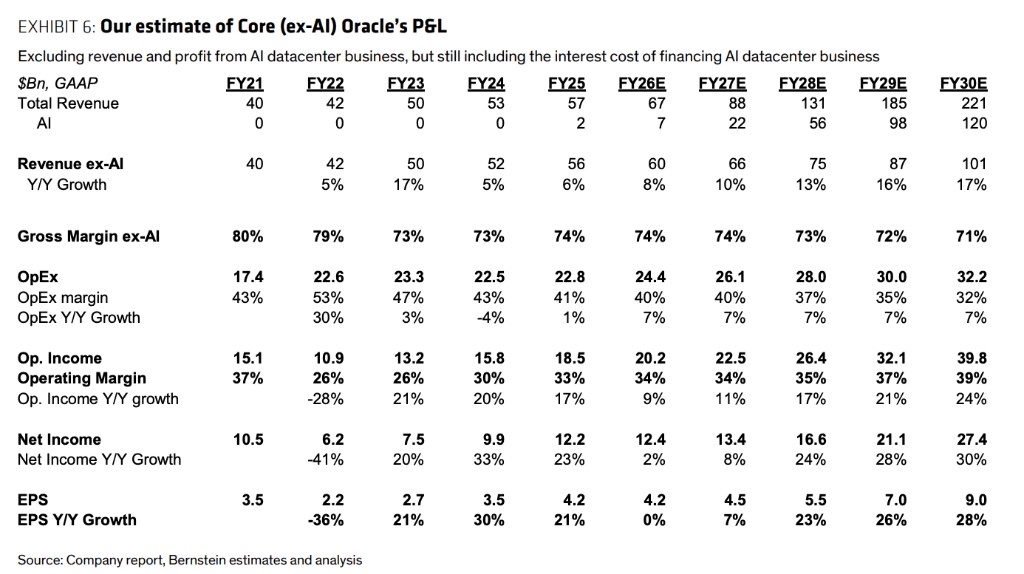
Bernstein further stripped away the AI business in its latest model, clearly outlining the independent value of Oracle's core business. Even if AI data center-related revenue is completely excluded, the company's total revenue from traditional databases, SaaS, and OCI business could still reach $101 billion by fiscal year 2030.
More importantly, after bearing the interest costs of the debt raised for AI infrastructure (including the recent $25 billion financing), its earnings per share can still achieve $9.00. Referring to the price-to-earnings ratio level of 27.3 times for software peers like Microsoft, SAP, and Salesforce, this earnings expectation corresponds to a valuation of $137 per share. In other words, even if the AI business goes to zero, Oracle can still support about 85% of the current stock price with its core business, highlighting the robustness of its cash generation capability.
Bernstein believes that the current Oracle stock price has overly priced in pessimistic expectations, and the risk-reward ratio is entering a highly attractive range. With the recent $25 billion debt and an equivalent amount of equity financing in place, the funding bottleneck for data center construction has been substantially resolved. The research report emphasizes that as long as the world does not fall into an extreme scenario of an "AI winter," the current valuation level provides investors with ample safety margin and asymmetric profit potential
