


China's large model "Spring Festival 档" is launched! Waiting for consumer-grade AI to produce "blockbusters"

The Spring Festival raid tactic of DeepSeek in 2025 has become an industry textbook case. By 2026, everyone has learned this trick. ByteDance, Alibaba, KNOWLEDGE ATLAS, and DeepSeek have intensively released flagship models during the "Spring Festival" period, shifting the focus of competition from purely model performance to "efficiency" and the implementation of "intelligent agents." Analysis indicates that if DeepSeek V4 achieves cost reduction in inference, it will drive AI from standalone apps to being "embedded" in high-frequency applications like WeChat, with Tencent likely becoming the biggest beneficiary
The Spring Festival of 2026 is no longer just a consumption frenzy, but has evolved into a race of speed and passion among China's AI giants for the "mobile entry point."
According to news from the Chasing Wind Trading Desk, JP Morgan pointed out in its latest research report released on February 11 that the Chinese internet and AI industry is 迎来史上最密集的旗舰模型发布潮. This is no longer a solo performance of a single model, but a game of musical chairs about who can convert "technology spillover" into "consumer-grade hits" the fastest.
Crowded "Spring Festival Release Season"
The Spring Festival raid tactic of DeepSeek in 2025 has become an industry textbook. In 2026, everyone has learned this trick.
According to JP Morgan's observations, the market is once again prepared for a similar "holiday release season," but the difference is: "This time it's not a solo performance; we see numerous flagship and near-flagship updates converging at the same window."
ByteDance took the lead, launching a three-model "gift package": Seedance 2.0 (video), Seedream 5.0 (image), and Doubao 2.0. Among them, Seedance 2.0 has already released "hit" signals.
Alibaba is also not to be outdone, reportedly preparing to launch Qwen 3.5 in mid-February, along with a 3 billion yuan incentive plan to drive customer acquisition.
KNOWLEDGE ATLAS released GLM-5 (the previously mysterious "Pony Alpha") on February 11, expanding its parameter scale from 355 billion to 744 billion.
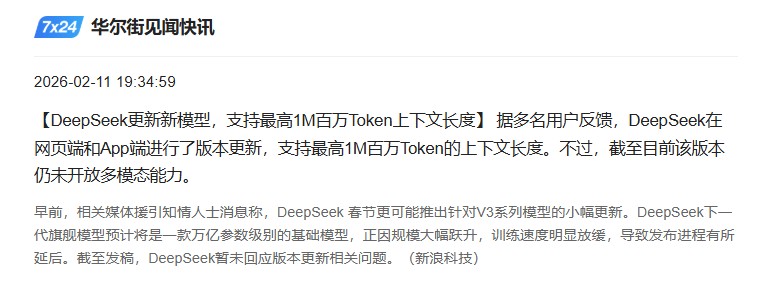
DeepSeek is reported to have its V4 version targeting mid-February, focusing on improvements in coding and ultra-long prompt processing. Reports on February 11 indicated that DeepSeek updated its new model, supporting a maximum context length of 1 million tokens.
MiniMax launched its latest large model M2.5 on the Agent platform on February 11.


JP Morgan bluntly stated that this clustering of releases will lead to a "winner-takes-all" situation:
"When multiple models appear simultaneously, developers and companies will strengthen comparative testing... The disadvantages faced by those who perform poorly will be more pronounced."
 In the attention-scarce Spring Festival window, if a lab cannot present a credible flagship update, it may directly fall off the developers' trial list.
"During the Spring Festival window, attention is scarce, but in a sense, it is abundant: users will try more things, but they will also decide more quickly which products to continue using. This is why we view the Spring Festival phase as a scoreboard reset period."
DeepSeek V4 and the Ambition of "Cost Reduction"
The variable that the market is most concerned about remains DeepSeek.
JP Morgan analysts point out that the potential Spring Festival release of DeepSeek has its core impact not in the chatbot itself, but in the "platform economic benefits" it may unleash.
DeepSeek's latest paper, "Conditional Memory Based on Scalable Search," reveals its technological path: improving quality through "conditional memory" as a second sparse axis without violent computational upgrades.
The research report believes that the technology proposed by DeepSeek to add "conditional memory" outside of the mixture of experts model (MoE) could become key to the next generation of models. This is not just about making the model lighter, but rather shifting expensive dense computations to cheaper retrieval operations.
"If the technical implementation is as stated in the paper, it would mean an increase in efficiency, not merely a lightweight model; it actually shifts part of what the model 'does' from expensive dense computations to cheaper retrieval/memory operations."
"If it prioritizes efficiency and achieves cost reduction in reasoning, then AI can be economically embedded directly into high-frequency consumer products, rather than being a standalone chatbot."
This means that AI will transform from an expensive "toy" into a cheap "tool." If the unit cost of reasoning decreases, it becomes reasonable to spend more tokens on multi-step reasoning and tool execution, which will drive the domestic AI adoption curve from "dialogue tools" to the highest frequency product interface of "AI embedded."
Who are the Winners? The Biggest Beneficiary May Be Tencent
In this model war, JP Morgan provides a counterintuitive deduction: the biggest beneficiary may not be the model vendors, but Tencent.
The logic is very clear: Tencent owns WeChat and QQ, the two highest-frequency communication interfaces in China.
"We believe Tencent is likely to become the biggest beneficiary of the potential new product release of DeepSeek...
Tencent has already begun to integrate third-party model capabilities into core consumer entry points like WeChat and Yuanbao, which increases the likelihood that stronger model performance translates into tangible improvements in user experience.
If model quality improves significantly, we also expect Tencent to be more confident in expanding and deepening AI functionality integration across high-frequency communication interfaces, including QQ."
For Alibaba and Baidu, the situation is more complex. On one hand, stronger models can enhance the user experience of their products (such as Taobao Q&A and Baidu Search); but on the other hand, if DeepSeek reignites a "price war," the entire industry's API services will face tremendous deflationary pressure
"If the newly released DeepSeek significantly improves efficiency, we expect that the pricing pressure on model application programming interface services across the industry will continue, which may put pressure on short-term unit economics."
For vertical giants like Trip.com, Beike, and Kuaishou, JP Morgan believes this is definitely a positive development. The powerful open-source models lower their technical barriers, allowing them to fine-tune proprietary data at a lower cost and accelerate product iteration.
Waiting for the "blockbuster" validation of consumer-grade AI
Despite the enthusiasm in the capital markets, JP Morgan remains objectively calm.
Current "2C intelligent agent" demonstrations are often impressive, but they frequently face inconsistencies when implemented in practice. The large-scale user testing during the Spring Festival will be a true litmus test.
"We agree with the current skeptical attitude in the market: many '2C intelligent agent' demonstrations are still inconsistent, and once users apply them to actual tasks on a large scale, consumer satisfaction usually falls below expectations."
However, if this flagship model during the Spring Festival can truly solve the reliability and latency issues of tool usage, then the turning point may indeed have arrived.
As JP Morgan summarized, "The real adoption signal is not the hype on the release day; rather, it is whether existing giants will make AI a default feature in high-frequency interfaces, as this is the driving force behind sustained demand for reasoning."
Valuation Reconstruction: Looking at Profitability in 2030
In addition, in terms of secondary market strategy, JP Morgan maintains an "overweight" rating on pure model developers KNOWLEDGE ATLAS and MiniMax.
KNOWLEDGE ATLAS's GLM-5 has achieved open-source SOTA (state-of-the-art) in agent capabilities, ranking first in multiple evaluation benchmarks. MiniMax has achieved dual commercialization in B2B/B2C with its full-spectrum model (text, video, audio).
JP Morgan's valuation logic has bypassed short-term losses and is looking directly at 2030:
KNOWLEDGE ATLAS: Target price of HKD 400, based on a 30x expected price-to-earnings ratio for 2030.
MiniMax: Target price of HKD 700, based on a 30x expected price-to-earnings ratio for 2030.
Analysts believe that as model capabilities approach the global frontier, the logic for valuation upgrades will undergo a qualitative change:
"Valuation upgrades may no longer be about national pride, but rather focus more on economic benefits: stronger willingness to pay and higher API workload retention rates."
The above exciting content comes from [追风交易台](https://mp.weixin.qq.com/s/uua05g5qk-N2J7h91pyqxQ).For more detailed interpretations, including real-time analysis and frontline research, please join the【 [追风交易台▪年度会员](https://wallstreetcn.com/shop/item/1000309)】