


Balance sheet reduction - "Federal Reserve Treasury Agreement" - Interest rate cuts, is this what Walsh calls "the grand strategy"?

Wash believes that the Federal Reserve's balance sheet is too bloated and suggests shifting long-term government bonds to short-term government bonds through Treasury issuance to force the Fed to cut interest rates. Barclays' report indicates that the Fed may abandon its pursuit of a declining total balance sheet and instead reduce portfolio duration by reinvesting in short-term government bonds. This strategy shifts duration risk to the private market, leading to a repricing of duration premiums. Wash hopes to shrink the Fed's balance sheet to reduce market intervention
Wash believes that the Federal Reserve's balance sheet is "too bloated and has too long a duration," and hopes to significantly shift the Fed's holdings from long-term Treasury bonds to short-term Treasury bonds through cooperation with the Treasury's bond issuance, which will lead to an increase in the term premium between long and short-term Treasury bonds, thereby forcing the Fed to lower policy interest rates.
According to the Wind Trading Desk, Barclays pointed out in its interest rate research report released on February 10:
In order to reduce the Fed's footprint in the market without triggering a liquidity crisis, the Fed may abandon its pursuit of a reduction in the total balance sheet and instead seek to reduce the duration of its portfolio by reinvesting maturing bonds into short-term Treasury bonds.
This "short for long" strategy appears to be merely an asset swap, but in reality, it shifts significant duration risk back to the private market. This will lead to a repricing of the term premium in the market.
To offset the tightening of financial conditions caused by a significant rise in long-end yields due to supply shocks, the Fed needs to lower interest rates on the short end to achieve balance. The core logic of the report is:
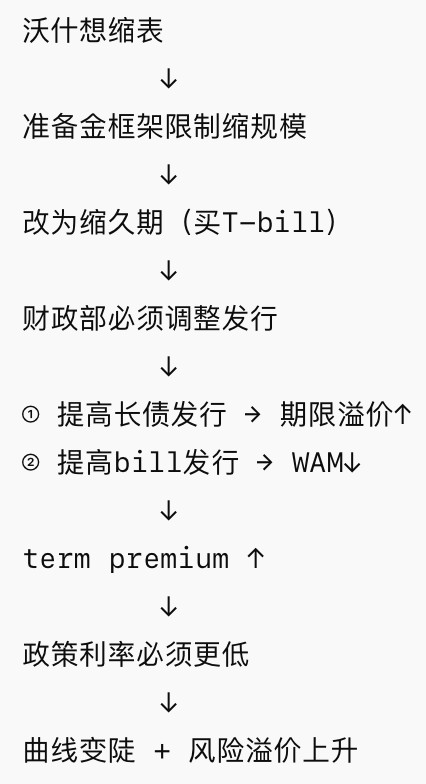
I. Unsustainable Status Quo: Wash's View of the "Distorted" Balance Sheet
As of early 2026, the Federal Reserve's balance sheet is approximately $6.6 trillion, a figure that far exceeds the pre-pandemic level of $4.4 trillion and the pre-global financial crisis (GFC) level of $0.9 trillion.
Barclays points out that what "hawkish" Wash cannot tolerate even more is its structure:
1. Excessive Size: Reserves are close to $3 trillion, accounting for 12% of bank assets.
2. Excessive Duration: The weighted average maturity (WAM) of the Fed's Treasury bond portfolio is currently about 9 years, compared to only 3 years before the GFC.
3. Imbalanced Holdings Structure: The proportion of Treasury bonds with maturities of 10 years or more has risen to 40%, while T-bills account for only 7% of the Treasury bond portfolio (compared to 36% before the GFC).
Wash has made it clear: "The Fed's bloated balance sheet... can be significantly reduced." He wants to return to an era when the Fed had less intervention in the market.
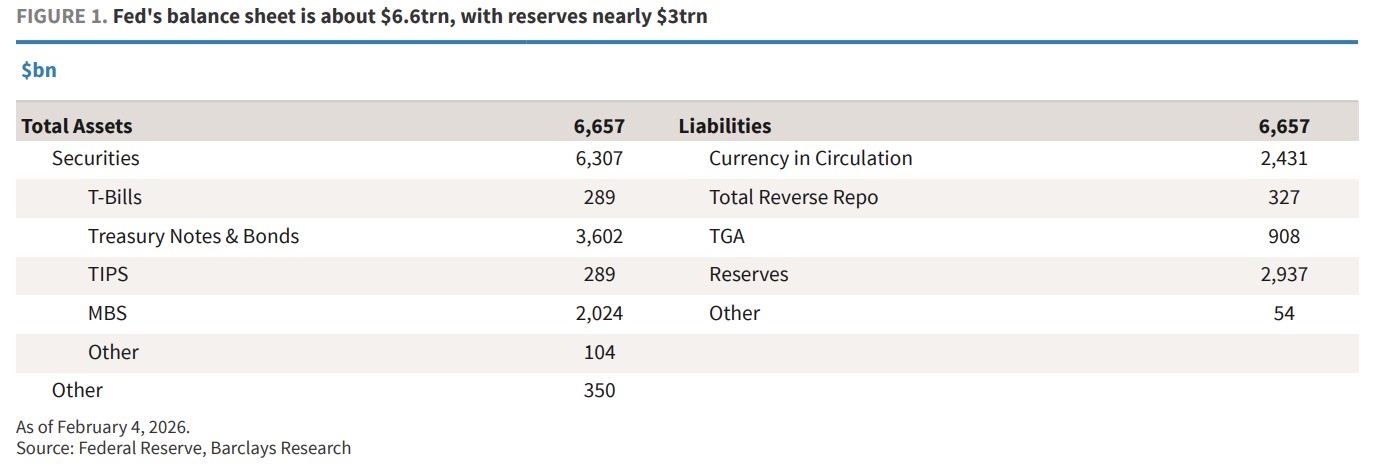
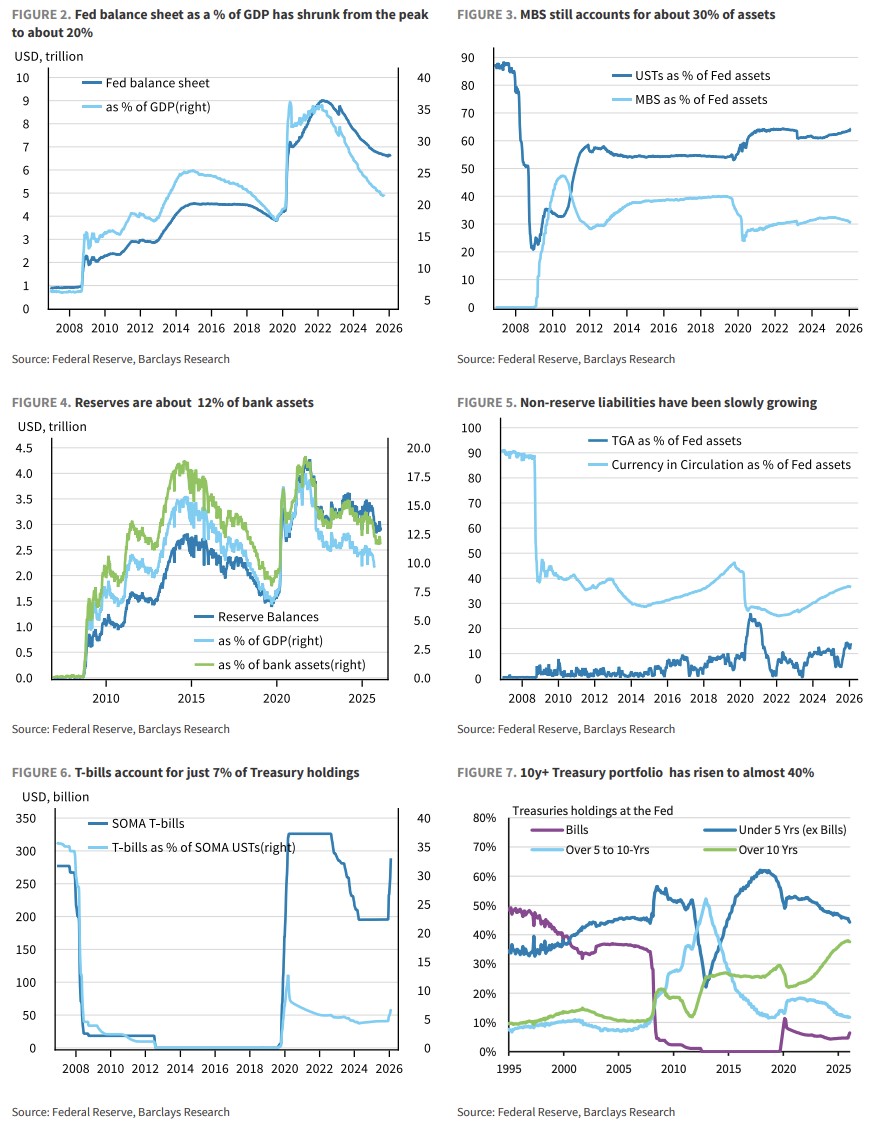
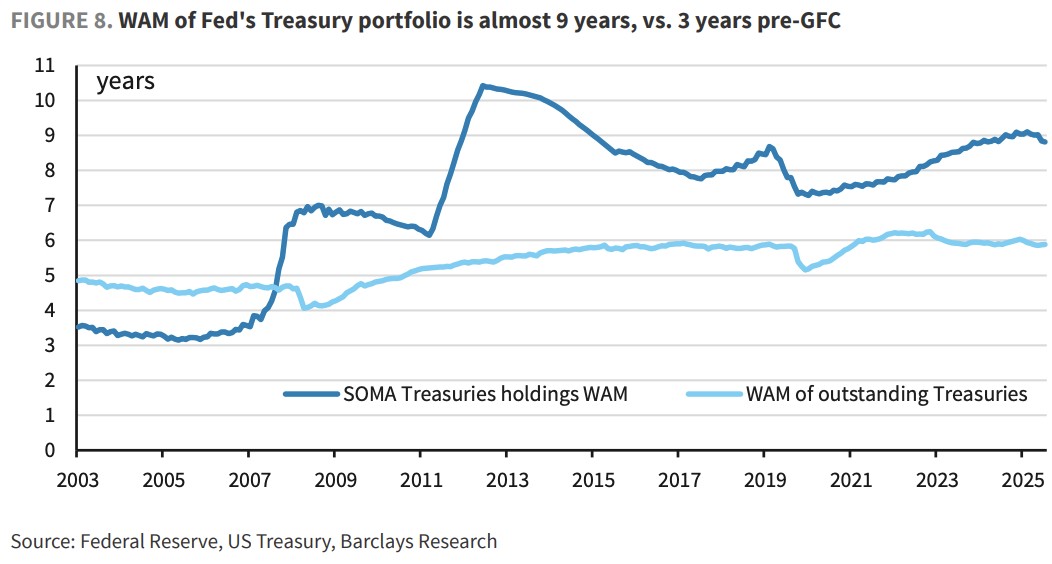
II. The Risk of Hard Landing: Why Can't QT Be Restarted Simply and Brutally?
If Waller wants to shrink the balance sheet by simply stopping Reserve Management Purchases (RMPs) or restarting Quantitative Tightening (QT), the risks are extremely high.
The current banking system operates under a "sufficient reserves" framework. The demand for reserves by banks is driven by liquidity regulation (LCR), internal risk management, and payment needs, which is not a straight line but a nonlinear and unpredictable curve.
As experienced during the repo crisis in September 2019, once reserve levels hit a critical point of scarcity, pressure in the financing market will explode instantly.
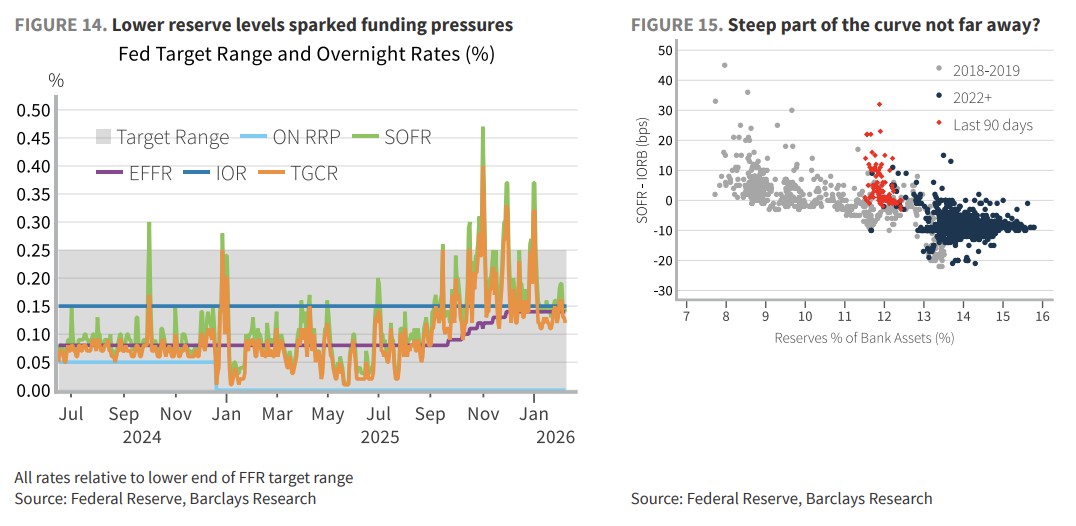
If the Federal Reserve forcibly reduces reserves, it could push the market into the "steep part" of the demand curve without warning, causing overnight financing rates to soar, triggering a deleveraging panic, and ultimately forcing the Fed to re-enter the market to rescue it, just like in March 2020. This would be contrary to the original intention of shrinking the balance sheet.
III. Waller's "Scalpel": Shortening Duration by Purchasing T-bills
Since simply selling assets is not an option, Waller's alternative is to shorten the duration.
Barclays has outlined a core strategy: the Federal Reserve will no longer reinvest maturing notes/bonds into similar assets but will reinvest them into short-term Treasury bills (T-bills) through the secondary market.
Over the next five years, approximately $1.9 trillion in notes/bonds will mature in the U.S. If the Fed implements this strategy, its holdings of T-bills will surge from the current $289 billion to about $3.8 trillion, accounting for 60% of the Treasury portfolio. The duration of the Fed's investment portfolio will decrease from 9 years to 4 years, approaching the pre-GFC norm.
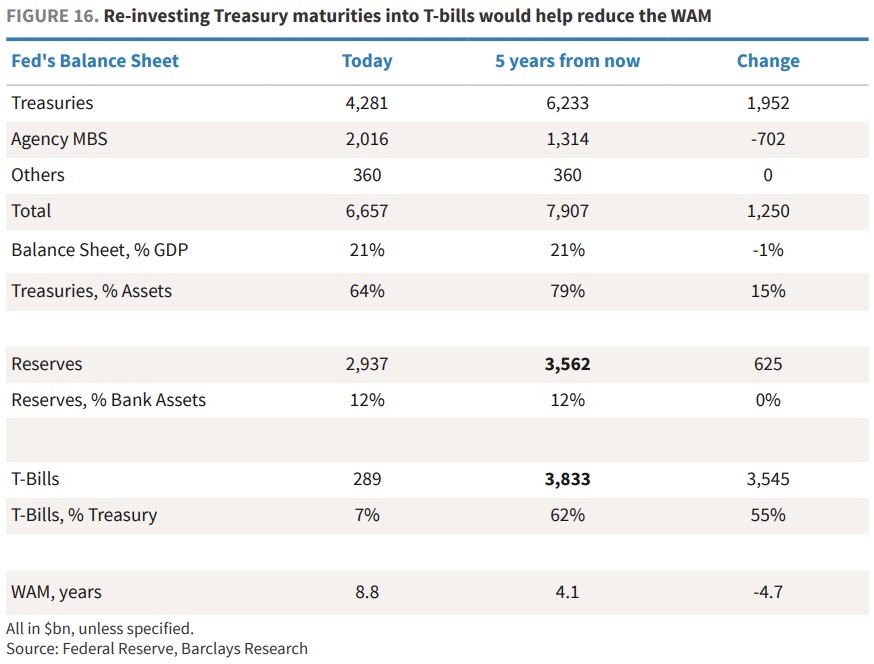
This will significantly reduce the interest rate risk of the Federal Reserve's balance sheet and leave room for future policy operations.
IV. Key Game: The "New Accord" Between the Federal Reserve and the Treasury
Whether this strategy can succeed still requires cooperation from the Treasury. This leads to what Waller refers to as the "New Accord."
Scenario A: A "Disaster" Without Coordination If the Federal Reserve stops purchasing long-term Treasury bonds at auctions, and the Treasury chooses to increase the issuance of long-term bonds (Coupons) to fill the gap, the private sector will have to absorb an additional approximately $1.7 trillion (10-year equivalent) of duration supply.
This will lead to an imbalance in the supply and demand for long-term U.S. Treasuries, significantly pushing up the term premium (estimated to raise the 10-year yield by 40-50 basis points)
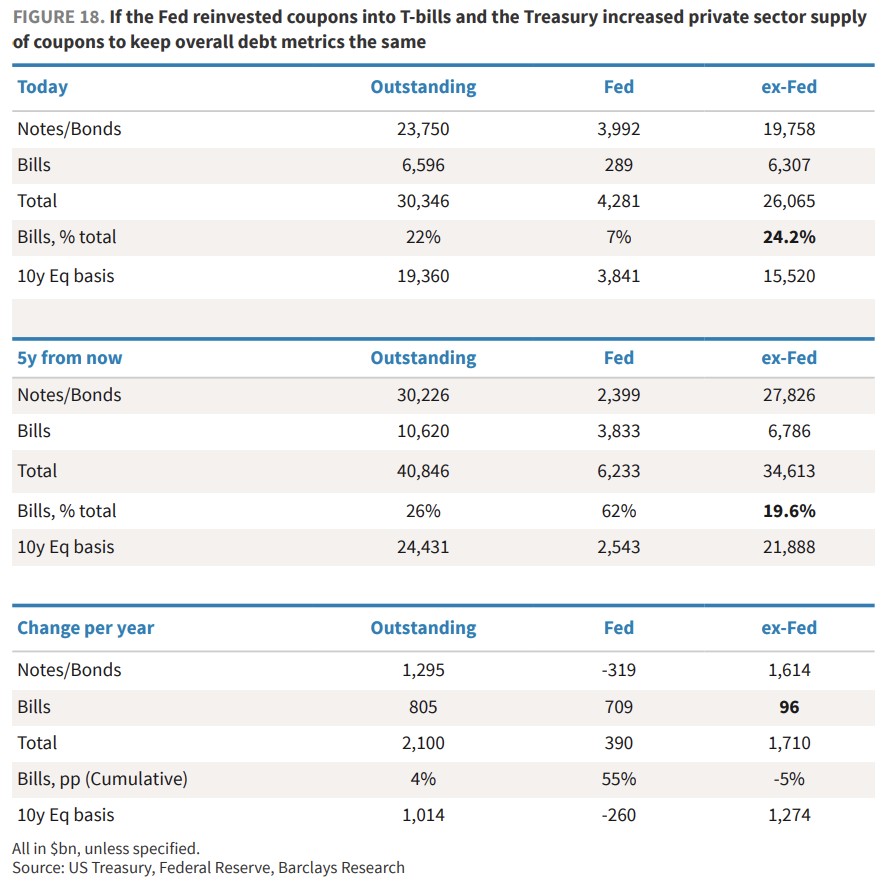
Scenario B: The most reasonable path to achieve the "tacit understanding" is that the Treasury maintains a constant long-term issuance of government bonds to the private sector, while meeting the Federal Reserve's new demand through the issuance of T-bills. In this case, the share of T-bills held by the private sector will stabilize at around 24%.
Although the average maturity of the Treasury's overall debt will shorten (from 71 months to about 60 months), this avoids severe market turbulence.
V. Endgame Simulation: Steeper Yield Curve and Lower Interest Rates
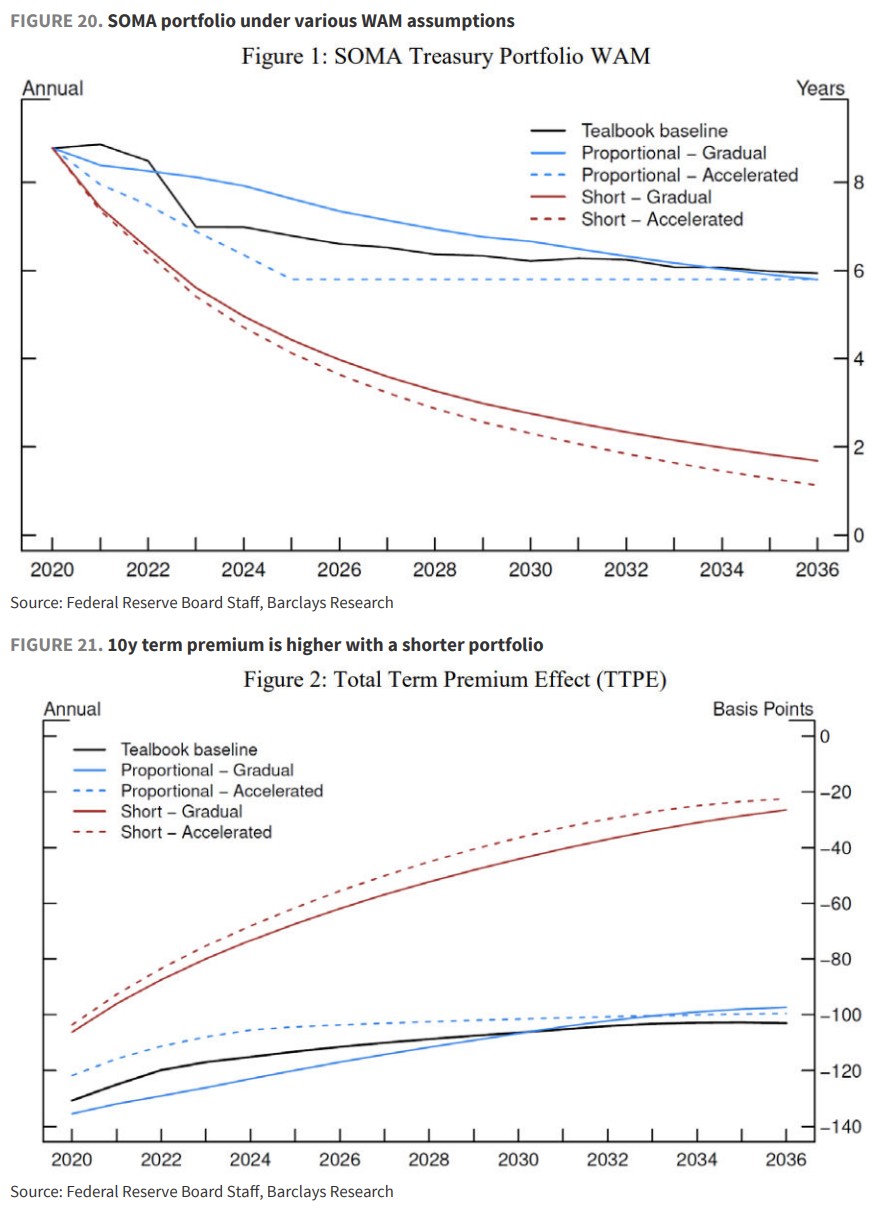
Barclays cited a study by Federal Reserve Board staff in 2019, which reached an intuitive yet crucial conclusion: a shortening of portfolio duration is equivalent to a de facto interest rate hike, thus requiring a reduction in policy rates to hedge.
Data models show:
-
Term premium rises: Even with the Treasury's cooperation, the market will expect an increase in duration supply during the transition period, leading to a rise in term premium.
-
Rate cuts as compensation: The study pointed out that to maintain the same macroeconomic output (with inflation and unemployment rates unchanged), if the Federal Reserve adopts a short-duration portfolio, the federal funds rate needs to be 25 to 85 basis points lower than the baseline scenario.
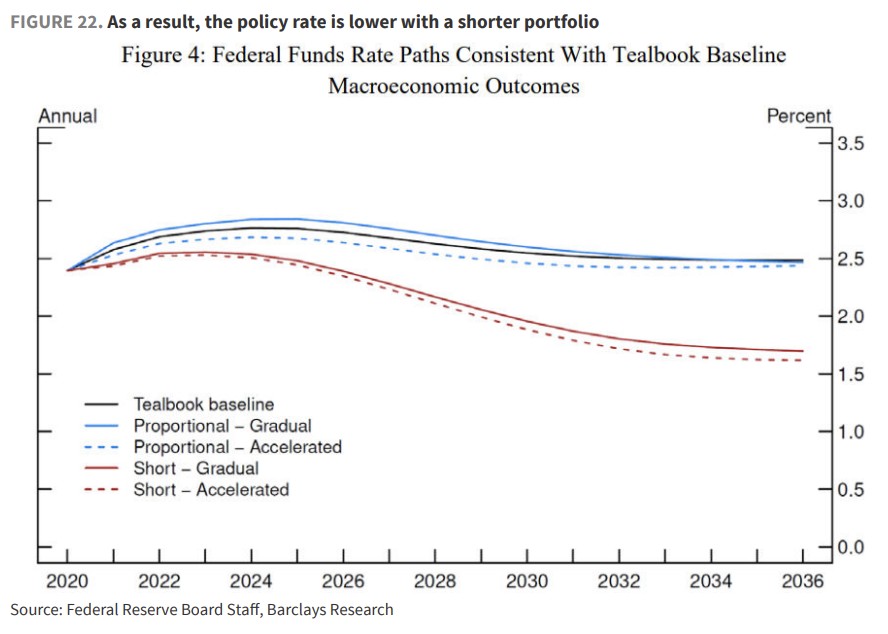
Barclays pointed out that Waller's balance sheet normalization is a multi-year process. During this process, investors will face: higher repo risk premiums (due to the Federal Reserve trying to test the reserve floor), higher term premiums (steepening yield curve), and a lower policy rate path (to offset tightening financial conditions).
For investors, this means going long on the front end (betting that rate cuts will exceed expectations) while remaining cautious on the long end (demanding higher risk compensation).
The above exciting content comes from the Wind Trading Platform.
For more detailed interpretations, including real-time analysis and frontline research, please join the【 **Wind Trading Platform ▪ Annual Membership**】

Risk Warning and Disclaimer
The market has risks, and investment requires caution. This article does not constitute personal investment advice and does not take into account the specific investment goals, financial situation, or needs of individual users. Users should consider whether any opinions, views, or conclusions in this article align with their specific circumstances. Investment based on this is at one's own risk