Why can't overseas tech giants stop burning money?

Morgan Stanley's latest research shows that global cloud capital expenditures are expected to reach $73.5 billion in 2026, a year-on-year increase of approximately 60%, maintaining rapid expansion for the third consecutive year. This growth is primarily driven by the significant upward adjustments in capital expenditure guidance from the four major U.S. cloud service providers (Meta, Alphabet, Amazon, Microsoft), reflecting that AI computing power demand continues to exceed supply. Analysts believe that cloud service providers face long-term supply constraints and need to accelerate investments to match demand growth, which will extend the high-intensity capital expenditure cycle
According to the Wind Trading Platform, Morgan Stanley's latest research indicates that global cloud computing capital expenditures are expected to soar to approximately $735 billion by 2026, representing a year-on-year growth of about 60%, marking the third consecutive year of growth exceeding 60%. This forecast has been significantly revised upward by 22 percentage points compared to three weeks ago, adding approximately $120 billion.
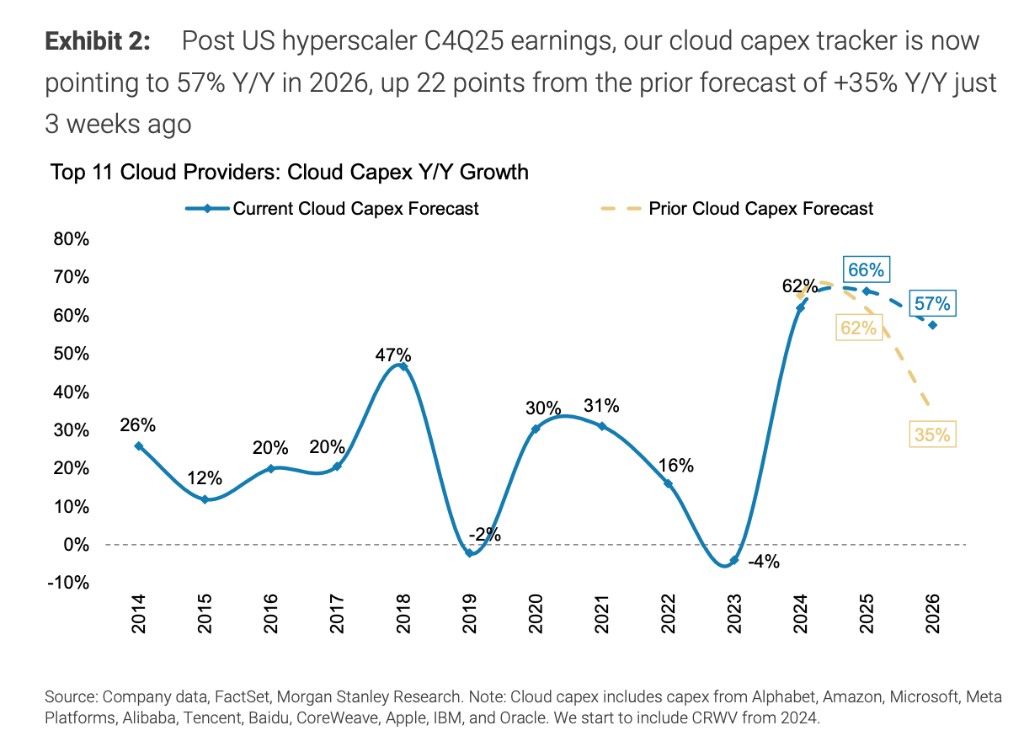
The core factor driving this upward revision is the strong capital expenditure guidance released by the four major U.S. hyperscale cloud service providers during the latest earnings season. Alphabet, Amazon, Microsoft, and Meta have all significantly increased their investment plans for 2026. Although the growth rate has slowed compared to 2025, the top 11 global cloud service providers have maintained such a high intensity of capital expenditure growth for three consecutive years, which is unprecedented in the industry's tracking history.
The research believes that, against the backdrop of AI-driven demand for computing power continuing to exceed supply, the high-intensity investment cycle in cloud infrastructure will persist. This trend is clearly beneficial for suppliers with significant capital expenditure exposure in the cloud computing industry chain.
Capital Expenditure Intensity Hits Record High
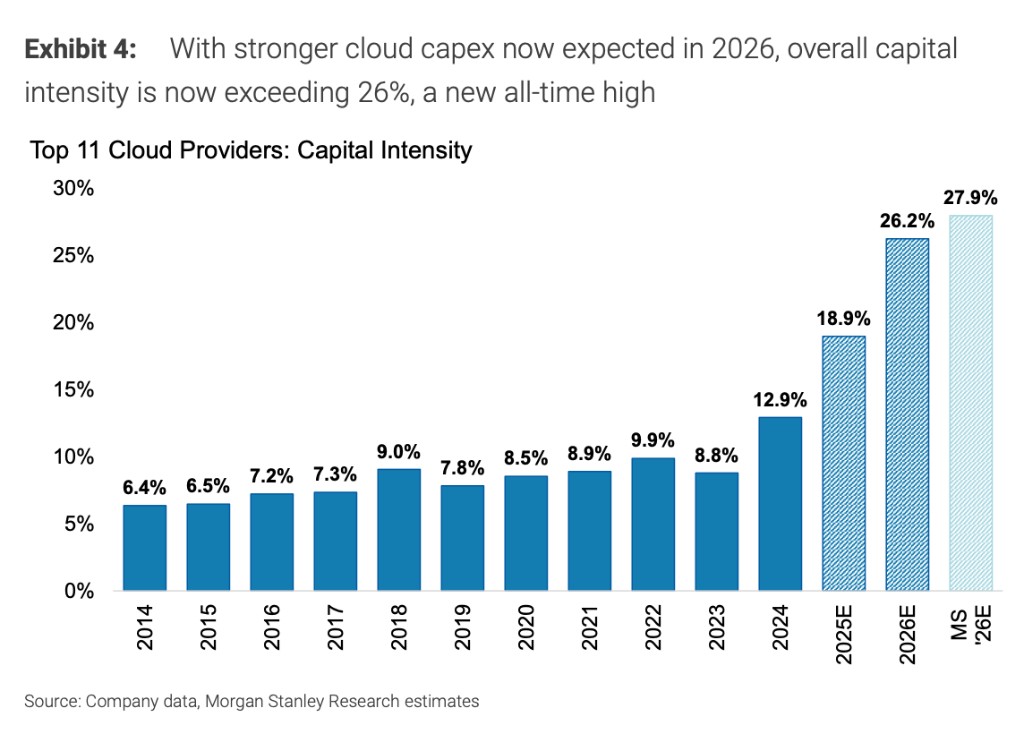
The capital expenditure intensity of the top 11 global cloud service providers has risen to a historical high of over 26% of total revenue, three times the average level from 2014 to 2023. Just a year ago, the market forecast for global cloud capital expenditures in 2025-2026 was about $710 billion, while the current expectation has surged to $1.2 trillion, indicating a cumulative upward revision of nearly $500 billion.
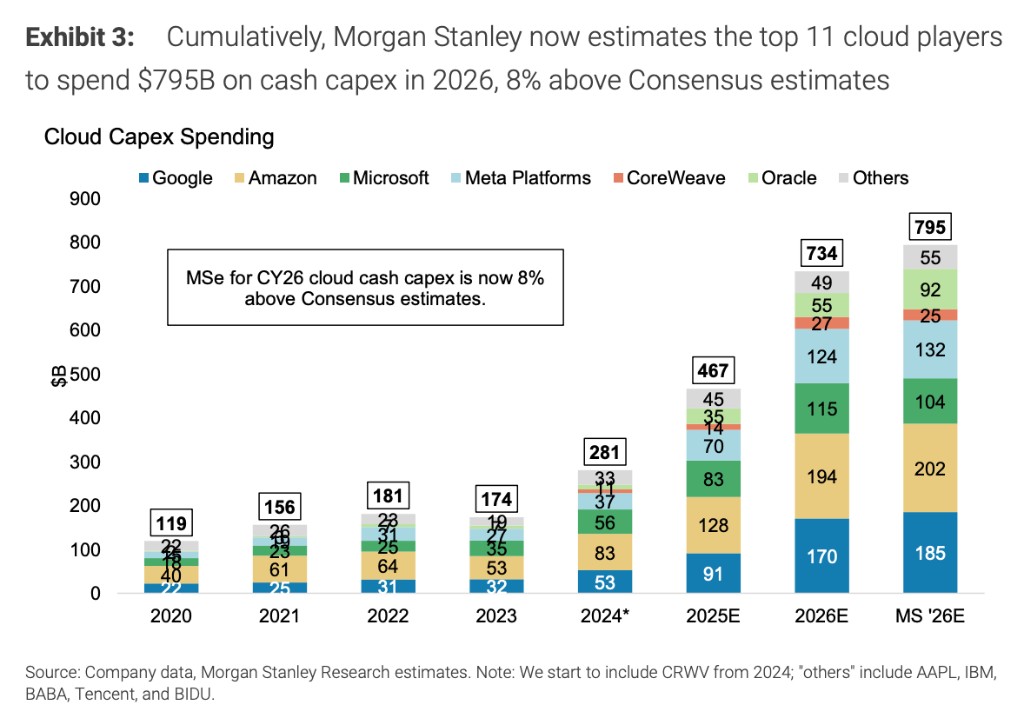
Morgan Stanley's forecast for global cloud capital expenditures in 2026 has reached $795 billion, approximately 8% higher than the current market consensus. Given that major cloud service providers have raised their capital expenditure guidance for at least nine consecutive quarters, analysts believe there is still room for further upward adjustments in current market expectations.
U.S. Hyperscale Cloud Service Providers Significantly Increase Investment
The four major U.S. hyperscale cloud service providers have further clarified the trend of accelerated AI-driven capital expenditures during the latest earnings season. Meta has set its capital expenditure guidance for 2026 at $115 billion to $135 billion, representing a year-on-year growth of 73% based on the midpoint, with funds primarily directed towards Meta's superintelligent laboratory and broader AI infrastructure needs.
Alphabet's capital expenditure guidance for 2026 is set at $175 billion to $185 billion, with a year-on-year increase of 97% based on the midpoint. The spending pace is expected to increase quarter by quarter throughout the year, mainly to support Google DeepMind, user-facing AI functionality optimization, and large-scale cloud infrastructure expansion The company revealed that approximately 60% of the expenditure will be used for server procurement, while the remaining 40% will be invested in long-term assets such as data centers and networks.
Amazon expects its capital expenditure to be around $200 billion in 2026, a year-on-year increase of 52%, mainly directed towards AWS business to meet the unexpectedly high growth demand for core non-AI business and AI cloud workloads. The company emphasized that its monetization speed is basically in sync with the deployment progress of installed capacity.
Although Microsoft did not provide specific quantitative guidance for 2026, it pointed out that capital expenditure for the March quarter this year will decline quarter-on-quarter due to fluctuations in the pace of cloud infrastructure construction and financing lease delivery arrangements. Management stated that the proportion of short-term assets (CPU and GPU servers) in capital expenditure will remain around two-thirds, similar to the structure of the previous quarter.
Supply Chain Benefits Clearly
According to Morgan Stanley's analysis, among the more than 50 technology companies it covers, the revenue contribution from cloud capital expenditure averages 45%.
As the number of AI tokens processed monthly grows exponentially, the total revenue growth of Google Cloud, AWS, and Azure is accelerating, commitments to data center construction continue to expand, and key component suppliers generally report accelerated demand and extended visibility. Morgan Stanley believes that these factors will collectively drive upward adjustments in the capital expenditure forecasts of hyperscale cloud service providers.
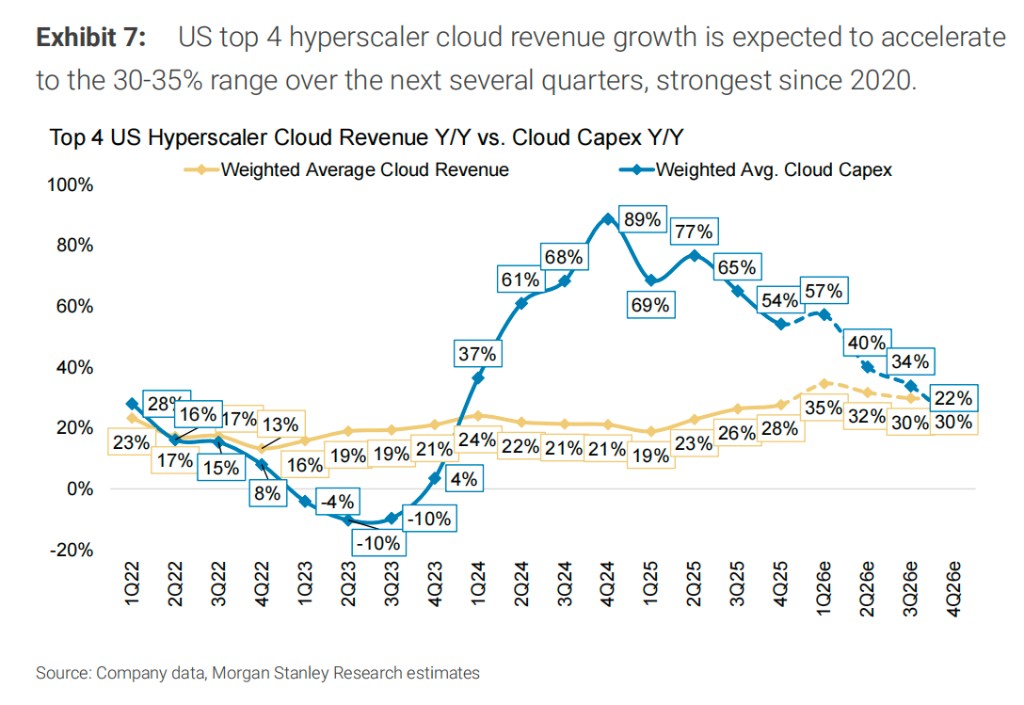
It is expected that the cloud revenue growth rate of the top four cloud service providers in the United States will rise to the range of 30%-35% in the coming quarters, marking the strongest growth level since 2020. Based on the bank's forecast, non-AI-related cloud capital expenditure is expected to maintain a high growth rate of nearly 60% in 2026 after an 80% year-on-year increase in 2025.
Market Expectations Continue to Be Upgraded
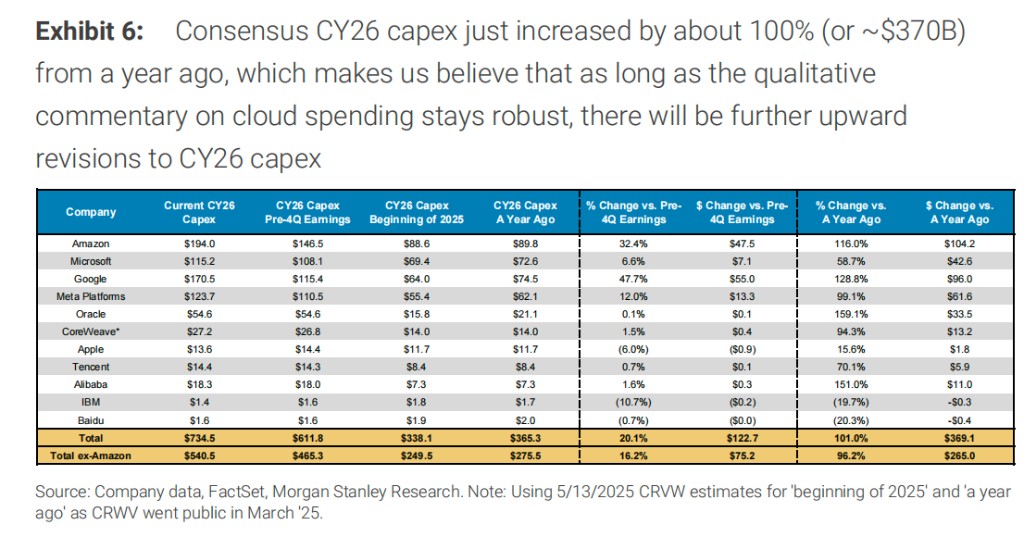
Over the past year, the market consensus expectation for cloud capital expenditure in 2026 has been significantly upgraded by about 100%, with a cumulative increase of approximately $370 billion. Morgan Stanley pointed out that as long as the industry's qualitative outlook on cloud expenditure remains positive, there is still room for further upward revisions of related forecasts.
The four major hyperscale cloud service providers in the United States have all stated that they will continue to face supply constraints for critical computing resources throughout 2026 and need to respond to rapidly rising demand by accelerating investments and optimizing capacity allocation. This ongoing supply-demand imbalance provides structural support for maintaining high-intensity growth in capital expenditure.