


The crisis in U.S. software stocks is not over! Citigroup: The impact of AI may cause terminal value to evaporate by one-third

Citigroup pointed out that the sharp decline in the software sector is due to the market's reassessment of the terminal value of "AI disruption." Stock prices have reflected a compression of terminal price-to-earnings ratios by 10%-20%, and if the compression reaches 30% or falls back to the 2023 low. There may be a short-term rebound, but the broad rally in the industry has ended, and it will enter a stage of significant differentiation among individual stocks, requiring the identification of AI integration capabilities
Citigroup pointed out that the software and services sector is undergoing a drastic valuation reassessment triggered by "AI disruption fears."
According to the Wind Trading Desk, Citigroup's latest U.S. stock strategy report released on February 6 believes that the current market sell-off is not due to a short-term deterioration in fundamentals, but rather that investors are aggressively repricing the "terminal value" of the industry.
The report indicates that the market is factoring in a structural decline in future profit margins, with current stock prices fully reflecting an expectation of a 10% compression in terminal multiples, and nearing a reflection of a 20% compression. However, if the impact of AI on business models leads to a 30% compression in terminal multiples, stock prices could fall to "liberation day lows" or even lower. For investors, although there may be a rebound in the short term due to overselling, the long-term uncertainty brought by AI means the "lay win" era for software stocks is over, and the future will enter a phase of severe stock differentiation.
The Significant Shrinkage of "Terminal Value" Triggered by AI Disruption
Citigroup's report emphasizes that the sharp decline in the software and services sector (down 20% year-to-date, down 28% since October 29, 2025) is primarily driven by concerns over AI-related disruptions. Although these concerns have not yet fully manifested in short-term financial numbers, they have undoubtedly shown in stock prices—presenting themselves in the form of "terminal multiple compression."
As a core weight in the industry (accounting for 55%), Microsoft's 17% decline since the release of its earnings report on January 28 has dominated the sector's performance. Citigroup believes that the market is rapidly factoring in expectations of reduced future profit margins, leading to a reassessment of long-term growth prospects. Despite the recent strong fundamentals, valuation headwinds have already formed. The current decline indicates that the market views AI not only as an enhancement tool but also as a potential disruptor of existing business models, which directly impacts the long-term valuation premium investors are willing to pay for these companies.
Profit Margin Peak Risk: Returning from Historical Highs to Mean
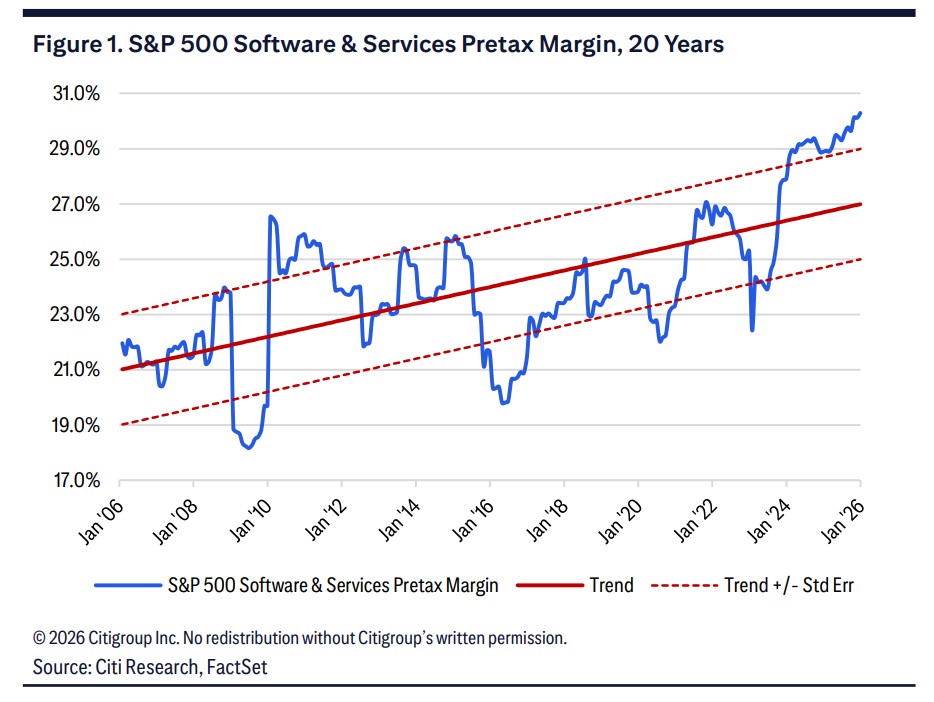
The report's data shows that the pre-tax profit margin in the software and services industry has reached historical highs (around 30%), a factor that has been fully or even excessively factored into valuations. Citigroup warns that once profit margins return to trend lines or fall below them, valuations will face severe damage.
If profit margins decline from the current 30% to the trend level of 28% over the next three years, it means that the terminal price-to-earnings ratio (Terminal P/E) would need to compress by 10%. If profit margins further decline to 26% (one standard deviation below the trend line), it would mean that the terminal P/E would need to compress by 20% to 30%.
Citigroup's model analysis shows that current stock prices have fully factored in a 10% compression in terminal multiples and are approaching the level that factors in a 20% compression. This indicates that a significant portion of the expected degradation in business models has already been reflected in prices
Valuation Sensitivity Analysis: Downside Potential Still Exists
Citi analyzed the current pricing logic through a reverse DCF (Discounted Cash Flow) model.
Already Accounted For: The current market price level roughly reflects a 10%-20% reduction in terminal multiples.
Pessimistic Scenario: If investors ultimately believe that the AI impact necessitates a 30% reduction in terminal multiples, then the current stock price still has significant downside potential. In this extreme scenario, the software sector will retreat to mid-2023 price levels.
Growth Threshold: Assuming a 30% decline in terminal multiples, companies must deliver growth results that far exceed sell-side consensus expectations in the short term to support the current stock price. The market currently expects a compound annual growth rate (CAGR) of 19% for EPS over the next three years, which is reasonable under a 10% reduction in terminal multiples, but appears to lack sufficient margin of safety under a 30% reduction scenario.
Relative Valuation and Trading Signals: Sell-off Peak May Indicate Short-term Bottom
From a relative valuation perspective, the valuation premium of the software and services sector relative to the S&P 500 index has significantly declined.
EV/Sales (Enterprise Value/Sales): The premium has returned to early 2023 levels.
EV/FCF (Enterprise Value/Free Cash Flow): The premium has returned to early 2021 levels.
Forward P/E Ratio: The premium is approaching a ten-year low.
Although these indicators suggest that valuation corrections have been quite severe, Citi warns investors not to take a textbook approach, as these low valuations may evolve into "valuation traps" when fundamentals are disrupted.
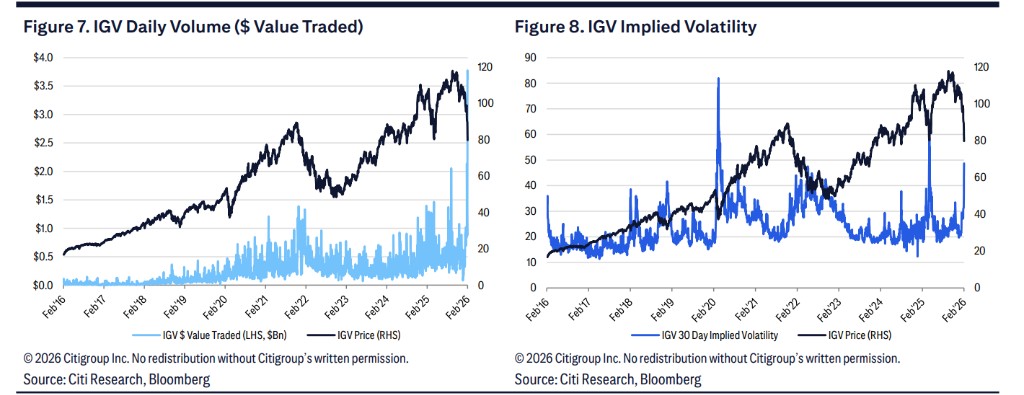
On the trading front, Citi has observed a surge in trading volume and implied volatility for major software ETFs (such as IGV). This extreme trading activity is typically characteristic of a "sell-off peak." Citi strategists believe that this panic selling may indicate that price trends are entering a more stable period, potentially even leading to a short-term rebound.
Goodbye to Broad Gains, Welcome to Distinctive Differentiation
Citi concludes that while the adjustments since the beginning of the year have been painful, they have quickly released some structural risks. As a 10%-20% compression in terminal multiples has been factored into stock prices, the market may experience a breathing opportunity in the short term.
However, the "terminal value crisis" brought about by AI will not disappear overnight. Citi emphasizes that future trading characteristics will no longer be characterized by sector-wide movements, but rather by highly distinctive performances. Investors need to discern which companies can leverage AI to enhance their business and which companies' business models will be completely disrupted by AI. As Citi stated in its 2026 outlook, this is a "more volatile bull market," and software stocks are experiencing the most intense fluctuations within it.
