


After touching the lower edge of the ten-year channel, U.S. tech stocks rebounded significantly. Has the correction ended?

The excess returns of U.S. tech stocks have fallen from the top of the 10-year channel all the way down to the bottom at last Thursday's close, followed by a rebound on Friday. Deutsche Bank stated that Friday's rebound may signal a reversal in sentiment, and the fund flow data also shows that the extremely crowded non-tech sector trades have shown signs of fatigue, while the fund inflows into the tech sector are beginning to warm up
Last Friday, U.S. stocks rebounded sharply, with the Dow Jones Industrial Average breaking 50,000 for the first time, and the S&P 500 rising nearly 2%, marking its best single-day gain since May of last year. NVIDIA surged 7%. Is this merely a dead cat bounce, or the start of a new rally?
According to the Wind Trading Desk, Deutsche Bank stated in its latest research report that a key feature of this round of sell-off is that earnings expectations are actually still being revised upward, and the market decline is entirely driven by valuation contraction rather than a deterioration in fundamentals. Friday's rebound may signal a reversal in sentiment.
Meanwhile, fund flow data shows that the extremely crowded non-tech sector trades are showing signs of fatigue, while inflows into the tech sector are beginning to recover.
Counterattack from the Bottom of the Ten-Year Channel
The recent "bottom rebound" of tech stocks is not coincidental. The report points out that over the past three months, funds have been fleeing large tech stocks and pouring into other sectors, triggered by the third-quarter earnings season of 2025—when the market first saw signs of earnings growth spreading beyond tech giants.
However, Friday's rebound may signal a reversal in sentiment. Deutsche Bank stated:
The performance of large growth stocks and tech stocks relative to the rest of the S&P 500 index fell from the top of its ten-year excess return channel in late October to the bottom at Thursday's close, followed by a rebound on Friday.
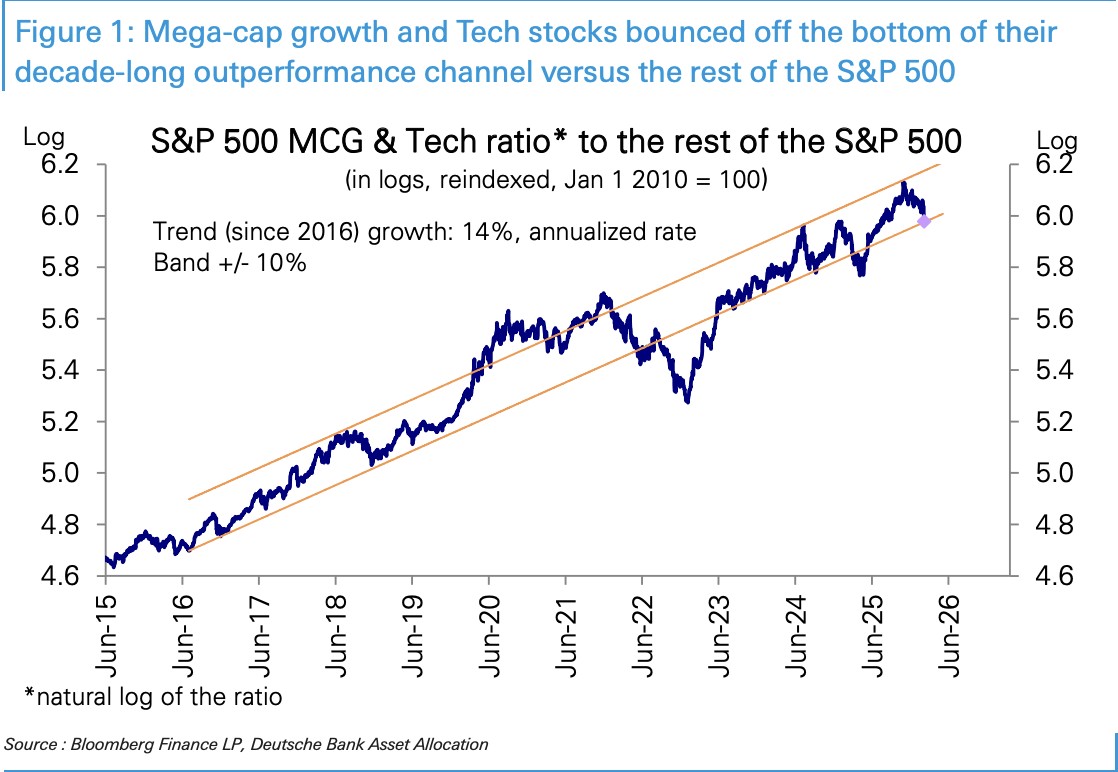
Such extreme volatility is not unprecedented. Analysts compare it to last year's market reaction following the "Deepseek announcement," or the concerns over slowing earnings in July 2024, and even the capital expenditure digestion period of 2018.
Killing Valuations, Not Earnings
What is most concerning is that this sell-off is essentially a "vote of no confidence" in the sustainability of earnings, rather than a deterioration in earnings themselves. Unlike the significant 17% year-on-year decline in earnings in 2022 that led to a prolonged bear market, the current fundamentals of tech stocks remain robust.
Deutsche Bank emphasized a fact that diverges from market sentiment:
Despite the market being severely impacted, the forward earnings expectations for large growth stocks and tech stocks have actually increased during this earnings season (2026 expectations up 2.0%, 2027 up 2.6%), and even the software sector is seeing upward revisions.
This indicates that the market performance this year has been entirely driven by valuation multiple compression, contrasting sharply with last year's market driven by earnings revisions.
Extreme Reversal in Fund Flows
Position data reveals the dramatic turmoil in investor sentiment. While overall stock positions have been consolidating at moderately overweight levels, internal rotations have been exceptionally fierce. Funds are withdrawing from large-cap tech stocks and betting on small-cap stocks and other sectors.
Even more shocking is the funding frenzy at the beginning of the year. Deutsche Bank's report noted:
Industry funds excluding tech stocks absorbed a record $62 billion in the first five weeks of this year... This inflow rate is nearly 4 standard deviations above the historical average.
Particularly in the materials sector, the inflow has exceeded the average level by more than 5 standard deviations However, the wind seems to be quietly changing. This week's data shows that inflows into non-tech sectors are slowing down, while inflows into tech stock funds have started to rebound (increasing from $4 billion last week to $6 billion). When extreme crowded trades begin to loosen, it may signal the entry of contrarian investors
