


A Century of Corning's Glamorous Transformation: Fiber Optics Ends Two Decades of Losses, Clinging to Meta's Thigh to Become an AI New Aristocrat!

After nearly twenty years of losses, Corning, a glass giant with a 175-year history, has turned the tide and become a key player in AI infrastructure through its optical fiber business. Based on its precise insights into data center pain points in 2018, it strategically laid out high-performance optical fiber products, ultimately securing billions of dollars in orders from giants like Meta. The company is positioning itself for future growth through technologies such as Co-Packaged Optics (CPO)
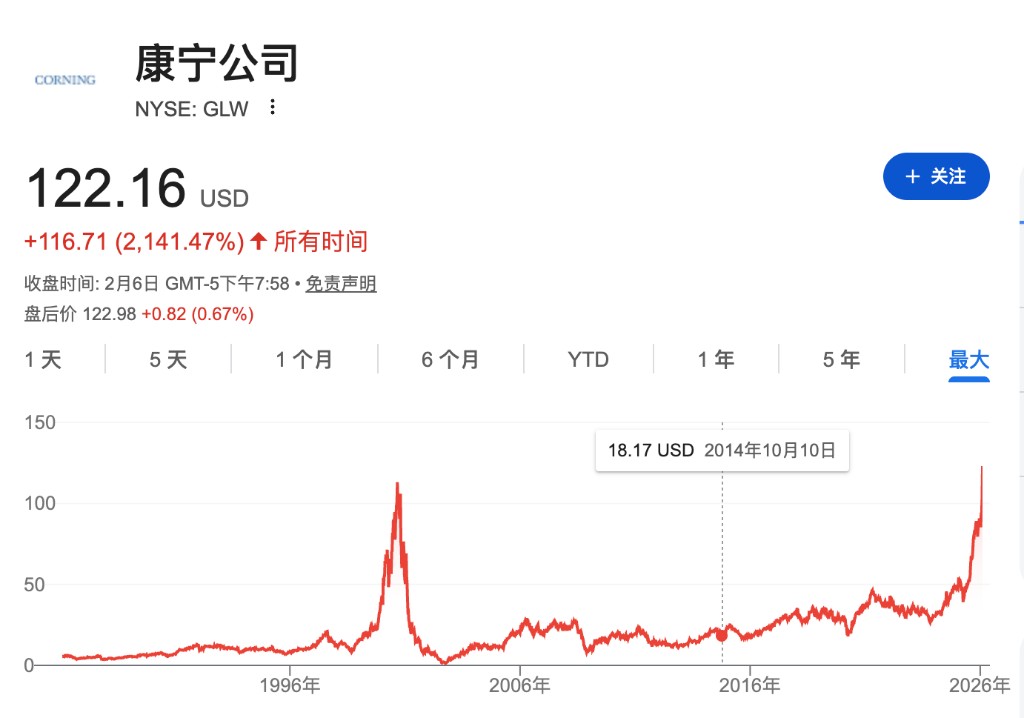
After nearly twenty years of losses, Corning's fiber optics business is becoming one of the key beneficiaries in the wave of AI data center construction. This 175-year-old materials science company recently signed a $6 billion fiber supply agreement with Meta to provide core connectivity solutions for its expanding AI data centers, and its stock price has risen to near historical highs.
The transformation is backed by clear physical advantages: photon transmission of data is three times more efficient than electronics over short distances and can reach up to twenty times more efficient over long distances. As global computing infrastructure accelerates, low-power, high-efficiency fiber transmission has become the preferred choice.
Corning's technological layout has extended to Co-Packaged Optics (CPO), directly embedded within servers to enhance data transmission efficiency. Computing giants like NVIDIA are actively evaluating this technology, further solidifying Corning's strategic position in the AI infrastructure field.
By consistently investing in technology and precisely positioning itself to meet the connectivity demands of the computing revolution, this century-old company has demonstrated the value of strategic determination in industrial transformation.
From Light Bulb Glass to AI Fiber
Founded in 1851, Corning's initial business was to provide glass lamp shades for Edison’s incandescent lamps. Over its more than 170 years of operation, the company has participated in the development of several important industries through a series of material technology innovations: such as heat-resistant glass PYREX, television cathode ray tube glass, and the low-loss fiber optics developed in 1970, which later became one of the infrastructures of modern communication networks.
The company achieved a technological breakthrough in low-loss fiber optics in 1970, but this business long struggled to achieve stable profitability. After the burst of the internet bubble in 2000, global telecom capital expenditures contracted, and the fiber optics business fell into nearly twenty years of operational difficulties, remaining in a state of long-term losses and facing repeated pressure from investors to divest.
Turning Point from Losses to Explosion
Corning's strategic turnaround in its long-losing fiber optics business stemmed from a key customer insight. In 2018, CEO Wendell Weeks and fiber optics business head Mike O'Day discovered during a visit to Meta's (then Facebook) data center that there were significant pain points in the interconnection of servers within the data center, as existing copper cables and generic fiber optics could not meet the high-density, high-bend wiring requirements. This discovery drove Corning to develop a new type of fiber optic cable that is thinner and more bendable.
This technological bet made several years in advance has shown great value following the explosion of AI computing demand triggered by ChatGPT. With the surge in demand for optical connections within data centers, Corning has become an important supplier for giants like Meta with its customized products. O'Day recalled that they did not foresee the subsequent explosion of AI at that time, but the innovation based on actual customer scenarios ultimately led to an extraordinary return on long-term investments
"Corning Way" Supports Long-term Investment
Corning's core competitiveness stems from its unique "vertical integration" model and long-term talent strategy. The company deeply controls key links in the industrial chain, not only outsourcing almost no core business but even independently designing and manufacturing production equipment, thereby building a strong technical barrier.
This concept runs through its operational management. During the business transformation period, the company prioritized reallocating internal engineers to respond to changes rather than resorting to layoffs, allowing the core technology team to accumulate unique cross-domain experience over decades. CEO Wendell Weeks pointed out:
"The skills our engineers possess cannot be obtained from textbooks."
During the challenging period when the pandemic caused six consecutive quarters of revenue decline, Corning still insisted on retaining production capacity and employee scale, and stabilized the team by allowing employees to receive part of their compensation in stock. Weeks admitted that the number of employees might exceed the level supported by current revenue by about 4,000 to 5,000 people.
Now, with the explosion of fiber optic demand driven by artificial intelligence, Corning's capacity and human resource reserves are transforming into significant competitive advantages. The company not only needs all of its existing capacity but also faces pressure for further expansion, and its long-term strategy has begun to yield returns in the industry's economic cycle.
Supply-Demand Imbalance and Future Challenges
As North America's largest fiber optic manufacturer, Corning's data center fiber optic business has become the fastest-growing revenue engine. However, the company's future sustained success heavily relies on the actual investment progress of large technology companies in data center construction. Morningstar senior equity analyst William Kerwin pointed out that the current stock price fully reflects perfect expectations, and the industry faces two major bottlenecks: first, capacity has reached its limit, "demand will continue to exceed supply"; second, there is a shortage of skilled installation labor.
To support the next round of growth, Corning is laying out technologies such as Co-Packaging Optics (CPO). NVIDIA has begun exploring the direct integration of this technology into servers, which may open up new market space. The cumulative delivery history of Corning's fiber optics shows an accelerating trend: the first billion miles took nearly 50 years, the second only took 8 years, and the next cycle is expected to be further shortened. Business leader Mike O'Day pointed out that the driving factor is that the demand for short-distance, high-density fiber optics within data centers is surpassing traditional long-distance business.
Despite positive progress in collaboration with NVIDIA, CEO Wendell Weeks stated that he has not yet been invited to the well-known industry exchange event hosted by NVIDIA CEO Jensen Huang. He demonstrated strategic patience, emphasizing that such disruptive innovations require long-term investment:
"When we truly achieve product delivery, perhaps we will be invited to share beer and fried chicken."
