


"Long Bull" trend still exists? JP Morgan: Technical indicators show that precious metals will enter a consolidation period in the coming weeks

JP Morgan expects that gold will form a wide fluctuation range that may last for several months, above the support level of USD 4,264-4,381 and below the resistance level of USD 5,100-5,150. The long-term theme of "currency devaluation" remains intact, as long as the US dollar index continues to stay below 100, the weak dollar environment will continue to support the long-term bullish logic for precious metals and commodities
The unilateral rise in precious metals has temporarily come to a halt.
According to news from the Chase trading desk, JP Morgan technical strategist Jason Hunter and his team released a report on Thursday stating that although the foundation for a long-term bull market trend remains solid, the recent sharp fluctuations have led to a technical pattern indicating that the market has officially entered a consolidation phase.
The bank expects gold to form a wide oscillation range that may last for several months, above the support level of $4264-$4381 and below the resistance level of $5100-$5150.
The report also pointed out that the US dollar index hovering below the 100 mark, along with the trend of the S&P 500/gold ratio, suggests that the long-term "currency devaluation trade" has not ended. The current consolidation in precious metals is a pause in the bull market, rather than a bear market reversal.
Short-term consolidation in gold, long-term bull market logic unchanged
JP Morgan's technical team analyzes that the recent performance of gold prices shows short-term "explosive" reversal characteristics, which is often a precursor to the arrival of a consolidation phase, but this is by no means the end of a long-term rebound.
From a tactical perspective, gold prices will undergo a necessary consolidation period before challenging the 5100-point mark.
Investors need to pay attention to key technical levels to define the oscillation range:
On the downside, the initial rebound in gold prices will be tested by mid-term support levels, especially the 50-day moving average around the 4500-point mark, as well as the breakout area in the 4264-4381 point region from the fourth quarter of 2025.
On the upside, the rebound momentum is expected to weaken near the 5000-point mark, with stronger resistance located in the 5100-5140 point range.
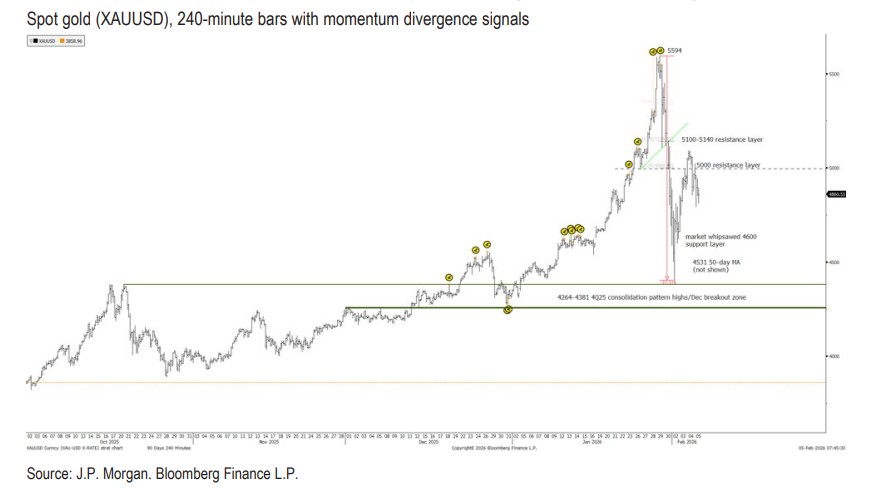
The report emphasizes that, in conjunction with long-term price patterns and comparisons to the end of the currency devaluation cycle in the late 1970s, the long-term currency devaluation cycle has not yet been completed. This means that the foundation for a bull market still exists, and the current consolidation is more about building momentum for future movements.
Copper: A pullback is a buying opportunity
Compared to precious metals, JP Morgan believes that base metals will show stronger resilience. Although LME copper prices have shown signs of fatigue and formed a deceleration pattern after reaching the mid-term target range of 14095-14596, the pro-cyclical rotation will provide support.
From a technical perspective, as the market enters consolidation, the first support level is expected to be in the 12074-12105 point area. A more critical mid-term support level is located in the 11100-11200 point range. As long as market trading remains above this multi-year breakout area, the long-term bullish trend will remain intact.
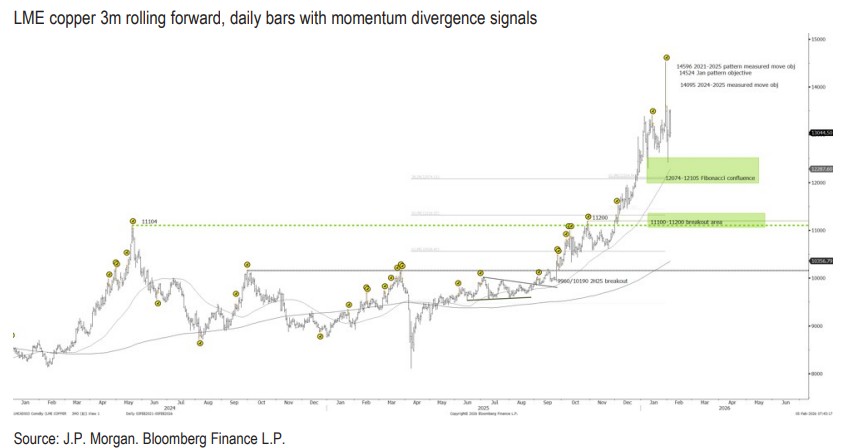
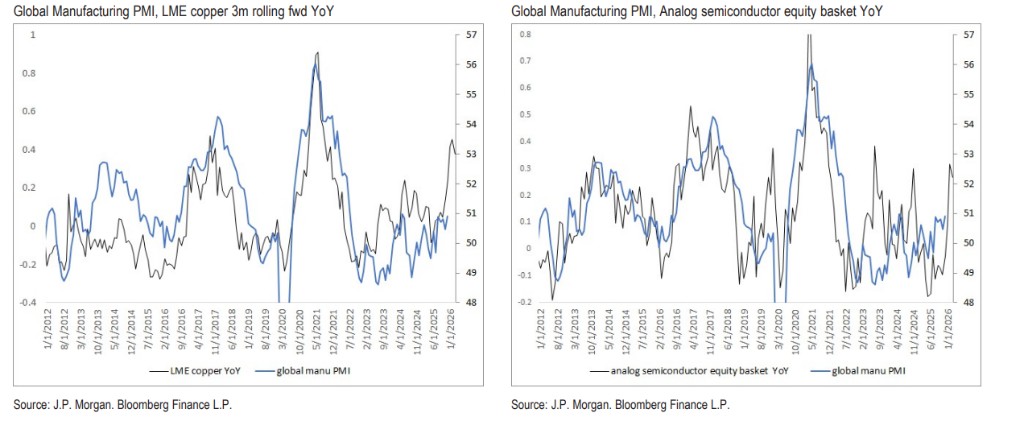
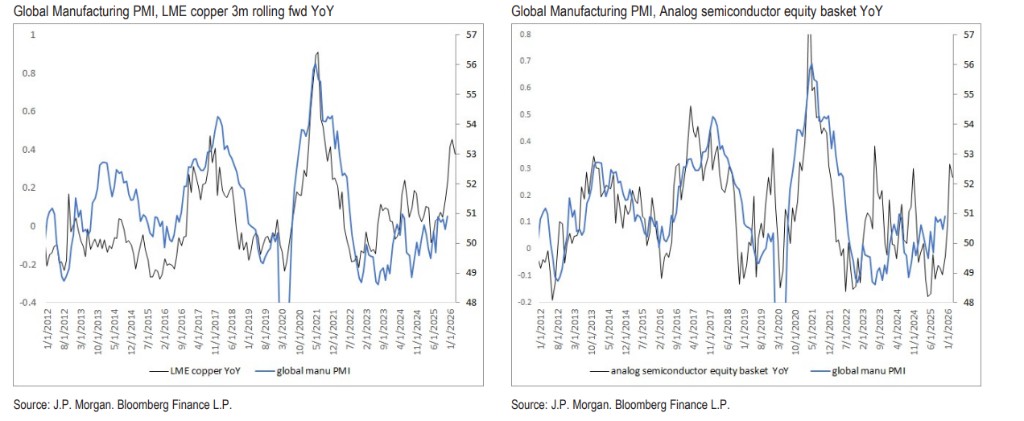
It is worth noting that the report indicates through regression analysis that the surge in copper prices is partly driven by "currency devaluation capital flows," with implied global manufacturing PMI expectations (around 53) significantly higher than actual readings (around 50.5). Although copper prices may have slightly overestimated the strength of the cyclical recovery, the integrity of the pro-cyclical trend means that copper will attract substantial buying interest during pullbacks
Macroeconomic Drivers: Weak Dollar Supports Long Bull Market
The core support for the long-term bullish logic of commodities still comes from the foreign exchange market. The US Dollar Index experienced significant fluctuations after attempting to break through the support level in the second half of 2025 in late January, and it is currently still trapped within a defined range.
JP Morgan pointed out that the key is that the US Dollar Index has mainly operated below the critical long-term turning point of 100 for the past eight months.
As long as prices remain below this level, the market is likely to resume the downward trend that began in early 2025. This weak dollar environment will continue to support the long-term bullish logic for precious metals and commodities
