


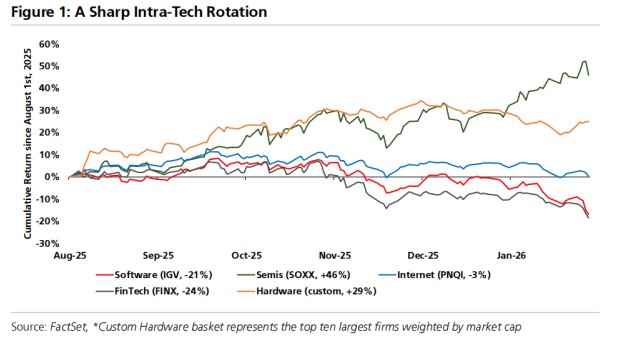
Software stocks plummet, is it time to hold patiently or buy on dips?

UBS pointed out that the sharp decline in software stocks reflects the structural dilemma of AI disruption and slowing growth. It is currently not advisable to blindly bottom-fish; instead, it is recommended to avoid general SaaS that is directly impacted by AI and to focus on infrastructure and cybersecurity sectors with more stable demand and reasonable valuations (such as Microsoft and Snowflake) for selective allocation
The software sector is undergoing a brutal sell-off, which is not just a fluctuation in market sentiment but a deep reassessment of the industry's future.
According to the Chase Wind Trading Desk, UBS pointed out in a significant research report released on February 4 that investors should not rush to "catch falling knives" but should remain patient. The core logic is that the acceleration of AI technology advancements (such as Gemini 3, Claude 4.5, and potential releases from OpenAI) is fundamentally impacting traditional SaaS business models. While the market has long anticipated that AI would bring about transformation, the current reality is that the pace of change is faster than expected, while the revenue growth curve of software companies has yet to show an upward trend.
For investors, this means that the "terminal value" risk of SaaS and application software stocks is rising sharply. UBS clearly stated that in the short term, investors should avoid application software companies that are priced based on "seats," as they are in the eye of the storm of AI disruption. If investors still want to seek opportunities in the tech sector, UBS recommends focusing on infrastructure, data, and cybersecurity fields (such as Microsoft, Snowflake, Datadog, Okta, etc.). Although these areas have also declined with the market, their customer spending trends are healthier, and they face a lower risk of direct replacement by AI. In short, the current strategy is: remain cautious on application software and selectively accumulate in infrastructure.
The Illusion of Growth Shattered: It's Not Just AI Fear, But Also a Cyclical Downturn
The market tends to attribute the sharp decline in software stocks entirely to fears of AI disruption, but this obscures a harsher fundamental truth. UBS emphasizes that long before investors debated who the winners of AI would be, the growth engine of the application software industry had already stalled. This is no longer an era of "growth at all costs," but rather a highly mature market with penetration rates that have peaked.
Data does not lie. UBS statistics show that large SaaS and application software companies have ended the high-growth era of 15-20% seen before the pandemic, with the current average organic revenue growth rate dropping to around 12-13%. For example, Salesforce, once a star with stable 20% growth, has now fallen to 9% and has yet to hit bottom; Adobe has dropped from 21% to 10%. When an industry's growth rate plummets from high levels to mediocre levels, a compression of valuation multiples is an inevitable physical reaction. Today's Fortune 500 CIOs are no longer keen on expanding SaaS coverage but are busy cutting software spending to free up budgets for expensive AI infrastructure and data modernization. Therefore, unless we see the growth curve rise again, buying simply because "the stock price looks cheaper than in history" is untenable.
Valuation Trap: Profitability Still Insufficient from a GAAP Perspective
If you think that software stocks are already very cheap, you may have misread the indicators. UBS sharply pointed out that the vast majority of software stocks are still using "non-GAAP" price-to-earnings ratios (with a median of about 23 times) to support valuations, but this obscures the fact that they are inflating their financial statements through massive stock-based compensation (SBC).
If we switch to a stricter GAAP perspective, the profitability of many companies instantly shrinks. Aside from Salesforce successfully transitioning from high growth to high profitability (with an expected GAAP earnings per share of $7.25 for fiscal year 2026), most companies in the industry still have high non-cash equity compensation expenses (accounting for over 15% of revenue). In this case, investors cannot even use non-GAAP multiples to reasonably assess valuations. More concerning is that, with stock prices halving, companies may be forced to reprice equity or issue more cash to retain talent, further eroding shareholder value. The reason private equity (PE) giants remain inactive despite such significant declines is that many SaaS companies have excessively high equity compensation costs, making them "unacquirable" financially.
The Truth About AI Monetization: Loud Thunder, Little Rain, Minimal Revenue Contribution
The AI craze has been loud for three years, but the data reflected in software companies' reports is pitifully scarce. UBS statistics show that the total AI revenue disclosed by public application software companies is only $5.6 billion. If we exclude Microsoft's Copilot and GitHub Copilot (which contribute about $3.8 billion), the entire industry's AI revenue is only about $2 billion.
For the total revenue base of $290 billion from the top ten SaaS companies, $5.6 billion in AI revenue accounts for only about 2%, which is hardly significant. This is why the AI concept is being shouted from the rooftops, yet the total revenue growth curve of software companies remains unchanged. In contrast, hardware and semiconductor companies are seeing tangible revenue from the AI wave. The harsher reality is that incremental AI spending has not fully flowed to traditional SaaS giants but has been diverted to model providers like OpenAI and Anthropic, as well as AI-native startups like Sierra and Glean.
Data cited by UBS shows that the total revenue of these AI-native companies has already matched the AI revenue of public software companies. This is a zero-sum game, and the competitive moat of traditional software companies is being eroded by these new players and the trend of enterprises "building their own AI applications" (DIY).
The Risk of Seat Compression and the Game of Corporate Spending
The most direct threat of AI to the SaaS model is "seat compression." UBS's research on Fortune 500 companies (including hotels, industrial, technology, retail, etc.) found that companies are indeed using AI to reduce the number of human customer service representatives and low-skilled employees, which means that the SaaS seats charged per head will significantly decrease.
For example, a large hotel group using Salesforce stated that its human seats would decrease by 10% in 2025, with an expected further decline of 30% in 2026. However, the flip side is that companies need to pay additional fees to deploy AI agents (such as Agentforce). **Multiple interviewed companies indicated that although the number of seats has decreased, the investment in AI capabilities has increased, resulting in a rise in the total amount paid to software vendors (net growth may be in the high single digits to low double digits). This may be the only positive signal at present:AI may not kill existing software giants, but it will force them to undergo a painful transformation—from selling "human resources" to selling "AI outputs."
UBS Suggests: Avoid the Eye of the Storm, Seek Safe Havens
In the face of such high uncertainty, UBS's final advice is: do not attempt to find winners in the "too difficult" basket of SaaS application software, at least not now. The time to enter will be when there is accelerated revenue growth, upward revisions of profit forecasts, or when SaaS companies prove they can coexist with AI giants.
If software stocks must be allocated at the current level, UBS clearly favors the following three directions:
-
Infrastructure and Data (Preferred): Microsoft, Snowflake, Datadog. These companies are the "shovel sellers" of the AI wave, with healthy customer spending and lower risk of disruption.
-
Cybersecurity: Okta, Zscaler. Compared to the highly valued CrowdStrike or Palo Alto Networks, these two companies have more attractive valuations and stable demand amid security threats posed by AI.
-
Non-Seat Pricing and Niche Markets: Focus on companies adopting usage-based pricing models (such as Twilio, Braze) and those like Autodesk that are in vertical fields and migrating to the cloud, as they are on the edge of the AI disruption debate and relatively safe
