


After eight consecutive days of selling, Goldman Sachs trading desk indicates: the sell-off is basically cleared, and software stocks are building a bottom

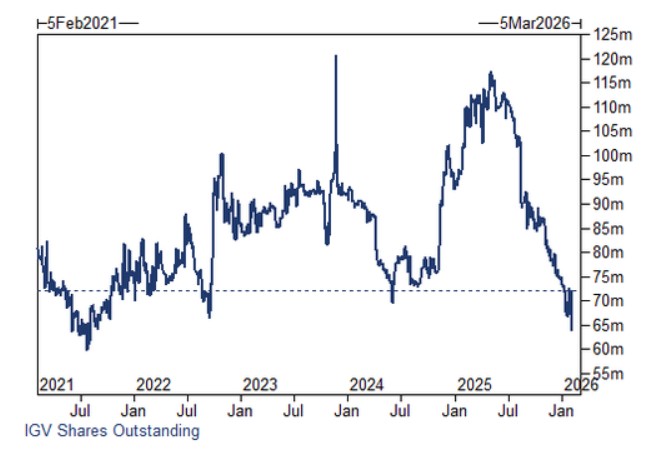
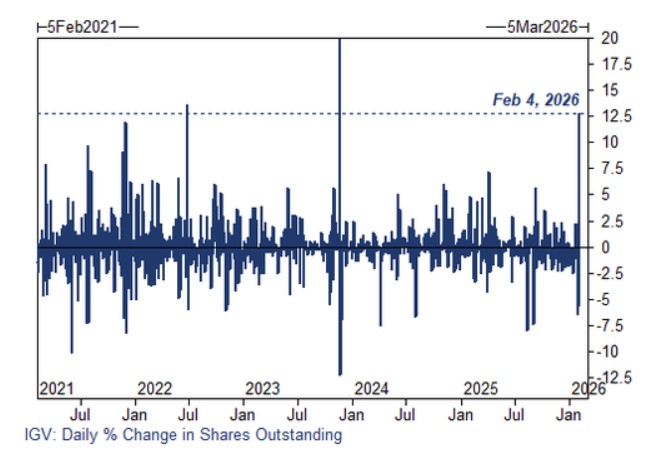
Goldman Sachs' trading desk has found that the circulating shares of the IGV Software ETF, a market barometer, have fallen to a near five-year low, indicating that selling pressure has largely cleared. More importantly, clients have begun to unwind index hedging positions, which is typically a precursor to a market bottom. Institutional investors started buying IGV on Wednesday and Thursday, with the fund's circulating shares increasing by 12% in a single day on Wednesday, marking the largest increase since 2023
After a trillion-dollar sell-off in U.S. software stocks, Goldman Sachs' trading department has observed signs of a market bottom. The trading desk noted that during eight consecutive days of sharp declines, the holdings in software ETFs have been significantly cleared, and institutional investors are beginning to attempt bottom fishing, which may indicate that this historic adjustment is nearing its end.
Software stocks plummeted 15% over the past week, down 29% from last September's peak. The IGV software ETF, a market barometer, set a trading volume record for two consecutive days in its 25-year history, with over 85 million shares traded since Tuesday. Goldman Sachs' trading desk activity reached 8 out of 10, with institutional clients net selling $2 billion.
Despite the ongoing sell-off, Goldman Sachs' trading department has captured key turning signals: The circulating shares of IGV have dropped to a near five-year low, indicating that selling pressure has largely cleared. More importantly, the derivatives trading desk has observed that clients are beginning to unwind index hedging positions, which is typically a precursor to market bottoms. Institutional investors started buying IGV on Wednesday and Thursday, with the fund's circulating shares increasing by 12% on Wednesday, marking the largest single-day increase since 2023.
This optimistic assessment from the trading desk sharply contrasts with the pessimistic outlook from Goldman Sachs' strategy department, highlighting the current market divergence regarding the software industry's prospects.
Trading Desk Observation: Signs of Exhaustion in Selling Pressure
Goldman Sachs' ETF trading desk is closely monitoring unusual trading activity in the IGV software ETF. This fund has become the primary tool for clients to gain exposure to software stocks this week, with ETF trading accounting for 37% of the overall trading volume. As of 11 AM Eastern Time, over 11 million shares had already been traded that day.
More critically, regarding changes in holdings, the circulating shares of IGV touched a near five-year low earlier this week, indicating that previous long positions have been significantly cleared. Data from Goldman Sachs' research department shows that large mutual funds had already reduced their software stock allocations to underweight levels as early as mid-last year.
Goldman Sachs' derivatives trading desk has captured a subtle shift in market sentiment. The U.S. Fear Index has risen to 8.3 (the 89th percentile over a three-year lookback period), but the trading desk has observed that clients are beginning to sell put options to realize profits, betting that the current sell-off may be coming to an end. After the S&P 500 index fell below the 100-day moving average, clients are readjusting their positions, "the market's expectations for a significant rebound in the index to historical highs have cooled."
Institutional Funds Begin to Test the Bottom
After several days of institutional selling, Goldman Sachs' trading desk finally observed institutional buyers entering IGV on Wednesday and Thursday. On Wednesday, the fund's circulating shares surged by 12%, the largest single-day increase since 2023, and Goldman Sachs believes this "feels like direct buyers are trying to find a bottom, as well as potential short covering."
 Morgan Stanley's data shows that as of 1 PM Eastern Time, retail investors net bought $1.7 billion, placing it at the 50th percentile for that time of day, approximately $115 million higher than the average level. Among this, $1.3 billion was in ETF purchases and $435 million in individual stocks, indicating a return of bottom-fishing funds.
However, the systemic selling pressure has not been completely alleviated. Morgan Stanley estimates that if the S&P 500 index closes down 1.5%, it will trigger $30 billion in stock sell-offs, and if the decline expands to 2%, the sell-off scale will reach $45 billion. Due to thin market liquidity, Goldman Sachs' derivatives trading desk noted that "internal market volatility this week is extreme," meaning that even small-scale buying could trigger a sharp rebound.
Pessimistic Tone from the Strategy Department
In contrast to the technical bottoming signals observed by the trading desk, Goldman Sachs' strategy department holds a cautious view on the long-term prospects of the software industry. Analyst Ben Snider and his team, in their latest report, compare the current software industry to the newspaper industry disrupted by the internet in the early 2000s and the tobacco industry that faced regulatory blows in the late 1990s.
Goldman Sachs believes that the current valuation decline reflects not just short-term profit fluctuations but a fundamental skepticism about whether the software industry's long-term growth and profit margins can be maintained. This analogy of software stocks to the "newspaper industry" highlights that Wall Street's concerns about AI impacting traditional software business models have reached an extreme stage.
This divergence reflects the core contradiction facing the market: oversold signals at the trading level versus structural concerns at the fundamental level. For investors, the short-term technical rebound opportunities and the long-term industry outlook uncertainties need to be assessed separately
