Spending big on AI surpasses Google! Amazon's spending guidance for this year unexpectedly exceeds $200 billion, plunging over 10% in after-hours trading | Earnings Report Insights

Amazon's Q4 revenue increased by 14% year-on-year, with cloud business AWS revenue exceeding expectations with a 24% surge, marking the highest growth rate in over three years. Free cash flow shrank by more than 70% over the year, while capital expenditures for the year surged nearly 59%. Annualized revenue from chips Trainium and Graviton exceeded $10 billion. Capital expenditures are expected to increase by 50% in 2026, nearly 40% higher than analysts' expectations and 11% above the median guidance from Google, reflecting investments in AI, chips, robotics, and low Earth orbit satellites. Q1 revenue is expected to grow by up to 15%, with operating profit expected to increase by nearly 17% at best and decline by 10% at worst, partly due to a $1 billion increase in low Earth orbit satellite costs
Amazon's sales growth in the fourth quarter of last year was stronger than Wall Street's expectations, and its aggressive investment in the AI sector this year has outpaced any other tech giant, surprising analysts.
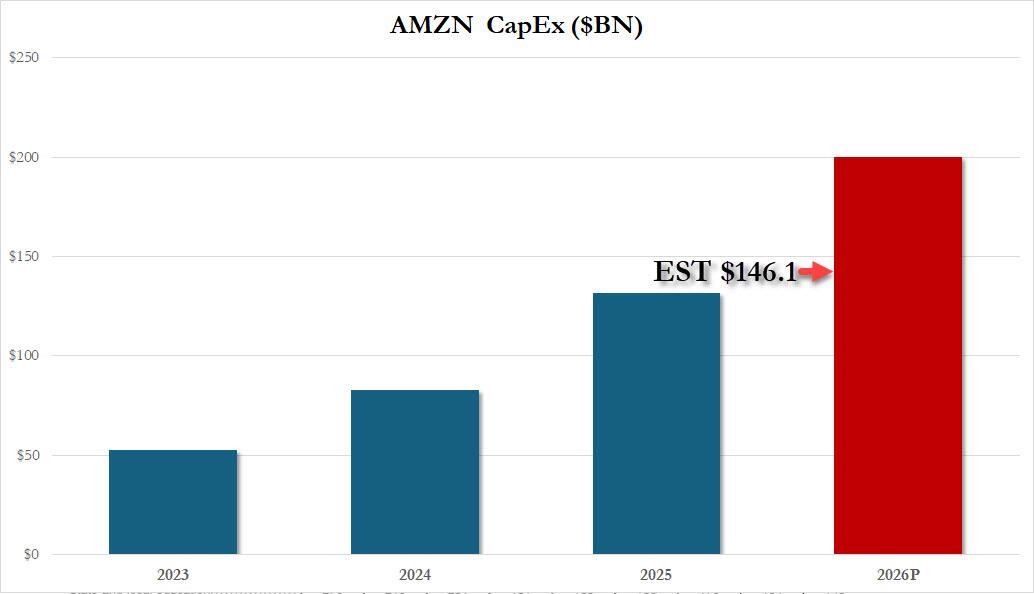
Amazon's total revenue and the much-anticipated cloud business AWS revenue growth for the fourth quarter of 2025 both exceeded expectations. Amazon expects its capital expenditures for 2026 to be around $200 billion, a 50% increase from 2025 and approximately 36.9% higher than Wall Street's expected spending level of $146.1 billion. Due to the unexpected surge in spending, Amazon's operating profit guidance for this year is more than 14% lower than analysts' expectations.
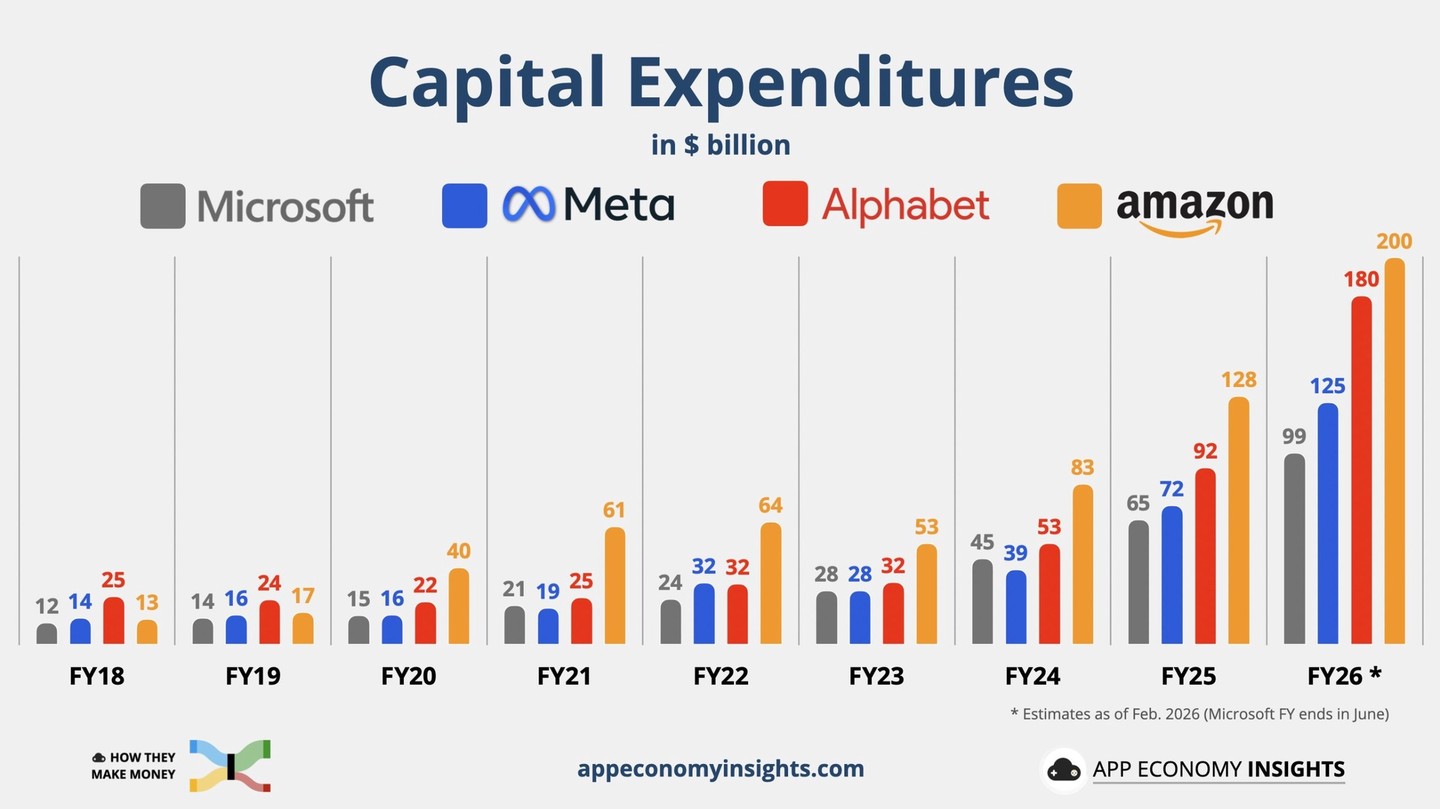
This guidance from Amazon is about 11% higher than Google's spending guidance median of approximately $180 billion announced on Wednesday, far exceeding Meta's planned maximum spending of $135 billion this year. For the fiscal year 2026 ending in June this year, Microsoft's total capital expenditures are expected to be less than $100 billion.
Like Google, Amazon's financial report also showcased the rapid growth of its cloud business, while also exposing the core contradiction faced by Silicon Valley giants: cloud growth was originally seen as a source of funding for generative AI development, but as the costs of building new data centers and chips continue to rise, investors are beginning to question whether such high investments can yield the expected substantial returns.
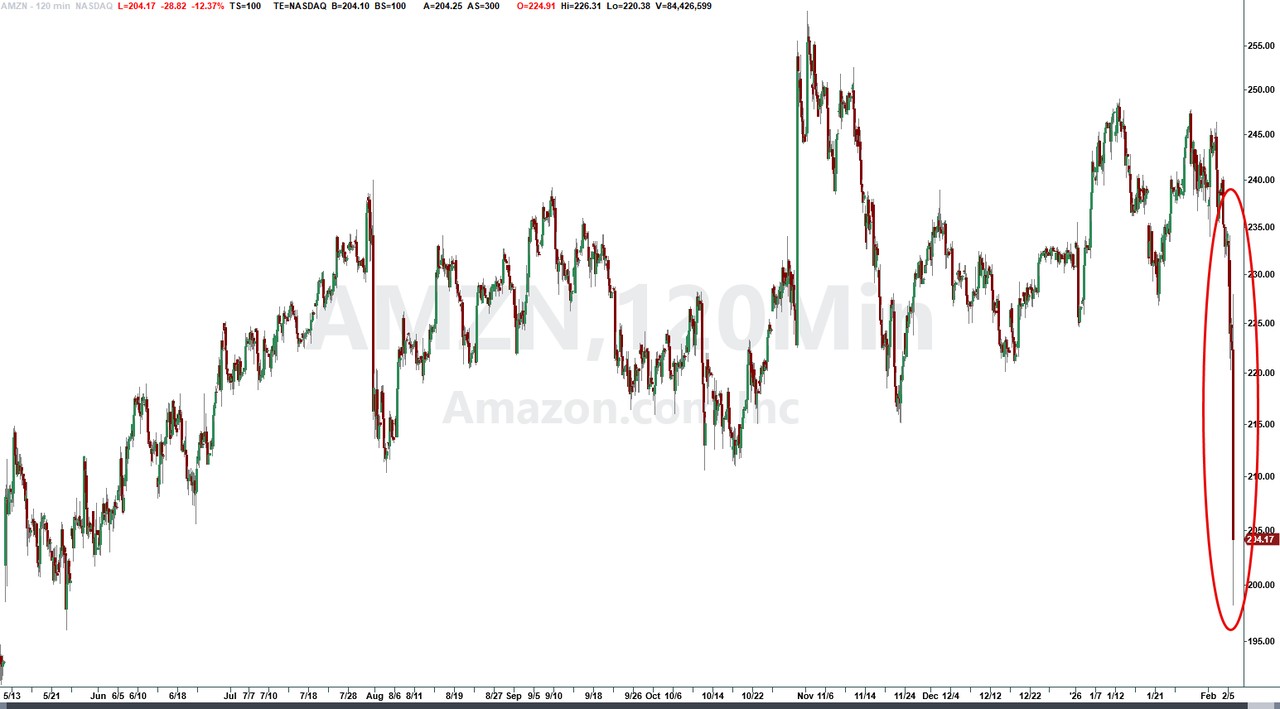
In the fourth quarter, Amazon's core retail business grew steadily, and AWS revenue exceeded expectations with a significant increase, yet the market did not respond positively. After the earnings report was released, Amazon's stock price, which had already fallen over 4% by Thursday's close, further plummeted, with after-hours losses quickly expanding to over 10%, at one point dropping more than 14%, before narrowing the decline to under 10%.
Three months ago, Amazon's third-quarter AWS revenue exceeded expectations, driving the stock price up nearly 10%. Now, amid a "software backlash" affecting the entire tech sector, investors are trying to sift through hundreds of billions of dollars in AI spending to identify winners and losers.
AWS Revenue Grew 24% Year-on-Year, Achieving Highest Growth Rate in Over Three Years
The financial report shows that Amazon's net sales in the fourth quarter grew 14% year-on-year to $213.39 billion, nearly 9% higher than analysts' expectations of $211.49 billion, with the growth rate slightly accelerating compared to the analysts' expected level of 13% in the third quarter.
Considered the "crown jewel" of Amazon, the AWS business is one of the most impressive metrics in this financial report and has somewhat alleviated market concerns about overall weakening cloud demand.
In the fourth quarter, AWS net sales grew 24% year-on-year to $35.58 billion, approximately 2% higher than analysts' expectations of $34.88 billion. The year-on-year growth rate of AWS sales was faster than the 20% in the third quarter, setting a new record for the highest growth rate since the end of 2022 At the same time, AWS's profitability has not continued to expand. In the fourth quarter, AWS's operating profit was $12.47 billion, a year-on-year increase of 17.3%, with an operating profit margin of 35.0%, down from 36.9% in the same period last year, but up from 34.64% in the third quarter, exceeding analysts' expectations of 35% with a quarter-on-quarter rebound.
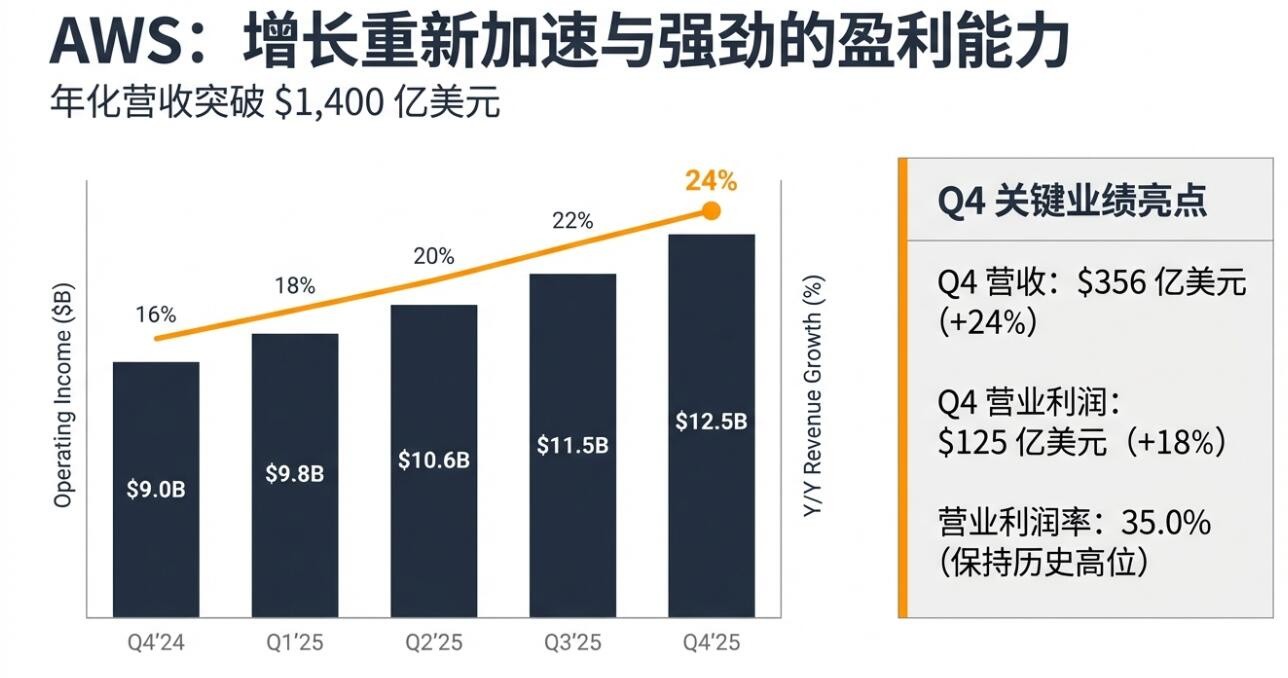
After AWS's revenue continued to grow at double digits, the market's demand for AWS has shifted from "can it grow" to "can it continue to expand profit margins and cash flow during a high investment cycle." This explains why, despite AWS recording high growth, Amazon's stock price still fell, as investors are concerned that AWS's acceleration comes more from the continued increase in infrastructure supply rather than a natural rebound in light capital demand.
Amazon's management emphasized in the announcement the progress of self-developed chips and AI platforms, such as Trainium and Graviton, which together have an annualized revenue exceeding $10 billion, with a year-on-year growth in triple digits. Trainium 2 and 3 are in short supply, and the expansion of the Bedrock model ecosystem reinforces Amazon's positioning as an "AI infrastructure provider," but it also tells the market that this round of growth requires larger capital expenditures to support.

Free Cash Flow Shrinks Significantly, $200 Billion Capital Expenditure Guidance Weighs on Stock Price
The real "turning point information" in the financial report lies in cash flow and investment intensity.
By the end of the fourth quarter, over the past 12 months, Amazon's operating cash flow was $139.5 billion, a year-on-year increase of 20%, while the free cash flow during the same period was only $11.2 billion, a significant decrease of 70.7% compared to $38.2 billion in the same period last year.
The direct reason for the weakening of free cash flow is the surge in capital expenditures: over the past 12 months, Amazon's spending on property and equipment, excluding disposals and incentives, reached $128.3 billion, an increase of 65% year-on-year.
According to the cash flow statement, the "purchase of property and equipment" in 2025 is as high as $131.8 billion, a nearly 59% increase from $83 billion last year, and the company clearly stated that this mainly reflects AI-related investments.
What the market finds hardest to digest is the future spending guidance provided by Amazon's management for the coming year. Amazon CEO Andy Jassy stated in the financial report announcement:
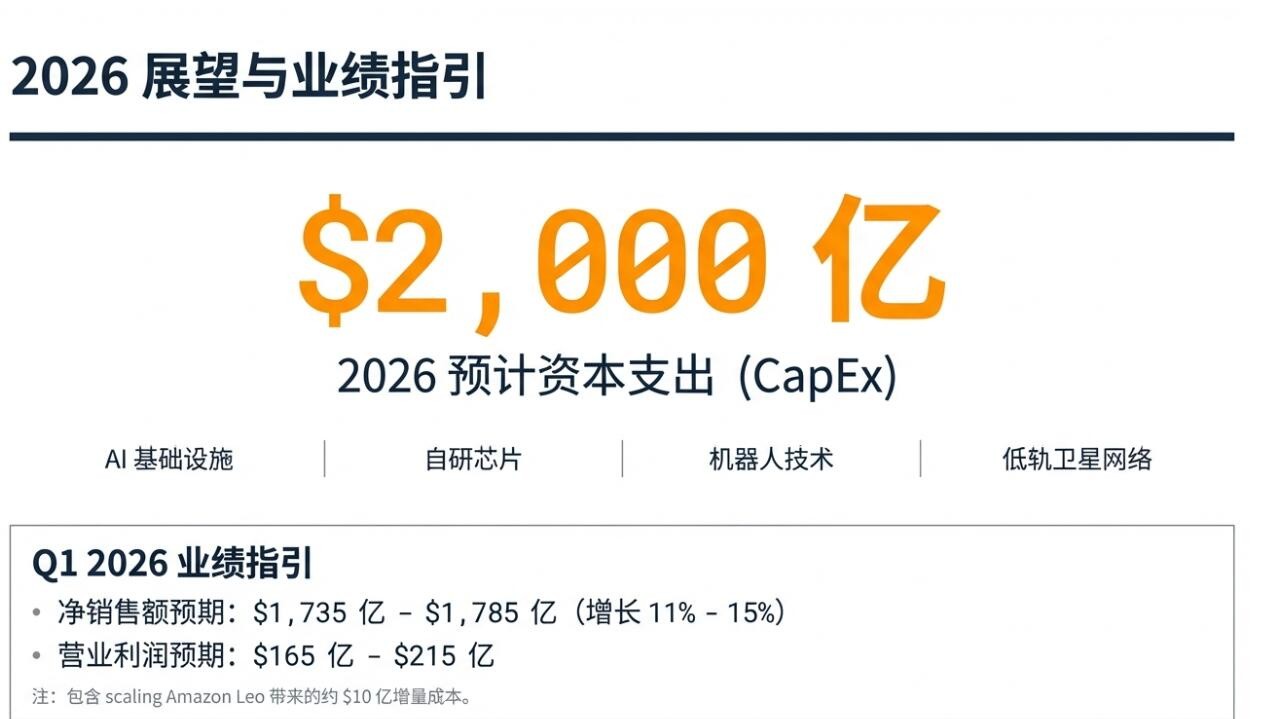
"Given the strong demand for our existing products and the enormous growth opportunities in areas such as artificial intelligence (AI), chips, robotics, and low Earth orbit (LEO) satellites, we expect Amazon to invest approximately $200 billion in capital expenditures by 2026, and we anticipate that the investment capital will yield strong long-term returns."
Considering that the previous market anxiety regarding tech giants was focused on "whether AI investments are excessive and when returns will materialize," the figure of $200 billion will naturally be interpreted as:
- Pressure on free cash flow may continue or even increase;
- Short-term profit margins must give way to computing power and infrastructure expansion;
- If AI monetization falls short of expectations, valuations will be under pressure.
This is also the most direct logic behind the recent sharp decline in stock prices: the quarterly performance is not bad, but the uncertainty of "cash flow - capital expenditure - return cycle" is rising for the next year.
Q1 revenue expected to continue double-digit growth, profit guidance cautious, cost items named
In addition to capital expenditures, in other guidance, Amazon expects Q1 2026 revenue to be between $173.5 billion and $178.5 billion, a year-on-year increase of 11%-15%, with about 180 basis points of growth coming from favorable exchange rates.
The average of the guidance range, $176 billion, roughly aligns with analysts' expectations of $175.54 billion. Even at the lower end of the range, Amazon will still maintain double-digit revenue growth in Q1.
Operating profit for Q1 is expected to be between $16.5 billion and $21.5 billion, with an average guidance range of $19 billion, which is about 3.3% higher than the $18.4 billion in the same period last year, but 14.4% lower than analysts' expectations of $22.2 billion. If profits are at the lower end of the range, it will represent a year-on-year decline of 10.3%, while at the high end, it will represent a year-on-year increase of 16.8%.
The key point of this guidance is that the operating profit range covers the possibility of a year-on-year double-digit decline, which at least indicates that short-term profit margin expansion is not a priority for management. The company also explicitly listed two sources of incremental costs in the guidance:
- Approximately $1 billion increase in Amazon Leo (low Earth orbit satellite) costs year-on-year;
- Investments in international retail for rapid e-commerce and lower prices.
In a market that is already highly sensitive to "whether cloud demand is slowing and whether AI investment is excessive," this combination of "profit elasticity slowing + accelerated investment" can easily trigger a repricing at the valuation level.
One-time expenses drag down quarterly profits, but not the main reason for market sell-off
In Q4, Amazon's earnings per share (EPS) were $1.95, a year-on-year increase of 4.8%, slightly below the consensus expectation of $1.96, and significantly slower than the 36.4% growth in Q3. Operating profit increased by 17.9% year-on-year to $25 billion, exceeding analysts' expectations of $24.82 billion, with growth stronger than the zero growth in Q3.
The Q4 operating profit included three special expenses:
- $1.1 billion (settlement of tax disputes and litigation related to Italian stores);
- $730 million in severance costs;
- $610 million in asset impairment (mainly related to physical stores).
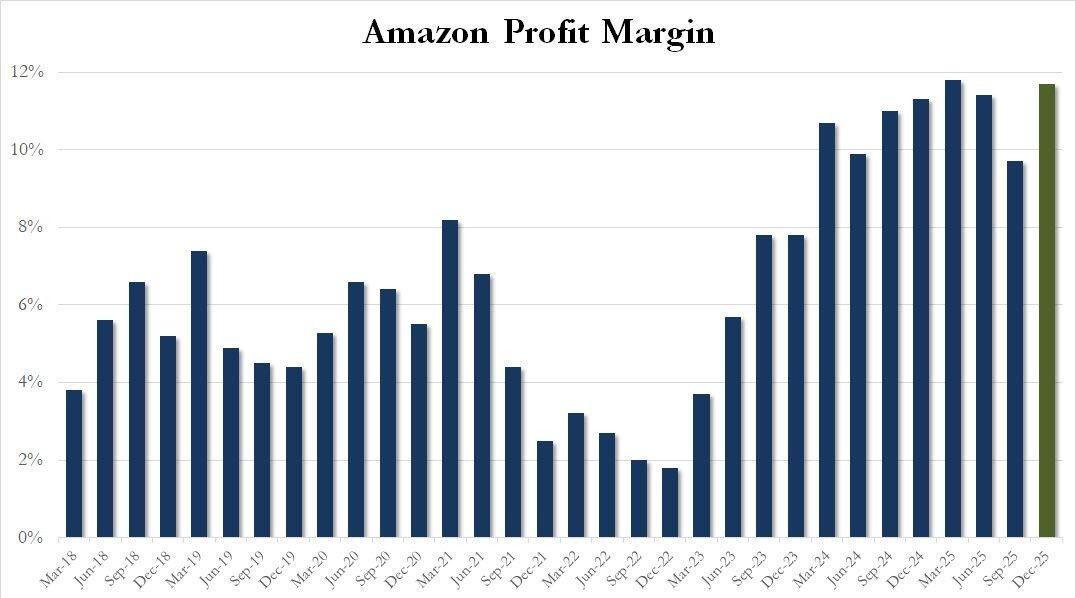
Excluding these, Q4 operating profit could reach $27.4 billion. One-time items did affect the "perception" of quarterly profits and reflect that the company is still adjusting and experimenting in areas like physical retail. However, from the post-market decline and the focus of market discussions, investors are more concerned about the "investment intensity for the next year" and "free cash flow path," rather than these retrievable accounting items Thanks to the rebound in AWS's profit margin, Amazon's overall operating profit margin in the fourth quarter rose from 9.7% in the third quarter to 11.7%, approaching the record high of 11.8% set in the first quarter.
Advertising Growth Outpaces E-commerce
Advertising continues to serve as a "stabilizer" for Amazon's profits.
In the fourth quarter, advertising service revenue reached $21.32 billion, a year-on-year increase of 22%, maintaining the high prosperity seen in recent quarters. E-commerce revenue for the quarter was $82.99 billion, a year-on-year increase of about 10%, exceeding analysts' expectations of $82.3 billion.
Compared to retail, which is more sensitive to fulfillment, capacity, and pricing strategies, the gross profit structure of advertising is more favorable and can more easily contribute certain incremental growth amid macro fluctuations.
For investors, the significance of the advertising business lies in the fact that when the company chooses to invest more resources in heavy asset areas such as AI computing power, satellite networks, and fast delivery, advertising remains one of the few sectors that can still provide profits and cash flow hedges in a short cycle.
North American Retail: Profit Margins Continue to Recover, but Fulfillment and Delivery Costs Are Still Rising
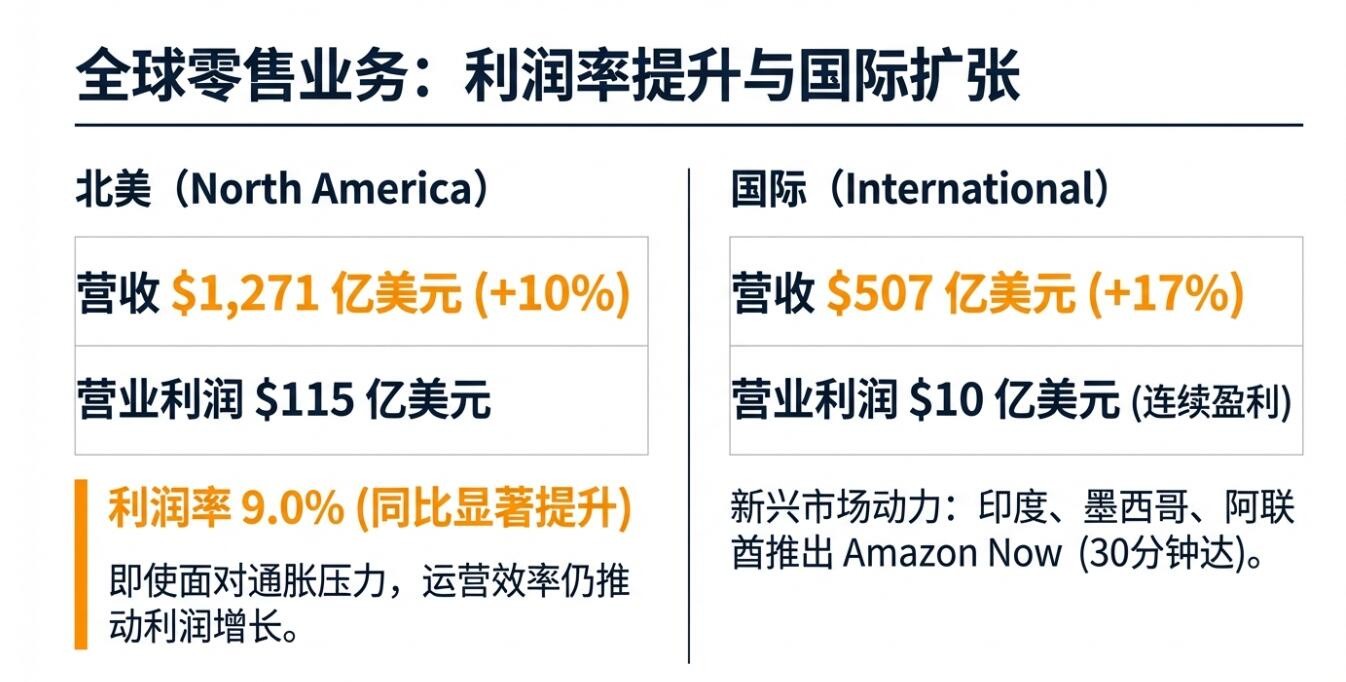
In the fourth quarter, Amazon's North American business revenue was $127.08 billion, a year-on-year increase of 10%, slightly below analysts' expectations of $127.21 billion; operating profit was $11.47 billion, a year-on-year increase of 23.9%, and the operating profit margin improved from 8.0% in the same period last year to 9.03%, exceeding analysts' expectations of 8.51%.
This indicates that Amazon's retail base is growing steadily, while the profit margin trend is still improving.
Operational metrics also reflect the resilience of retail demand: global paid sales grew by 12% year-on-year in the fourth quarter, and delivery speed continued to improve. The company disclosed that it aims to achieve "the fastest speed ever" for Prime members by 2025, with same-day delivery and expanded grocery delivery coverage continuing to advance.
However, the cost side is not easy: global transportation costs in the fourth quarter increased by 10% year-on-year to $31.49 billion, coupled with the company's ongoing investments in fast delivery and low-price strategies, which means that while North American profit margins are recovering, achieving linear growth is not easy—especially if the company intensifies its "sharper pricing" strategy in international markets, profit elasticity may be diluted.
International Business: High Revenue Growth, but Profit Declines
Amazon's international business revenue growth is impressive, with fourth-quarter revenue reaching $50.72 billion, a year-on-year increase of 17%, and an approximate growth rate of 11% after excluding exchange rate effects, which is about 2% higher than analysts' expectations of $49.74 billion.
However, the operating profit for the international business in the fourth quarter was $1.04 billion, a year-on-year decrease of 21.2%, and the operating profit margin fell from 3.0% in the same period last year to 2.1%, lower than analysts' expectations of 4.27%.
More importantly, the company directly pointed out in its first-quarter guidance that it will increase investment in international stores, including "quick commerce" and "sharper pricing." This effectively informs the market in advance that the international business may continue to exchange profits for scale and user experience in the short term, with the pace of profit improvement potentially slower than expected