


In January, U.S. Challenger Companies laid off 108,000 people, the highest for the same period since 2009, a month-on-month increase of 205%

The U.S. job market started off severely in 2026, with a report from Challenger Gray & Christmas showing that the number of layoffs in January reached 108,435, a new high since 2009, surging 205% month-on-month. Hiring plans have dropped to a minimum, with only 5,306 new positions added. The transportation and technology sectors experienced the most severe layoffs, with UPS and Amazon cutting 30,000 and 16,000 jobs, respectively. Despite the dismal unemployment claims data, businesses' pessimism about the economic outlook has translated into actual layoffs
The U.S. job market has experienced the most severe start since the financial crisis.
The "Challenger Job Cut Report" released by the outplacement consulting firm Challenger Gray & Christmas on Thursday shows that the number of layoffs announced by employers surged to the highest January level in 17 years, while hiring plans fell to the lowest level for the same period on record.
The report indicates that in January, U.S. companies announced layoffs of 108,435 people, a staggering 118% increase compared to the same period last year, and a 205% surge compared to December 2025. This is the highest number of layoffs for the same period since January 2009, when the U.S. economy was at the tail end of the most severe recession since the Great Depression.
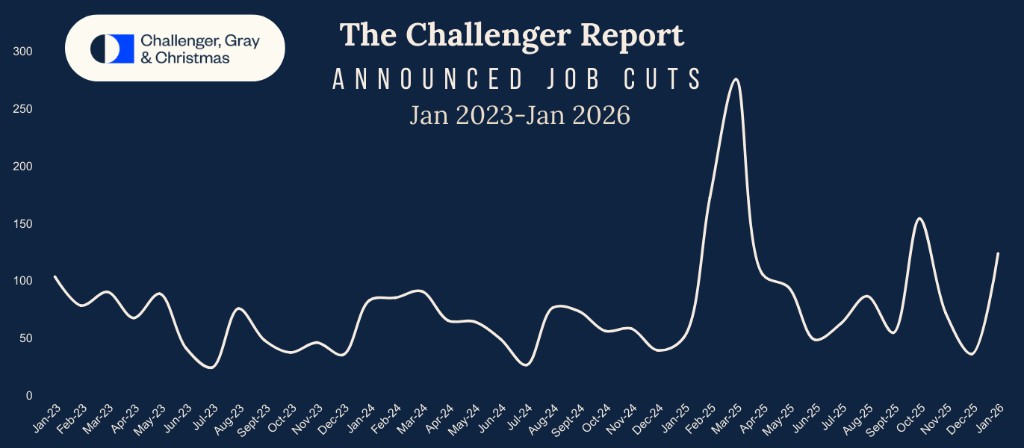
Meanwhile, companies announced plans to add only 5,306 jobs, also setting a record low for January since the firm began tracking such data in 2009. The transportation and technology sectors led this wave of layoffs, with UPS planning to cut over 30,000 positions and Amazon announcing the elimination of 16,000 positions primarily at the corporate level.
This data indicates that, despite official unemployment claims remaining low, businesses' pessimism about the economic outlook for 2026 is translating into actual actions, and the narrative of the labor market being "no hiring, no layoffs" may be shifting.
Transportation Sector Sees Largest Layoffs, Technology Sector Follows
The total number of layoffs in January more than doubled from 35,500 in December 2025, marking aggressive cost-cutting measures taken by companies at the beginning of the year.
Andy Challenger, Chief Revenue Officer and part-time expert at Challenger, stated:
"Typically, we see a lot of layoffs in the first quarter, but this is a very high number for January. This suggests that most plans were made at the end of 2025, indicating that employers are not optimistic about the outlook for 2026."
In terms of industry distribution, the transportation sector saw the largest layoffs, primarily driven by logistics giant UPS's plan to cut over 30,000 positions. The technology sector ranks second, with Amazon's announced layoffs of 16,000 dominating. The healthcare sector also experienced significant layoffs.
Contract losses and economic uncertainty are the main factors driving the layoffs. Notably, job cuts related to artificial intelligence accounted for 7% of the total layoffs.
Hiring Intentions Drop to Historical Low for the Same Period
The shrinkage of hiring plans is also noteworthy. The 5,306 new positions announced in January represent a 13% decrease from January 2025 and a sharp 49% drop from December 2025, setting a record low for January since Challenger began tracking. This data sharply contrasts with the surge in layoffs, highlighting companies' cautious approach to human resource allocation The dual deterioration of hiring and layoff data indicates that the labor market may be shifting from a previous "no hiring, no layoffs" state to a more defensive posture. Companies seem to be preparing for a potential economic slowdown, prioritizing cost control over business expansion.
Official Data Has Yet to Reflect the Trend
Although Challenger data shows a clear trend of deterioration, this change has not yet fully manifested in official statistics. As of the week ending January 24, the number of initial unemployment claims was only 209,000, with the long-term trend nearing its lowest level in two years.
However, Challenger's data tends to be volatile and its correlation with official statistics is not stable. Nevertheless, documents received by the Department of Labor in January under the Worker Adjustment and Retraining Notification Act (WARN) indicate that over 100 companies have issued mass layoff notices, which somewhat corroborates the trend reflected in Challenger data.
The recent announcements of large-scale layoffs by well-known companies such as Amazon, UPS, and Dow also contrast with the stability presented in official data, suggesting that the labor market may be at a turning point.
Risk Warning and Disclaimer
The market carries risks, and investment should be approached with caution. This article does not constitute personal investment advice and does not take into account the specific investment goals, financial situation, or needs of individual users. Users should consider whether any opinions, views, or conclusions in this article align with their specific circumstances. Investment based on this is at one's own risk
