


Hold steady! The Bank of England maintains the interest rate at 3.75%, with a 5 to 4 voting result sending a strong signal for rate cuts

The Bank of England maintained the interest rate at 3.75%, but the internal vote was close to a rate cut at 5:4, releasing a strong dovish signal. Governor Bailey stated that "there should be further room for rate cuts this year" and predicted that inflation would fall to 2% in April. Following the decision, the British pound fell by 0.8%, and short-term government bond yields declined. Although current inflation remains high, the focus of decision-making has clearly shifted from combating inflation to addressing economic weakness and the risks of declining demand, paving the way for the start of a rate cut cycle within the year
The Bank of England decided to keep the benchmark interest rate unchanged at 3.75% during its policy meeting on Thursday, but there was an unexpectedly fierce division within the Monetary Policy Committee (MPC), with the voting results indicating that the bank is just one step away from a rate cut. This decision, while aligning with market concerns about the current high inflation environment, released strong dovish signals regarding the decision-making details behind it.
During this meeting, Bank of England Governor Andrew Bailey became the key swing vote, choosing to maintain the interest rate but clearly stating that if everything goes smoothly, "there should be room for further cuts to the bank rate this year." The latest forecasts from the Bank of England show that despite the current inflation rate still being as high as 3.4%, it is expected to fall back to the target level of 2% by April this year and remain below this target for most of 2027.
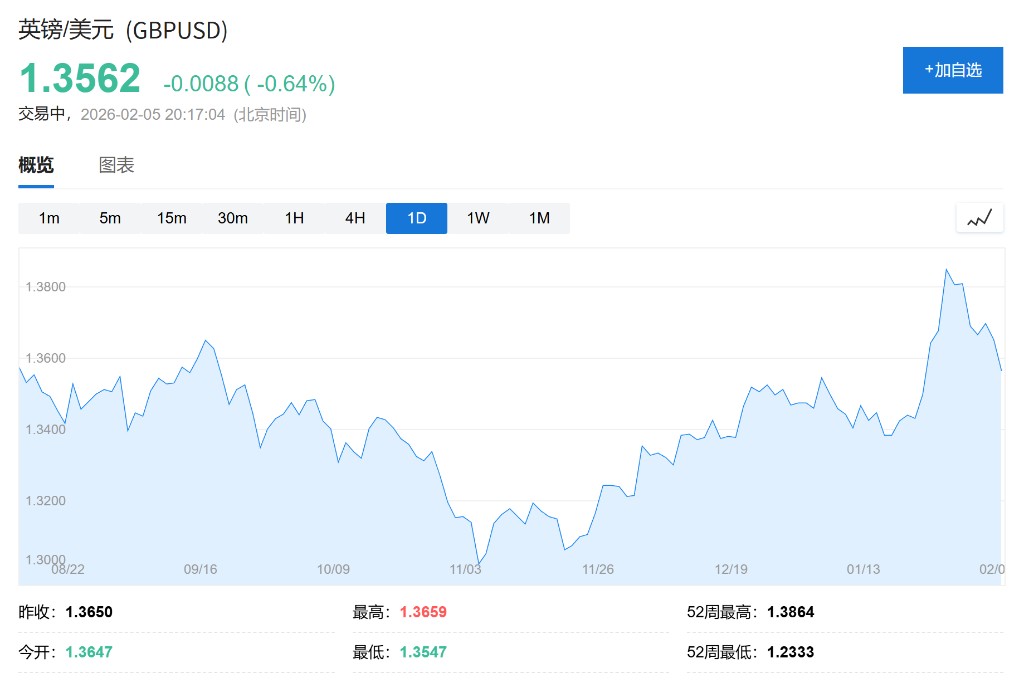
Following the announcement of this decision, the market reacted sharply. According to Bloomberg data, due to the dovish stance of the decision-makers being far beyond expectations, the GBP/USD exchange rate fell by 0.8% to 1.3552 at one point. Meanwhile, UK government bonds rebounded, especially short-term bonds, with the yield on two-year government bonds dropping by 7 basis points to 3.65%. Although the market had previously bet on the interest rate remaining unchanged, it did not anticipate such a high level of support for a rate cut.
This meeting highlighted the difficult balance the Bank of England faces between combating inflation and responding to economic slowdown. Although the rebound in the December inflation rate forced the central bank to remain cautious for the time being, concerns about the persistence of inflation have clearly diminished, shifting focus more towards signs of weakness in the labor market and pressures on the demand side, which opens the door for future monetary easing policies.
The Intense Game of "One Vote Difference"
The most striking detail of this meeting was the narrow 5 to 4 decision by the nine MPC members to hold rates steady. Four members—Swati Dhingra, Alan Taylor, Dave Ramsden, and Sarah Breeden—voted in favor of lowering the rate to 3.5%, the expansion of this camp was unexpected by most economists, as the market had generally anticipated only two to three members would support a rate cut.
Ultimately, Governor Andrew Bailey maintained the status quo through his key swing vote. He explained in a statement that his core outlook aligns with the staff's view on "weak demand." The minutes of the meeting show that although Bailey and external member Catherine Mann voted to keep rates unchanged this time, both have signaled that they are nearing a shift towards the rate-cutting camp. They are now "placing greater emphasis on the downside risks to inflation posed by weak economic activity," indicating a subtle shift in the stance of the decision-makers.
Reshaping Inflation Outlook and Policy Balance
Although data shows that the UK's December inflation rate rose to 3.4%, far exceeding the central bank's 2% target, prompting the central bank to remain cautious at this meeting, the medium-term outlook has changed significantly. According to Bloomberg, the latest forecasting models indicate that inflation pressures will continue to ease, with inflation rates expected to not exceed 2% from April this year until early 2029, and even four quarters below the target level The Bank of England pointed out in the minutes of the meeting that the upside risks to inflation have "become less apparent."
Bailey further elaborated on the current policy considerations, stating that service sector inflation and wage growth need to decline further before the MPC can confidently believe that inflation will return to target and remain at that level. However, he also emphasized that the latest analysis from Bank of England staff shows that structural changes in wage setting will not continue to exacerbate inflationary pressures, which is reassuring.
Currently, there are signs of loosening in the labor market, with reduced hiring and increased layoffs. "Evidence of sluggish economic growth and increased idle capacity in the labor market" has become a key consideration for decision-making. In addition, Chancellor of the Exchequer Rachel Reeves has canceled measures such as taxing household energy bills in the November budget, which is expected to mechanically lower the inflation rate by 0.5 percentage points in the second quarter.
The Future Path is Full of Uncertainty
Bailey admitted that the judgment on further interest rate cuts will become more nuanced. On one hand, cutting rates too quickly or excessively may lead to persistent inflationary pressures; on the other hand, waiting too long could result in a sharp decline in economic activity. He pointed out that after each rate cut, it will become increasingly difficult to judge how much more can be cut in the future.
In light of the dovish signals released at this meeting, markets and economists are beginning to reassess the timing of the next rate cut. Although Berenberg Bank previously pushed back its rate cut expectations to the second quarter, its senior economist Andrew Wishart noted that while strong demand and stubborn inflation exist, the next action may be taken at the meeting on April 30.
Edward Allenby from Oxford Economics believes that the current mild stagflation may lead to divisions within the committee regarding timing, resulting in a gradual easing policy. He also considers late April to be the most likely time for the next rate cut. Dany Stoylova from BNP Paribas is more aggressive, expecting the next rate cut to occur as early as March.
Currently, all eyes are on future wage adjustment data, which will be key evidence to verify the extent of economic weakness. Although a pause has been pressed this time, against the backdrop of slowing economic growth and declining inflation expectations, the path for further rate cuts by the Bank of England this year has gradually become clearer
