


This year has earned $24 billion! Hedge funds are aggressively shorting software stocks

Data shows that the software industry's market value has evaporated by $1 trillion this year. Short sellers are focusing on basic automation service companies that can easily be replaced by AI tools. Giants like Microsoft and Oracle have seen declines of over 15%, while small and medium-sized software stocks have dropped by more than 30%. The short-selling strategy has rarely changed, with no signs of covering positions and instead increasing short-selling efforts. Institutional analysts point out that hedge funds are almost all net short on the software industry
Since the beginning of this year, Wall Street hedge funds have made a profit of $24 billion by heavily shorting software stocks, driven by growing market concerns that advancements in AI technology will disrupt traditional software business models, leading to significant industry damage.
Currently, this wave of selling is accelerating. On February 4th, Bloomberg cited data from S3 Partners indicating that under the fierce assault of short sellers, the overall market value of the software industry has evaporated by $1 trillion this year. Sources from major Wall Street hedge funds revealed that investors are focusing their short-selling efforts on companies that provide basic automation services, which are easily replicable and replaceable by new AI tools.
Meanwhile, short sellers have not backed off amid falling stock prices; instead, they view it as a "falling knife," further increasing their short positions. DA Davidson analyst Gil Luria pointed out that almost all hedge funds are currently net short on the software industry.
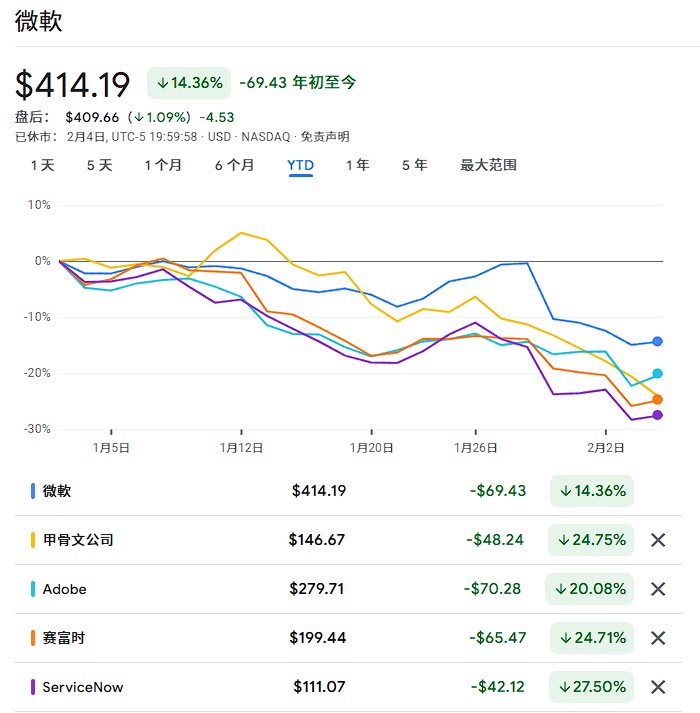
The sharp decline in software stocks has triggered widespread market turmoil. The iShares Expanded Tech Software Sector ETF fell 8% this week, with a cumulative decline of over 21% this year, down 30% from the historical high set last September. Microsoft and Oracle have dropped 15% and 25% respectively this year, while Salesforce, Adobe, and ServiceNow have all seen declines exceeding 20%.
Short Sellers Reap Rich Rewards, Targeting "Easily Replaceable" Stocks
Data from S3 Partners shows that year-to-date, short sellers have realized $24 billion in paper profits on software stocks. This wave of short selling is not without purpose but is highly targeted.
According to Bloomberg, sources from two major hedge funds revealed that the current focus seems to be on companies whose business models are easily replaceable by emerging AI tools, particularly those providing basic automation services.
As concerns about AI's disruptive capabilities grow, investors increasingly believe that the software industry is undergoing a "structural transformation." This expectation of transformation has led hedge funds to view indiscriminate sell-offs of software stocks as opportunities for further short selling.
In ETF holdings, the concentration of stocks with the highest short ratios is evident. TeraWulf currently has over 35% of its float shorted, while Asana's ratio stands at 25%. Additionally, the short ratios for Dropbox and Cipher Mining have reached 19% and 17%, respectively.
Giants Also Face Pressure, Short Selling Strategies Shift
It is noteworthy that the sell-off is not limited to small and medium-sized software companies; industry giants are also facing significant downward pressure.
In addition to industry giants like Microsoft, Oracle, Salesforce, and Adobe, even niche leaders such as tax software manufacturer Intuit and document processing giant DocuSign have seen declines exceeding 30% this year More importantly, the strategy of short sellers is undergoing a rare shift. S3 Partners pointed out that short sellers are increasing their bets on large tech stocks including Microsoft, Oracle, Broadcom, and Amazon, which is a stark contrast to the past practice of covering shorts during declines.
Leon Gross specifically mentioned the case of Microsoft. Historically, Microsoft has typically behaved as a "reversal stock," with short sellers tending to buy to cover when the stock price falls. However, now its trading characteristics resemble those of a "momentum-driven pressured stock," with short sellers increasing their short positions as its stock price weakens.
Data shows that since the beginning of this year, short positions in Microsoft have surged by 20%, while Oracle has seen a 10% increase.
Credit Side Stabilizes, Market Awaits Earnings Guidance
Despite the heavy toll on the stock market, the credit market has not yet shown signs of panic.
According to CNBC, a banker revealed that the industry's revolving credit lines have not been tapped, indicating that corporate balance sheets still possess a certain degree of resilience.
Some analysts believe that with several software companies scheduled to release earnings reports in the coming days, market sentiment in the public markets may reach a turning point.
Meanwhile, investors within the industry generally believe that the current structural pressures may prompt more trading activity, including mergers and acquisitions initiated by large companies, which could bring new variables to the beleaguered software sector
