


Google conference call: $185 billion in spending "must be spent," confirms collaboration with Apple, Gemini is not the "terminator" of SaaS

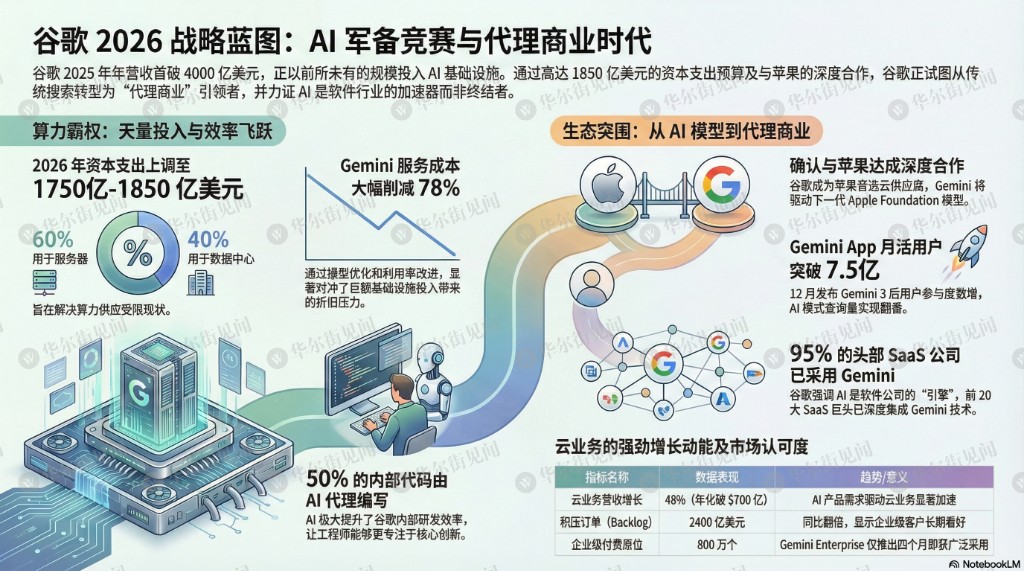
Google announced that its capital expenditure in 2026 will reach up to $175 billion to $185 billion, primarily for servers and data centers, fully investing in the AI arms race. It officially confirmed a partnership with Apple to develop the next-generation foundational model based on Gemini. In response to market fears about "AI disrupting SaaS," the CEO stated that Gemini is its "engine" rather than a terminator, with 95% of leading SaaS companies already adopting it. Additionally, Gemini App's monthly active users have surpassed 750 million, and Google is moving towards the "agent commerce" era
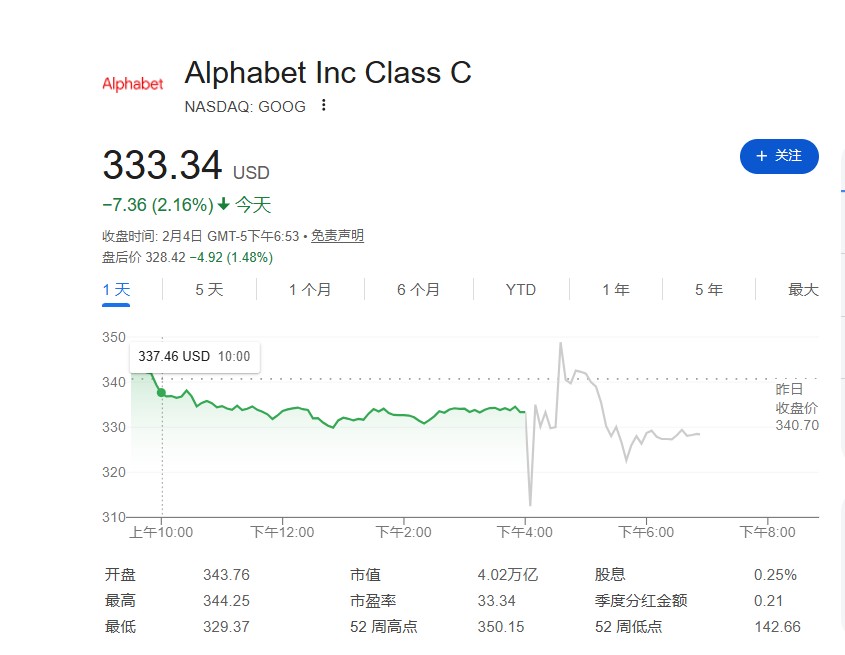
Alphabet (the parent company of Google) sent a clear signal during its earnings call on Wednesday: the AI arms race is far from over and has just entered the "deep waters." Although Q4 performance exceeded expectations, the market was spooked by the company's guidance for capital expenditures of $175 billion to $185 billion in 2026. The depreciation pressure from such massive capital expenditures and the potential erosion of profit margins have also become clouds over investors' heads. The company's stock price fell slightly in after-hours trading.
In response to investors' concerns, CEO Sundar Pichai and CFO Anat Ashkenazi elaborated on the necessity of high expenditures, the commercialization prospects of AI agents, and the significant collaboration with Apple. They also directly countered the recent market narrative that "AI will kill software companies."
Responding to Massive Capital Expenditures Aimed at "Looking to the Future"
The most striking focus of the call was undoubtedly Alphabet's capital expenditure forecast for 2026. CFO Anat revealed that capital expenditures are expected to be between $175 billion and $185 billion in 2026, with investments gradually increasing each quarter.
In response to analysts' questions about return on investment and efficiency, Pichai explained that this level of expenditure is necessary to support the development of cutting-edge models at Google DeepMind and to meet the surging demand from cloud customers. He pointed out that the current supply of computing power remains tight.
“Even as we have been increasing capacity, we are still in a supply-constrained state. Clearly, this year's capital expenditures are aimed at the future... The demand we see across our services, whether for DeepMind's future work or cloud services, is exceptionally strong. Therefore, I expect that we will continue to operate in a supply-constrained state throughout the year.”
Anat added that similar to 2025, about 60% of capital expenditures in 2026 will be allocated to servers, and 40% to long-cycle assets such as data centers and network equipment. She also warned that as infrastructure investments increase, depreciation expenses will rise significantly, with the depreciation growth rate expected to accelerate further in 2026, which will exert ongoing pressure on the income statement.
Facing the Software Stock Sell-off: Google Supports SaaS, Claims Gemini is an "Engine" Not a Terminator
Recently, as Anthropic launched legal automation tools, panic over "AI disrupting traditional software business models" spread, leading to a bloodbath in the U.S. software sector.
Regarding this topic, analyst Mark Mahaney asked during the call: "There is a belief in the market that these software companies are losing seat power and pricing power, which seems like a very bad customer base." In response, CEO Sundar Pichai provided a completely opposite assessment, attempting to define Google as an ally of SaaS companies.
“Gemini is becoming the AI engine for the most successful software companies in the world.” Pichai countered, citing data to prove that SaaS giants are embracing rather than fleeing from AI, “95% of the top 20 SaaS companies and over 80% of the top 100 companies are using Gemini, including Salesforce and Shopify.”
Pichai emphasized that companies able to seize this moment will have the same growth opportunities. Chief Business Officer Prabhakar Raghavan also added that successful SaaS customers are deeply integrating Gemini into their key workflows, “If I look at it from the perspective of token usage, the growth in the fourth quarter is very strong.”
Confirmation of Deep Collaboration with Apple: Gemini Technology Will Drive Apple's Next-Generation Models
During the conference call, Pichai officially confirmed the long-speculated rumors—Google has reached a deep collaboration with Apple. This not only solidifies Google's position in the iOS ecosystem but may also become a key channel for distributing its AI models.
Pichai clearly stated in his opening remarks:
“I am pleased that we are working with Apple as their preferred cloud provider and developing the next-generation Apple Foundation model based on Gemini technology.”
This confirmation undoubtedly reassured investors worried about Google being disrupted at the mobile entry point.
Progress in AI Commercialization: Gemini App Monthly Active Users Exceed 750 Million, Ushering in the Era of "Agentic Commerce"
Google is trying to prove that its AI products not only have traffic but also monetization capabilities. Pichai revealed: “The Gemini App now has over 750 million monthly active users. Especially since the launch of Gemini 3 in December, we have seen a significant increase in user engagement.”
More importantly, Google is building a new business model based on "Agentic AI." Pichai mentioned the "Universal Commerce Protocol," marking Google's shift from simple information retrieval to "executing tasks" for users.
“We are laying the foundation for shopping in the AI era... This is a new open standard for agentic commerce that we are building together with many leaders in the retail industry... In this agentic world, I believe 2025 is more about laying the groundwork for making models more robust in agentic use cases... This year (2026), you will see consumers truly able to use all of this.”
Is Google Search Being Eroded? CEO Refutes: This is an "Expansionary Moment"
In response to concerns about whether the Gemini App will erode traditional Google search traffic, Pichai gave a negative answer, defining it as an incremental market "We have not seen any evidence of cannibalization," Pichai emphasized in response to an analyst's question.
"In fact, this is an expansionary moment. People are using search, experiencing AI Overviews and AI models, while also using the Gemini App. All of this combined is expanding the types of queries people are making on Google."
He revealed that in the United States, since its launch, the daily query volume for AI models has doubled, "the query length under AI models is three times that of traditional search."
Cloud Business and Infrastructure: Parallel Development of Self-Developed TPU and NVIDIA GPU
The strong growth of Google Cloud's business (revenue growth of 48%) is largely attributed to its advantages in AI infrastructure. Pichai emphasized Google's "two-legged" strategy in the chip field.
"We have the broadest range of computing options in the industry, including GPUs from our partner NVIDIA... along with our self-developed TPUs that we have been developing for a decade," Pichai stated.
YouTube and Waymo: Advertising Growth and Globalization of Autonomous Driving
Regarding the 9% growth in YouTube advertising revenue (although not as strong as the search business), Chief Business Officer Prabhakar Raghavan explained that it was mainly affected by "some slight impacts from major brand verticals" and the high base effect from last year's U.S. election advertising spending. However, he emphasized: "Shorts now average over 200 billion views per day."
In terms of autonomous driving, Google confirmed a new round of significant investment in Waymo. Pichai stated: "Waymo raised its largest round of funding to date this week... and will soon expand its services to multiple cities in the U.S. as well as the UK and Japan." CFO Ruth Porat added that Alphabet funded a large portion of the $16 billion investment round announced by Waymo on Monday.
Efficiency and Layoff Metaphor? AI Writing Half the Code
On the other side of the massive spending is Google's relentless pursuit of internal efficiency.
Regarding efficiency, Pichai pointed out: "Through model optimization, efficiency improvements, and utilization enhancements, we successfully reduced the unit cost of Gemini's services by 78% by 2025."
In response to a question about how to improve operational efficiency to fund growth investments, CFO Prabhakar Raghavan mentioned a thought-provoking detail:
"As Sundar has mentioned in the past, about 50% of our code is now written by coding agents and then reviewed by our own engineers. This certainly helps our engineers do more with the existing footprint and act faster."
 The full translation of Alphabet's Q4 2025 earnings call is as follows:
Meeting Topic: Alphabet Q4 2025 Earnings Call Meeting Date: February 4, 2026 Speakers:
Sundar Pichai (CEO)
Philipp Schindler (Senior Vice President and Chief Business Officer)
Anat Ashkenazi (Senior Vice President and Chief Financial Officer)
Jim Friedland (Head of Investor Relations)
Speaking Session
Operator: Welcome, everyone. Thank you for joining Alphabet's Q4 2025 earnings call. Currently, all participants are in listen-only mode. There will be a Q&A session following the presentation. Now, I will turn the call over to Jim Friedland, Head of Investor Relations.
Jim Friedland (Head of Investor Relations): Thank you. Good afternoon, everyone, and welcome to Alphabet's Q4 2025 earnings call. Joining me today are Sundar Pichai, Philipp Schindler, and Anat Ashkenazi.
First, I would like to quickly go over the safe harbor statement. Some of the statements we make today regarding our business, operations, and financial performance may be considered forward-looking statements. These statements are based on current expectations and assumptions and are subject to various risks and uncertainties that could cause actual results to differ materially. Please refer to our 10-K and 10-Q filings, including the risk factors contained therein. We do not undertake any obligation to update any forward-looking statements. In this call, we will present both GAAP (Generally Accepted Accounting Principles) and non-GAAP financial metrics. Today's earnings press release includes a reconciliation of non-GAAP to GAAP metrics, which you can access on our investor relations website at abc.xyz/investor. Unless otherwise noted, our comments are based on year-over-year comparisons.
Now, I will turn the time over to Sundar.
Sundar Pichai (CEO): Thank you, Jim. Hello, everyone, and thank you for joining us. This has been an excellent quarter for Alphabet.
The launch of Gemini 3 is a significant milestone, and we are maintaining strong momentum. Alphabet's annual revenue has surpassed $400 billion for the first time. This quarter, our search business continued to accelerate, with revenue growth of 17%. YouTube's annual revenue from ads and subscriptions exceeded $60 billion. Our cloud business has significantly accelerated, with revenue growth of 48%, and the current annualized revenue run rate has exceeded $70 billion. The backlog increased by 55% quarter-over-quarter to $240 billion, representing a broad customer base driven by demand for AI products. We have over 325 million paid subscribers in consumer services, with strong adoption rates for Google One and YouTube Premium In addition, our Gemini Enterprise (Enterprise Edition), launched just four months ago, has sold over 8 million paid seats.
Our Gemini application currently has over 750 million monthly active users. We have also seen significant increases in user engagement, especially since the launch of Gemini 3 in December. Overall, our AI investments and infrastructure are driving comprehensive revenue and growth. To meet customer demand and seize future growth opportunities, we expect capital expenditures (CapEx) in 2026 to be between $175 billion and $185 billion.
Today, I will introduce our latest progress in AI and then share highlights from Search, Cloud, YouTube, and Waymo.
First, progress in full-stack AI. Our unmatched infrastructure is the cornerstone of the AI technology stack. We have the industry's broadest computing options, including GPUs from our partner NVIDIA—who announced at CES that we would be one of the first companies to offer the latest Vera Rubin GPU platform—and our TPUs, which we have developed over the past decade. In December, we announced our intention to acquire Intersect, a company that provides data center and energy infrastructure solutions. As we scale, our efficiency has significantly improved. Through model optimization, efficiency enhancements, and utilization improvements, we have reduced the service unit cost of Gemini by 78% by 2025.
Second, world-class AI research, including models and tools. We offer the world's most extensive model portfolio and lead the LMRena leaderboard in text, visual, and image-to-video. Gemini 3 Pro is at the forefront of reasoning and multimodal understanding. Its adoption rate is the fastest among all our models in history. Since its launch, the average daily token count processed by Gemini 3 Pro has been three times that of 2.5 Pro. Our latest model powers Google Antigravity, our new development platform where agents can autonomously plan and execute complex software tasks. Launched just over two months ago, it has over 1.5 million weekly active users. Our first-party models (like Gemini) now process over 10 billion tokens per minute through direct APIs, up from 7 billion last quarter.
Third, bringing AI into our products and platforms. We are rolling out innovations at scale, bringing useful AI features to users everywhere. In January alone, we launched personal intelligence features in the "AI mode" of Search and the Gemini app, introduced new features for Gmail, updated Veo, and redefined Chrome as an AI-first browsing agent with features like Chrome Auto Browse. We also announced Project Genie—allowing users to create and explore interactive worlds in real-time using our universal world model Genie 3. We have also established a Universal Commerce Protocol with many leaders in the retail industry. This is a new open standard for Agentic Commerce, laying the foundation for shopping in the AI era.**
Finally, from Android to Pixel, we are bringing the best AI capabilities to users. At CES, a range of partners, including Samsung, showcased how they are bringing Gemini to more devices, from XR (extended reality) to living rooms and beyond. To confirm the rumors, I want to announce that we will soon launch the Pixel 10a, joining our highly-rated Pixel 10 series.
Now turning to the key highlights of this quarter, first is the search business. Search usage in the fourth quarter is higher than ever, with AI continuing to drive this expansion moment. Our execution speed is remarkable. In just the last quarter, we launched over 250 product updates in "AI mode" and "AI Overviews." We have integrated Gemini 3 directly into the AI mode of search. Now, search can better understand your queries, delve deeper into the web, and generate interactive UI experiences. Last week, we upgraded AI Overviews to Gemini 3, providing users with top-notch AI answers at the top of the search results page. We also made the search experience more cohesive, ensuring that the transition from AI Overviews to conversations in AI mode is completely seamless. These new experiences have proven to be more helpful and have driven increased usage.
There are several highlights in this regard: First, once people start using these new experiences, they use them more. In the U.S., we have seen the daily AI mode query volume per user double since its launch, and the performance of AI Overviews continues to improve. Second, people are engaging in longer and more complex conversations. The query length in AI mode is three times that of traditional search. We are also seeing conversations becoming more dialogic, with a significant portion of AI mode queries now leading to follow-up questions. Third, people are searching in new ways that go beyond text. Nearly one-sixth of AI mode queries are now non-textual, using voice or images. Additionally, "Circle to Search" is now available on over 580 million Android devices.
Next is Google Cloud. Our growth in revenue, operating margin, and backlog highlights the strength of our entire product portfolio. First, we are winning new customers at a faster pace. By the end of the year, our new customer growth rate was twice that of the first quarter. Second, we are also signing larger customer commitments. The number of deals exceeding $1 billion in 2025 is greater than the total for the past three years. Third, we continue to deepen relationships with existing customers, whose spending is over 30% higher than their initial commitments.
Nearly 75% of Google Cloud customers are using our vertically optimized AI products, from chips to models to AI platforms and enterprise AI agents, which provide exceptional performance, quality, security, and cost efficiency. The number of products used by these AI customers is 1.8 times that of non-AI customers, allowing us to diversify our product portfolio, deepen customer relationships, and accelerate revenue growth Our product line has multiple monetization levers, covering infrastructure, platforms, and high-margin AI-driven products and services, with a total of 14 product lines generating annual revenues exceeding $1 billion.
We provide leading AI training and inference infrastructure for cloud customers, with the industry's most extensive computing options, from our self-developed seventh-generation Ironwood TPU to the latest NVIDIA GPUs. We have a 10-year track record in building our own accelerators, with expertise in chips, systems, networks, and software, translating into leading power consumption and performance efficiency for large-scale inference and training. Our cloud AI accelerators serve leading frontier AI labs, capital market companies like Citadel Securities, enterprises like Mercedes-Benz, and government agencies for high-performance computing applications.
We also offer leading generative AI models to cloud customers, including Gemini, Imagen, Veo, Chirp, and Lyria. In December alone, nearly 350 customers processed over 100 billion tokens each. In the fourth quarter, product revenue based on our generative AI models grew nearly 400% year-over-year, significantly accelerating compared to the previous quarter. Today, over 120,000 enterprises use Gemini, including AI unicorns like Lovable and Open Evidence, as well as global companies like Airbus and Honeywell . 95% of the top 20 SaaS companies and over 80% of the top 100 are using Gemini, including Salesforce and Shopify. Gemini is becoming the AI engine for the world's most successful software companies.
Leading enterprises are also driving strong demand for our enterprise AI agents. We have sold over 8 million paid seats of Gemini Enterprise (our enterprise AI platform) to more than 2,800 companies, including BNY Mellon and Virgin Voyages, to streamline knowledge management and achieve process automation. Gemini Enterprise managed over 5 billion customer interactions in the fourth quarter, delivering 65% year-over-year growth for clients including Wendy's, Kroger, and Woolworths Group. Our integration of Gemini into Google Workspace is gaining favor with global brands like Schwarz Group and public sector agencies like the U.S. Department of Transportation.
We are also seeing strong momentum from independent software vendors. Revenue from AI solutions built by partners grew nearly 300% year-over-year, with commitments from the top 15 software partners increasing more than 16 times year-over-year. Before continuing, I am pleased to announce that we are partnering with Apple as their preferred cloud provider and developing the next-generation Apple Foundation model based on Gemini technology.
Next is YouTube. I want to emphasize four points. First, streaming. In the living room scene, according to Nielsen data, YouTube has been the number one streaming platform in the U.S. for nearly three years. From the NFL to the Coachella music festival, YouTube is the place where people watch today's biggest pop culture moments. Second, subscriptions. We continue to see strong growth in YouTube subscription revenue, particularly with YouTube Music Premium. We will soon launch new YouTube TV plans that offer subscribers more choices and flexibility, including over 10 specific types of packages. The NFL Sunday Ticket subscription user growth on YouTube is strong, with the number of paid subscribers reaching an all-time high for the product. Third, podcasts. To illustrate YouTube's popularity, in October 2025, viewers watched over 700 million hours of podcasts on living room devices, a 75% increase from a year ago. Fourth, AI is changing the YouTube experience for creators and viewers. In December, an average of over 1 million channels used our new AI creation tools daily to enhance creativity. In the same month, over 20 million viewers used our Gemini-powered new Ask tool to learn more about the content they were watching.
Finally, Waymo. This week, Waymo completed its largest funding round to date and is in a favorable position to maintain momentum, always with safety at its core. In December, we surpassed 20 million fully autonomous driving trips, now providing over 400,000 ride services weekly. Waymo continues to expand its service area. Two weeks ago, we launched services in our sixth market, Miami, and Waymo will soon expand services to multiple cities in the U.S. as well as the UK and Japan. The team has made incredible progress in key capabilities, including opening public services to airports and highways.
In summary, 2025 is shaping up to be an excellent year for the company. A big thank you to our employees and partners around the world. We are in a very favorable position as we enter 2026. Now, I’ll hand it over to Philipp.
Philipp Schindler (Senior Vice President and Chief Business Officer): Thank you, Sundar, hello everyone. I will present the performance of Google Services for this quarter, and then expand on the significant progress we’ve made in search, YouTube, and partnerships.
This quarter, Google Services revenue was $96 billion, a 14% year-over-year increase, primarily driven by accelerated growth in search. To further supplement the performance details: search and other businesses grew by 17%, driven by broad strengths across all major verticals, with retail being particularly strong. On YouTube, ad revenue grew by 9%, driven by direct response ads. Network affiliate ad revenue declined by 2% year-over-year this quarter First, let's talk about search and other revenues, which brought in over $63 billion this quarter. Sundar mentioned the moment of expansion in search, and advertising as well. We are investing in AI to drive significant improvements across all areas of marketing. We are expanding the entire field in which advertisers can compete. AI enables businesses to reach more customers in more places than ever before. Gemini allows us to uniquely position and bring the transformative benefits of AI to three key areas for customers: ad quality, advertiser tools, and new AI user experiences.
First is ad quality. Over the past two years, we have been deploying the Gemini model to improve query understanding at almost a monthly pace. These improvements have driven better query matching, ranking, and quality, making search ads more effective. By applying Gemini in the ad quality stack, we have assessed relevance with higher accuracy than previous generations of models. This has significantly enhanced our ability to systematically deliver more useful, high-quality ads, helping to greatly reduce the delivery of irrelevant ads. Gemini's understanding of intent has improved our ability to serve ads on longer, more complex searches that were previously difficult to monetize. The Gemini model has also had a significant impact on query understanding in non-English languages, expanding opportunities for businesses to scale globally.
Secondly, we are building more agentic operations into advertiser tools. Businesses can now leverage Gemini for conversational experiences in advertising and analytics consulting to identify and execute recommended actions, such as generating new campaigns. Advertisers use Gemini as a real-time partner to combine creativity. In the fourth quarter alone, they created nearly 70 million creative assets using Gemini through the text customization features in AI Max and PMax. For example, Canada's top fashion brand Aritzia used AI Max to find new high-value customers that traditional strategies missed, achieving an 80% increase in conversion value in the fourth quarter. As one of the first Alpha testers, L'Oréal Group conducted 800 unique campaigns across 30 brands in 23 countries using AI Max in 2025. AI Max enabled L'Oréal Group to maximize its presence throughout the consumer journey, driving consumer growth and increasing revenue for DTC brands like NYX by 23%.
The third area is how we monetize new AI user experiences in search. We have significantly increased our focus on "AI mode" and are in the early stages of testing monetization for "AI mode," such as testing ads below AI answers, with more tests underway. For example, we announced a new Google Ads pilot project called "Direct Offers," which will allow advertisers to showcase exclusive offers to shoppers ready to purchase directly in AI mode. This new type of sponsored content uses AI to match the right offers from retailers with the right users. As Sundar mentioned, we are building the era of agentic e-commerce and collaborating with partners to introduce universal business agreements across our consumer products and the entire network We have received excellent feedback from the industry. Soon, people will be able to use the new checkout experience to purchase products directly from selected merchants in AI mode and Gemini.
Now turning to YouTube. According to Nielsen data, YouTube has maintained its position as the number one streaming platform in the U.S. for nearly three years. YouTube creators are providing an unparalleled breadth of content. Our investments in AI innovation in creativity, viewing experience, and monetization continue to pay off. We see strong appeal in our subscription business and are innovating to meet consumer demand. We added a new sports tier to YouTube TV at a lower price point. YouTube Premium Lite has proven to be a popular choice. We continue to achieve strong year-over-year growth in YouTube subscriptions, particularly in YouTube Music and Premium.
In terms of YouTube monetization, the momentum for Shorts and living room scenarios continues. Shorts now has over 200 billion daily views. As we shared earlier, in many countries, the revenue per hour viewed for Shorts has surpassed traditional in-stream ads on YouTube, including in the U.S. The retail vertical continues to grow, driven by the increasing adoption of Demand Gen ads by small advertisers. Similarly, direct response ads continue to benefit from the momentum we see among small and medium-sized business advertisers. Audiences trust product and brand recommendations from YouTube creators, and we are focused on making YouTube a preferred shopping destination. Innovations like shoppable ad formats are improving advertisers' return on investment.
During "Black Friday," advertisers piloted shoppable masthead ads, a new interactive ad format that allows viewers to browse products and send links to their phones for easy shopping. On the brand side, our Creator Collaboration Center makes it easier for brands to find creators and launch campaigns. This holiday season, brands like JCPenney, Old Navy, and Target are collaborating with creators for holiday campaigns. Mattel partnered with eight top YouTube creators during the holiday shopping peak to target families, helping to drive a 25% increase in searches for Uno.
Finally, I will summarize our progress in partnerships, where customers leverage the advantages and breadth of Google products to accelerate transformation. I want to first echo Sundar's remarks; I am very pleased that we are working with Apple as their preferred cloud provider and developing the next generation of Apple Foundation models based on Gemini technology. We are partnering with Reliance Jio to offer over 500 million consumers an 18-month free trial of our Gemini product suite and 2TB of cloud storage. Reliance Enterprise customers will also gain access to Google Cloud's Gemini Enterprise and TPU, bringing the best of Google AI to every employee and workflow The Home Depot is fully applying Google AI, from cloud tools to AI-driven advertising, as well as partnerships with YouTube creators to connect with the next generation of doers. Their investments in PMAX and YouTube creator partnerships have led to double-digit growth in ad clicks and visits.
Finally, I want to thank Google employees around the world for their contributions to our success, and as always, thank our customers and partners for their continued trust. Anat, over to you.
Anat Ashkenazi (Senior Vice President and Chief Financial Officer): Thank you, Philipp. Unless otherwise noted, my comments will focus on year-over-year comparisons for the fourth quarter. I will start with the performance at the overall level of Alphabet, then discuss the performance of each segment. Finally, I will make some comments on our outlook for the first quarter and full year of 2026.
2025 was a strong year for Alphabet in terms of innovation and execution. These efforts, combined with our investments in AI, drove significant results across the business. For the full year 2025, Alphabet's total revenue was $403 billion, growing 15% both on a reported and constant currency basis.
Fourth Quarter Performance: We achieved strong growth in the fourth quarter. Total revenue reached $113.8 billion, an increase of 18% (17% growth on a constant currency basis), primarily driven by accelerated growth in search and cloud revenue.
Costs and Expenses: We reported $2.1 billion in stock-based compensation expense, which was due to the investment round announced on Monday that led to an increase in Waymo's valuation. The vast majority of this expense is reflected in R&D expenses. Total cost of revenue was $45.8 billion, an increase of 13%. Technology costs were $16.6 billion, an increase of 12%. Other cost of revenue was $29.2 billion, an increase of 13%, primarily driven by depreciation related to technology infrastructure deployment, mainly the content acquisition costs for YouTube, and other operational costs of technology infrastructure.
Total operating expenses grew 29% to $32.1 billion. R&D expenses increased by 42%, driven by compensation and depreciation. The increase in compensation was due to Waymo's expenses and investments in AI talent. Sales and marketing expenses grew 12%, mainly to support marketing investments for Gemini applications and search. General and administrative expenses increased by 21%, primarily due to changes in the timing of our charitable contributions.
Operating profit grew 16% to $35.9 billion, with an operating margin of 31.6%. Both operating profit and operating margin were negatively impacted by the $2.1 billion Waymo expense this quarter. Other income and expenses were $3.2 billion, primarily due to unrealized gains in our non-marketable securities portfolio.
Net profit grew 30% to $34.5 billion, with earnings per share increasing 31% to $2.82. We generated a record $52.4 billion in operating cash flow in the fourth quarter, totaling $164.7 billion for the year. This translated to $24.6 billion in free cash flow for the fourth quarter and $73.3 billion for the year. At the end of this quarter, we held $126.8 billion in cash and marketable securities, along with $46.5 billion in long-term debt
Segment Performance:
Google Services: Revenue grew 14% to $95.9 billion, reflecting strong growth in search and subscriptions. Google Search and other advertising revenue increased 17% to $63.1 billion, representing another strong quarter, with all major verticals continuing to grow, and retail contributing the most. YouTube advertising revenue grew 9% to $11.4 billion, driven by direct response advertising. As we mentioned in previous earnings calls, performance was negatively impacted by the high base effect of strong spending in the U.S. presidential election in Q4 2024. Online advertising revenue was $7.8 billion, down 2%. Subscription, platform, and device revenue grew 17% this quarter to $13.6 billion, benefiting from strong growth in YouTube subscriptions (especially YouTube Music and Premium) and increased demand for Google One due to AI program needs. Google Services operating profit grew 22% to $40.1 billion, with an operating margin of 41.9%.
Google Cloud: This segment delivered outstanding performance in Q4 as the business continued to benefit from strong demand for enterprise AI products. Cloud revenue significantly accelerated, growing 48% to $17.7 billion. Revenue was driven by strong performance from GCP (Google Cloud Platform), with GCP's growth rate far exceeding the overall revenue growth rate of the cloud business. As Sundar pointed out, we drove performance by increasing the win rate for new customers, signing larger customer commitments, and increasing spending from existing customers. GCP's performance was driven by accelerated growth in enterprise AI products, which generated billions of dollars in quarterly revenue. Strong growth was achieved in enterprise AI infrastructure driven by deployed TPUs and GPUs, as well as enterprise AI solutions benefiting from demand for industry-leading models, including Gemini 3. Core GCP was also a significant contributor to growth, with strong demand for infrastructure and other services such as cybersecurity and data analytics. Workspace also achieved double-digit growth, benefiting from increases in average revenue per seat and the number of seats. Cloud business operating profit was $5.3 billion, more than doubling year-over-year, with an operating margin increasing from 17.5% in Q4 last year to 30.1%. At the end of Q4, Google Cloud's backlog grew 55% quarter-over-quarter and more than doubled year-over-year to $240 billion. The increase in backlog was driven by strong demand for our cloud products, with multiple customers leading the demand for our enterprise AI products.
Other Bets: Revenue was $370 million, with an operating loss of $3.6 billion, reflecting the previously mentioned $2.1 billion expense for Waymo. We allocate resources in Other Bets to businesses like Waymo, where we see significant value creation opportunities. Alphabet funded a large portion of the $16 billion investment round announced by Waymo on Monday, which will enable the business to accelerate its global expansion
Capital Expenditure (CapEx): Capital expenditure for the fourth quarter was $27.9 billion, totaling $91.4 billion for the year, in line with our expectations. The vast majority of our capital expenditures are invested in technology infrastructure, with approximately 60% allocated to servers and 40% to data centers and networking equipment.
Capital Returns: In the fourth quarter, we returned capital to shareholders through $5.5 billion in stock repurchases and $2.5 billion in dividend payments.
Outlook: I would like to provide some comments on the factors affecting our business performance in the first quarter and the full year of 2026. First, in terms of revenue, we are pleased with the overall momentum of the business. At current spot exchange rates, we expect foreign exchange tailwinds for consolidated revenue in the first quarter. However, fluctuations in exchange rates may impact the foreign exchange effect on first-quarter revenue. In Google Services, we expect growth to be driven by continued innovation in user experience and improved return on investment for advertisers, while keeping in mind the normal seasonal patterns of advertising revenue. In Google Cloud, we see tremendous demand for products and services, and although we are in a supply-constrained environment, we expect this to continue driving strong growth.
Regarding investments, our investments in AI have translated into strong performance across the business, as seen in the financial results. Our successful execution, combined with strong performance, reinforces our belief in making necessary investments to further capitalize on AI opportunities. For the full year of 2026, we expect capital expenditures to be between $175 billion and $185 billion, with investments gradually increasing throughout the year. We are investing in AI computing capabilities to support the development of cutting-edge models at Google DeepMind, ensuring ongoing efforts to improve user experience and enhance return on investment for advertisers in Google Services, meet the enormous demand from cloud customers, and make strategic investments in Other Bets. Please note that the availability of supply, component pricing, and the timing of cash payments may lead to some fluctuations in reported capital expenditure figures.
In terms of expenses, as we discussed in previous conference calls, the significant increase in our investments in technology infrastructure will continue to put pressure on the income statement in the form of higher depreciation expenses and related operating costs for data centers (such as energy). In 2025, depreciation increased by nearly $6 billion, or 38%, from $15.3 billion in 2024 to $21.1 billion in 2025. Given the increase in our capital expenditure investments in recent years, we expect the depreciation growth rate for 2026 to accelerate in the first quarter and increase significantly throughout the year. We also plan to continue hiring in key investment areas such as AI and cloud.
In 2025, our team delivered amazing innovations and executed with high discipline and speed. These efforts provided excellent experiences for consumers and outstanding performance for creators, partners, and enterprise customers, driving strong revenue growth. I would like to take this opportunity to thank our employees for their contributions to this impressive performance
Now Sundar, Philipp, and I will answer everyone's questions. Thank you.
Q&A Session
Operator: Your first question comes from Brian Nowak of Morgan Stanley.
Brian Nowak: Thank you for taking my question. I have two questions, one about Agentic and one about YouTube. Regarding Agentic, Sundar, looking back at 2025, what do you think were the biggest advancements in new Agentic commercial products? Looking ahead to 2026, what areas are you most optimistic about making further progress and bringing practicality to users and advertisers? The second question is about YouTube. We have seen a lot of new content creation models like Genie. Please discuss Alphabet's long-term vision for how Genie and these content creation tools will integrate into YouTube over time.
Sundar Pichai (CEO): Okay, thank you, Brian. First, regarding the Agentic part. I do think that 2025 is more about laying the groundwork to make models more robust in Agentic use cases, and clearly coding is the area where progress is most noticeable. In commercial areas, I think we spent a year working with the ecosystem to develop the underlying protocols needed for this Agentic world. Therefore, I think the Universal Commerce Protocol launched in January at NRF with many founding partners was very well received. So I’m glad we have laid the interoperability foundation needed for Agentic commercial operations, and now we are integrating these experiences into products like Gemini AI models. So I think consumers will really be able to use all these features this year, and I’m excited about the opportunities ahead.
Regarding YouTube, I am very excited about Genie, and the incredible world it creates amazes me. I think it will have broad applicability. The areas where we perform well are usually multimodal and represent the real world, and I think Genie has taken a further step in building world models. All the innovations we are doing, whether it’s Imagen, Veo, Lyria, or Genie, we will bring this work into our products and cloud customers, and YouTube will be a natural place for creators, and we will continue to integrate these tools. Creators have already responded by adopting these tools, but we really want to put creators at the center of the experience, which is very important to us. Therefore, ensuring that YouTube becomes a platform for creators to express their voices is the foundation of how we approach this issue.
Brian Nowak: Great, thank you, Sundar.
Operator: Your next question comes from Eric Sheridan of Goldman Sachs.
Eric Sheridan: Thank you very much for taking my question. If you don’t mind, I have two questions. In the past few earnings calls, we have talked a lot about the imbalance between internal and external AI demand and capacity As you now predict a step change in absolute capital expenditures for 2026, could you discuss the pathways to narrowing the demand gap (both internally and externally), and what outputs might result from narrowing this gap as the year progresses? The second part is, given your current forecast of such high expenditure levels for 2026, how do you consider continuing to seek operational efficiencies within the business to fund these growth investments? Thank you.
Sundar Pichai (CEO): Thank you, Eric. You're right, even as we continue to increase capacity, our supply remains constrained. Clearly, our capital expenditures this year are forward-looking, and you have to remember that some of the time cycles around things like the supply chain are increasing. So, we have been planning for the long term and working towards that. Clearly, how we narrow the gap this year depends on the work we've done in previous years, right? So, keep in mind there is a time lag. I expect that the demand we see across our services, the investments we need to make for the future work of Google DeepMind and the cloud business, I think are all very strong. Therefore, I do expect this year to still be spent under supply constraints. Perhaps Anat can talk about the second part.
Anat Ashkenazi (CFO): Okay. Thank you for Eric's question. I mentioned in previous earnings calls our approach to efficiency and productivity; we don't see it as a one-time project or effort, but rather as the way we operate our business regularly, always seeking additional opportunities to improve efficiency across the business. Of course, as we see demand, whether from external customers or internally across the organization, the more capital we can release internally for investment, the more we can turn that flywheel to invest in driving future growth, and we are doing this across the organization. Whether it's within our technology infrastructure—of course, when we make such significant investments, we look at how to ensure that every dollar invested in technology infrastructure is as efficient as possible. This involves scientific innovation and technological innovation. As you know, we have previously mentioned that we primarily focus on building our own data centers. Sometimes we collaborate with external parties to lease, but most data centers are built by us, and we ensure they are done in the most efficient way to match our workloads and demands. We focus on coding productivity; Sundar has mentioned in the past that about 50% of our code is written by coding agents and then reviewed by our own engineers. This certainly helps our engineers do more with existing resources and act faster. We are exploring how to operate the business across the organization, leveraging AI to drive day-to-day operations. This can range from engineering teams all the way to small teams in the back office, even in my finance team, for example, we have deployed agents in the funding department, and we are also deploying agents in areas like how we run, pay, and reconcile invoices. Therefore, we regularly assess opportunities across the business to ensure we can release more capacity to invest in our future
Operator: Your next question comes from Doug Anmuth of JP Morgan.
Doug Anmuth: Thank you for taking my question. I have two questions. Over the past few years, we have seen a significant leap in large language models (LLMs), and many expect this trend to continue. What methods does Google have to establish and maintain its position with Gemini in terms of data, distribution, and product integration? Then, how should we view the potential for TPU to expand from Google Cloud to external data centers and develop into an incremental revenue stream? Thank you.
Sundar Pichai (CEO): Doug, I think the frontier of LLMs has been an exciting trajectory, and I believe we will continue to showcase this progress through 2026. We are clearly improving these models across multiple paradigms, including pre-training, post-training, and compute at inference time. We are introducing multimodal models. We are bringing in agent capabilities, and the encoding space shows significant progress. Clearly, integrating all of this together and providing an excellent customer experience through our products and via API to our cloud customers feels like there is still a lot of room ahead. As you've seen in our progress trajectory over the past two years, I believe we are on a very relentless pace of innovation, and I am confident we will maintain this momentum as we enter 2026. Regarding TPU, I would think of it this way: it reflects in our overall product, which is also part of what makes Google Cloud an attractive choice—we bring a wide range of accelerator options, we meet customer needs and choices, and other things that come with being part of Google Cloud, such as end-to-end efficiency in data centers, all play a role. This is precisely what you see in the strong momentum of Google Cloud, considering the overall investments we are making, and we expect to drive momentum there, that’s my view.
Doug Anmuth: Thank you, Sundar.
Operator: Your next question comes from Mark Mahaney of Evercore.
Mark Mahaney: Thank you, two questions. First, can you comment on YouTube's advertising revenue, which saw a 9% year-over-year growth? It sounds like direct response advertising is performing well, and retail looks relatively strong from search, so it's a bit surprising that this hasn't translated into growth in YouTube advertising revenue. Second, Sundar, can I ask you to try to anticipate the debate in the market? This feels a bit like the DeepSeek moment back in the day. You mentioned earlier that Gemini is the AI engine for some of the world's most successful software SaaS companies, but there seems to be a perception in the market that these software companies are losing seat rights and pricing power, and it looks like this will be a very bad customer base. I can't imagine that this would really happen. But can you talk about it? You are at the forefront of AI and its impact on software companies. Why won't this happen, or why would it undermine the economics of your large software SaaS company customer base? Thank you.
Sundar Pichai (CEO): Mark, first of all, thank you for your question. For the full year of 2025, our YouTube's annual revenue from advertising and subscriptions exceeded $60 billion. In the fourth quarter, YouTube advertising was indeed driven by strong growth in direct response advertising. On the brand side, as Anat shared, the biggest factor negatively impacting the year-over-year growth rate was the high base from last year's strong spending during the U.S. elections. We also saw slight impacts in some other brand-related verticals. But stepping back, I think it's important to look at YouTube advertising and subscriptions as a whole, because when users transition from ad-supported to YouTube Music and Premium customers, it has a slight negative impact on YouTube advertising revenue but a positive impact on our business. We achieved strong revenue growth in YouTube subscriptions this quarter, particularly in the YouTube Music and Premium categories. Perhaps the interesting part that we are really excited about is our roadmap for brands, the opportunities on connected TVs, and more innovative ad formats. For example, the shoppable header ads we piloted during "Black Friday" that I mentioned earlier. We are working very hard to further connect brands and creators, expand sponsorships, and enable advertisers to showcase their products and services during high-visibility spotlight moments. We continue to expand the capabilities of the Creator Collaboration Center to make it easier for brands to find creators and run campaigns. We are very focused on brand deals and measurement work. So there is a lot of interesting work in the pipeline. In addition, we are actually seeing upward opportunities for performance advertising. Small and medium advertisers are adopting Demand Gen strongly. We are also excited about ongoing advertising innovation in direct response, such as shoppable formats, including in living room scenes, which help drive strong retail performance, as well as the continued momentum of Shorts, and so on. So overall, we are very excited.
Philipp Schindler (Chief Business Officer): Okay. Mark, regarding the adoption of Gemini and what this moment means for SaaS, from my perspective, I do see that we have very good SaaS customers who are leaders in their respective categories. What I see successful companies doing is that they are definitely integrating Gemini deeply into their key workflows, whether it's in improving product experiences and driving growth, or leveraging it to enhance efficiency within their organizations. I think this is an empowering tool, just as it has always been an empowering tool across our products and services (such as search, YouTube, etc.). I believe companies that seize this moment face the same opportunities. At least we are excited about the partnerships and momentum there; if I look at their Token usage, for example, the growth in the fourth quarter was very strong
Mark Mahaney: Thank you.
Operator: Your next question comes from Mark Shmulik of Alliance Bernstein.
Mark Shmulik: Yes, if I may, thank you for taking two questions. The first question is, could you elaborate on the relationship between investment levels and your expected core performance trends? Is there an operating profit or free cash flow target that you are committed to addressing, or how do you consider greenlighting resources and projects? The second question is for all of you. A year ago, we might have been able to guess the answer to this question, but given today's circumstances, what keeps each of you up at night when thinking about Google's story and the next steps? Thank you.
Anat Ashkenazi (CFO): Thank you, Mark. I'll start with the question about the investment framework. This is an important question, and you can imagine it is very important to us as well. We use a very rigorous framework internally, where we look at all investment demands, whether they come from our own organization or from external clients, and estimate the potential returns of that investment, clearly not just in the short term but also in the long term. Therefore, we take this into account when making the following decisions. First is the total investment across the company. For example, we invested $91 billion in capital expenditures in 2025, as well as the estimated capital expenditures for this year. So, what is the total amount we need to invest to ensure we can drive the company's near-term and long-term growth? Then we use the second way of this framework to allocate these funds across the organization, determining where we should make these investments. Throughout the year, you can imagine we are always trying to understand the direction of developments, whether external dynamics or internal dynamics. I mentioned some of the external supply chain pressures we are seeing. Therefore, we look at this issue with a very rigorous framework to ensure we make the right decisions. It is exciting to see that we are already monetizing this, as you can see in our performance released this quarter; our investments in AI have delivered results across the business. I know this is particularly evident in the cloud business externally, but you also heard Sundar and Philipp comment on the successes we are seeing in search and the development of frontier models, which is indeed foundational for the organization. Then we also look at cash flow, the generation of cash flow, the health of our finances and balance sheet, which is also important. Therefore, we take this into account when deciding on the overall investment level. We want to ensure that we are doing so in a fiscally responsible manner and making appropriate investments, but we want to do so in a way that keeps the organization in very healthy financial condition.
Sundar Pichai (CEO): Perhaps I can answer what keeps us up at night. Look, overall, we have been on an AI-first trajectory for over a decade, and this is something we have been methodically thinking about. This is also why we have been committed to work like TPU for over a decade. But I think particularly at this moment, the primary concern is absolutely around computing capacity, all the constraints, whether it's power, land, supply chain constraints, and how to enhance capacity to meet the extraordinary demand of this moment, making the right investments for the long term And we are doing all of this in a way that we are improving efficiency and doing it in a world-class manner. This is where I think we are handling this moment well, but it is definitely an area I have spent a lot of time focusing on.
Operator: Your next question comes from Michael Nathanson of MoffettNathanson.
Michael Nathanson: Thank you, I have a question for Sundar and one for Anat. Sundar, you have mentioned the Universal Commerce Protocol several times. I would like to know if you could take some time to talk about the rationale for developing it, what opportunities you think it addresses, and what it means for the consumer product discovery funnel? Then for Anat, any insights you could provide on the capital expenditure allocation (CapEx Split) between long-duration assets like buildings and infrastructure versus short-cycle assets like technology equipment would be helpful. Thank you.
Sundar Pichai (CEO): Thank you, Michael. Clearly, people are experiencing a lot of commercial journeys across many of our interfaces, search, YouTube, the Gemini app, and so on. I think this is also true for how we support our entire retail partners through cloud and advertising. The opportunity to improve the experience I think can lead to significant foundational enhancements. But when addressing this issue, it’s important to keep in mind our users and the merchants here and figure out the value of this. One of the benefits of designing the Universal Commerce Protocol is that it makes it much easier for users to complete transactions, while also allowing merchants to help showcase their product offerings if they want to promote, and so on. All of this is built into the protocol. I think you have to correctly provide a value proposition for the ecosystem to make the experience better. So this is foundational, and more importantly, we are now implementing these protocols, and our Gemini model is making progress in these agent capabilities. So I am excited about the future, when people are discovering, searching, and looking for new things, if they are interested in taking action, all of this is seamless. So this overall creates an expansion moment.
Anat Ashkenazi (CFO): Regarding capital expenditures and the composition of the total we are announcing this year and last year, about 60% of the 2025 investment (2026 will be quite similar) is for machines, i.e., servers; then 40% is what you referred to as long-duration assets, namely our data centers and network equipment. I think you might be referring to the depreciation differences between them. Those long-term assets (buildings) may have a depreciation period of 40 years or more. Other components may be less than that. Another important component is how we allocate these capital expenditures. We have previously commented on our machine learning (ML) compute allocation across the business. For 2026, we expect slightly more than half of the ML compute to be used for cloud business
Michael Nathanson: Thank you very much.
Operator: Your next question comes from Ross Sandler of Barclays.
Ross Sandler: Great. Regarding the native Gemini's 750 million users. We added 100 million monthly active users (MAU) in the fourth quarter. Can you talk at a high level about the usage and retention of native Gemini? Is this 750 million the right way to measure your competitive progress against companies like ChatGPT, or is there another group of users not included in this 750 million that we should consider? Thank you very much.
Philipp Schindler (Chief Business Officer): Ross, I think we have indeed seen an extraordinary growth period for the Gemini application in the fourth quarter. It's not just the growth in monthly active users, but the engagement per user on the app has indeed increased dramatically. So all metrics, whether it's active usage, usage intensity, or retention rates, show significant progress across platforms like iOS, Web, Android, and globally. Therefore, all the product experience improvements, the work we've done with Nano Banana (note: possibly a future model or project code name), and the advancements in the Gemini model have translated into strong momentum that is continuing. So we are excited about this and will continue to invest. Clearly, many people are gaining a deep AI-native experience in the context of search AI models. We have indeed seen strong growth and progress, and the introduction of Gemini 3 in the AI model is also a very positive driving factor. Clearly, we will continue to develop these experiences, and I am excited about the opportunities there.
Operator: Your next question comes from Ken Gawrelski of Wells Fargo.
Ken Gawrelski: Thank you very much. If I may, two questions, both about search. First, given that each session is more conversational and has longer engagement times, can you elaborate on how your views on monetizing AI search activities have evolved? Consumer utility is increasingly driven by results on the platform rather than specific external links and recommendations. In this structure, how do you consider increasing revenue opportunities to match consumer utility? Is this increasingly where premium subscriptions come into play? Question two, which is also related, when you consider partnerships like the new Apple Siri collaboration, how do you think about aligning with these partners in the right way to achieve success? Previously, as disclosed in DOJ documents, this was a revenue-sharing relationship. But now, if you consider the utility driven by Gemini through AI search on these platforms, it may not relate much to actual search (i.e., "search revenue"). Can you talk about how you align with partners to succeed here? Thank you.
Sundar Pichai (Chief Executive Officer): First, it's worth mentioning that the acceleration we see in search is not due to a single driving factor, but indeed the result of many different parts of our business showing strength and working in synergy Perhaps I should quickly add a perspective on vertical fields; retail, finance, and health contribute the most to search revenue, although nearly every major vertical actually accelerated in the fourth quarter. To answer your question more specifically, as you know, continuous innovation is at the core of our work, and enhancing the experience for users and advertisers continues to drive our performance. We make hundreds of such changes every quarter. We see that AI overviews and AI models continue to drive greater search usage and overall query growth, including important commercial queries. The improvements in search advertising based on Gemini help us better match queries and create creatives for advertisers. I mentioned the understanding of intent and how this significantly expands our ability to advertise on longer and more complex searches that were previously difficult to monetize. For example, AI Max has been used by hundreds of thousands of advertisers and continues to unlock billions of new queries. In this sense, we see small and medium-sized business (SMB) advertisers expanding their budgets and adopting automation tools, resulting in better returns on investment. In terms of creativity, we are using Gemini to generate millions of creative assets through text customization in AI Max and P Max, among others. So we are very satisfied with what we see here.
Operator: Your last question comes from Justin Post of Bank of America.
Justin Post: Great. I want to follow up on the Gemini app question. Clearly, the growth there is fantastic. As people start using the app more, are you seeing any cannibalization of search activity? Secondly, how are you progressing on monetization? With the arrival of agents and other ads, could this become an incremental growth driver for you in the coming years? Thank you.
Sundar Pichai (CEO): Look, overall, we are giving people choices. People are clearly using search, experiencing AI overviews and AI models as part of it, along with the Gemini app. The combination of all these, I think, creates a moment of expansion. I believe it is expanding the types of queries people use Google for. So overall, what we see is a growth opportunity. We have not seen any evidence of cannibalization. Perhaps Philipp can comment on monetization.
Philipp Schindler (Chief Business Officer): Yes, I think Sundar has previously commented on agents and how we think about them. Look, overall, like all our products, our primary focus is on creating an excellent user experience. We are very excited about the current state of advertising and AI overviews, as well as early experiments in AI models, including innovations like Direct Offers and our future roadmap. Regarding today's Gemini app, we are focused on the free tier and subscriptions, and we have seen tremendous growth, as Sundar discussed. But advertising has always been part of expanding products to reach billions of people. If done well, advertising can be very valuable and useful commercial information At the appropriate time, we will share any plans. But as we said, we are not in a hurry here.
Operator: Thank you. The Q&A session for today has concluded. I would like to hand the meeting back to Jim Friedland for further comments.
Jim Friedland (Head of Investor Relations): Thank you all for attending our meeting today. We look forward to communicating with everyone again during the conference call in the first quarter of 2026. Thank you, and have a good evening.
Operator: Thank you, everyone. Today's conference call has ended. We appreciate your participation. You may now disconnect
