


Google All in AI: Q4 cloud revenue surged 48%, this year's spending guidance nearly doubled and greatly exceeded expectations, causing a huge shock after hours | Earnings Report Insights

In Q4, Alphabet's total revenue increased by 18% year-on-year, reaching a new high. Research and development expenses surged by 42% due to AI investments. After accounting for a one-time Waymo compensation expense of $2.1 billion, the operating profit margin still exceeded 30%. Google Cloud revenue was more than 9% higher than analysts' expectations; search revenue exceeded expectations with a 17% increase. Revenue from other bets, including Waymo, declined by 7.5%, falling short of expectations. The Gemini App had over 750 million monthly active users. The median spending guidance for 2026 is $180 billion, more than 50% higher than expected. The CEO stated that spending will help meet customer demand and seize growth opportunities. The stock price initially fell 7.5% in after-hours trading but later rose over 4%, before turning back down again
Alphabet, Google's parent company, demonstrated its strong commitment to AI in its latest financial report, with capital expenditure guidance for 2026 reaching astonishing levels, far exceeding market expectations.
In the fourth quarter of 2025, Alphabet's performance from revenue to EPS profits was broadly better than expected, but the company disclosed that this year's capital expenditure will reach between $175 billion and $185 billion, nearly double the total for 2025, shocking Wall Street.
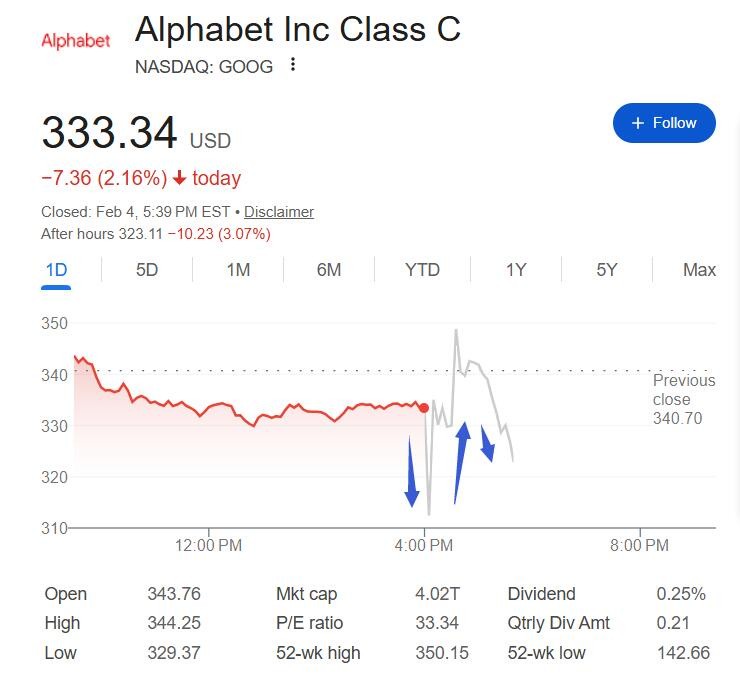
After the earnings report was released, Alphabet's stock price initially plummeted, dropping 7.5% in after-hours trading, with a market value evaporating by about $350 billion, before rebounding to rise over 4%. The market value fluctuated dramatically by about $800 billion within minutes, before turning down again. The stock price volatility reflects investors' mixed feelings about the company's AI strategy.
As the synergistic effects of Google's Gemini 3.0 and TPU chips gradually become apparent, the market may be underestimating the growth potential of this year's search and cloud businesses. Google is accelerating the reshaping of its business, striving to maintain user habits of using the search page in the face of competitors like OpenAI, and these efforts are beginning to yield results. However, to justify the high expenditures, Alphabet still needs to demonstrate momentum in its cloud computing and search advertising businesses. The company also faces risks from competitors like OpenAI rapidly iterating and entering the advertising market.
The financial report shows that Alphabet's revenue in the fourth quarter grew by 18% year-on-year to $113.8 billion, setting a new quarterly record following the first quarter of over $100 billion in the third quarter, exceeding analysts' expectations of $111.4 billion by more than 2%. Earnings per share (EPS) were $2.82, maintaining a year-on-year growth rate of over 30%, exceeding analysts' expectations of $2.65 by more than 6%.
Google's cloud business became the biggest highlight of Alphabet's fourth-quarter performance, with business revenue soaring by 48% year-on-year to $17.7 billion, exceeding analysts' expectations of $16.2 billion by more than 9%. This growth was primarily driven by surging demand for enterprise AI infrastructure, enterprise AI solutions, and core Google Cloud platform products. Alphabet disclosed that by the end of 2025, Google Cloud's annualized revenue will exceed $70 billion.
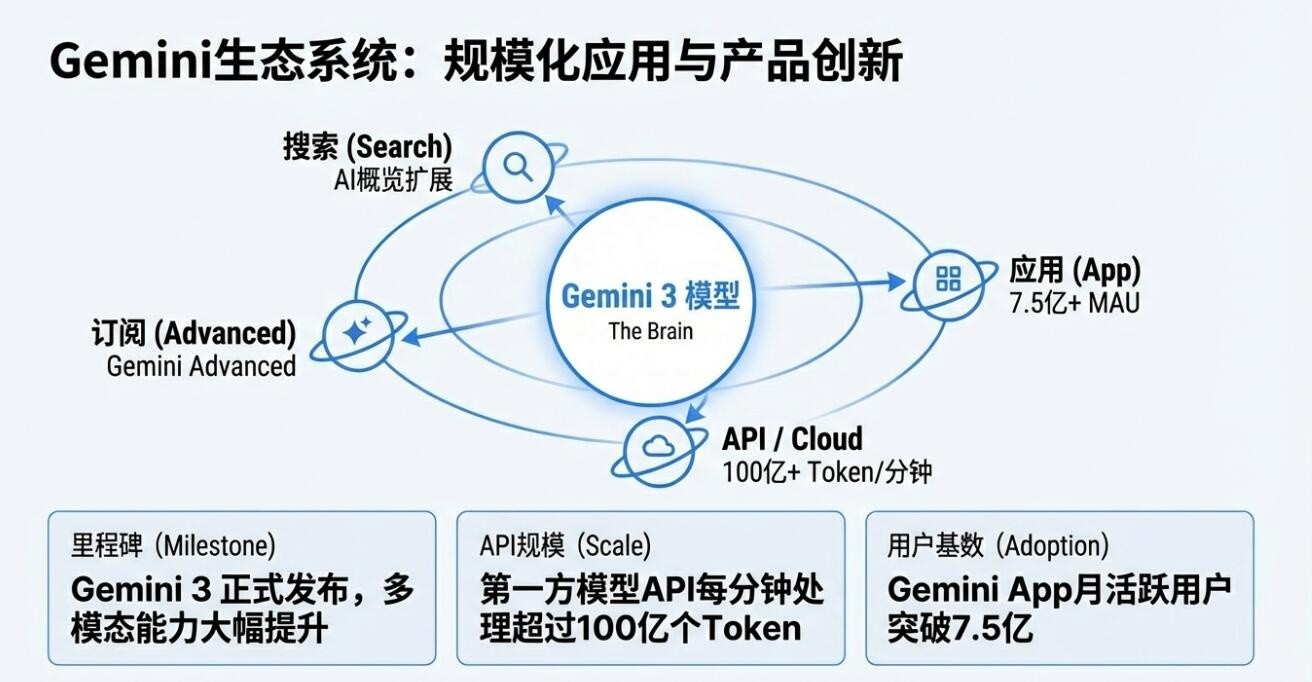
Alphabet CEO Sundar Pichai stated that the company's "AI investments and infrastructure are driving revenue and growth across all business lines," and the high capital expenditure in 2026 will help the company "meet customer needs and seize future growth opportunities." Pichai also emphasized that the release of the AI large model Gemini 3 is an important milestone, with monthly active users of the Gemini application exceeding 750 million in the fourth quarter, up from 650 million in the third quarter
Revenue Accelerates Again, Profit Margin Remains High Even After Including One-Time Compensation for Waymo
Alphabet's fourth-quarter revenue grew 18% year-on-year to $113.8 billion, slightly accelerating from the 16% growth in the third quarter, with a 17% increase on a constant currency basis, indicating that growth was not primarily driven by favorable exchange rates. Excluding Traffic Acquisition Costs (TAC), revenue for the quarter grew 19% to $97.2 billion, surpassing the expected $95.2 billion.
Fourth-quarter EPS was $2.82, a year-on-year growth of 31%, slightly lower than the approximately 35% growth in the third quarter, but still significantly above market expectations.
In terms of profit margin, Alphabet's operating profit for the fourth quarter grew 16% year-on-year to $35.9 billion, with an operating margin of 31.6%, unchanged from the same period in 2024. Although this figure was slightly below the market expectation of 33.1%, it is noteworthy that the operating profit included a one-time expense of $2.1 billion for Waymo employee compensation. Excluding this item, both operating profit and margin would exceed expectations.
The consolidated operating margin maintaining a high level of 31.6% reflects Alphabet's strong profitability while significantly increasing its investment in AI.
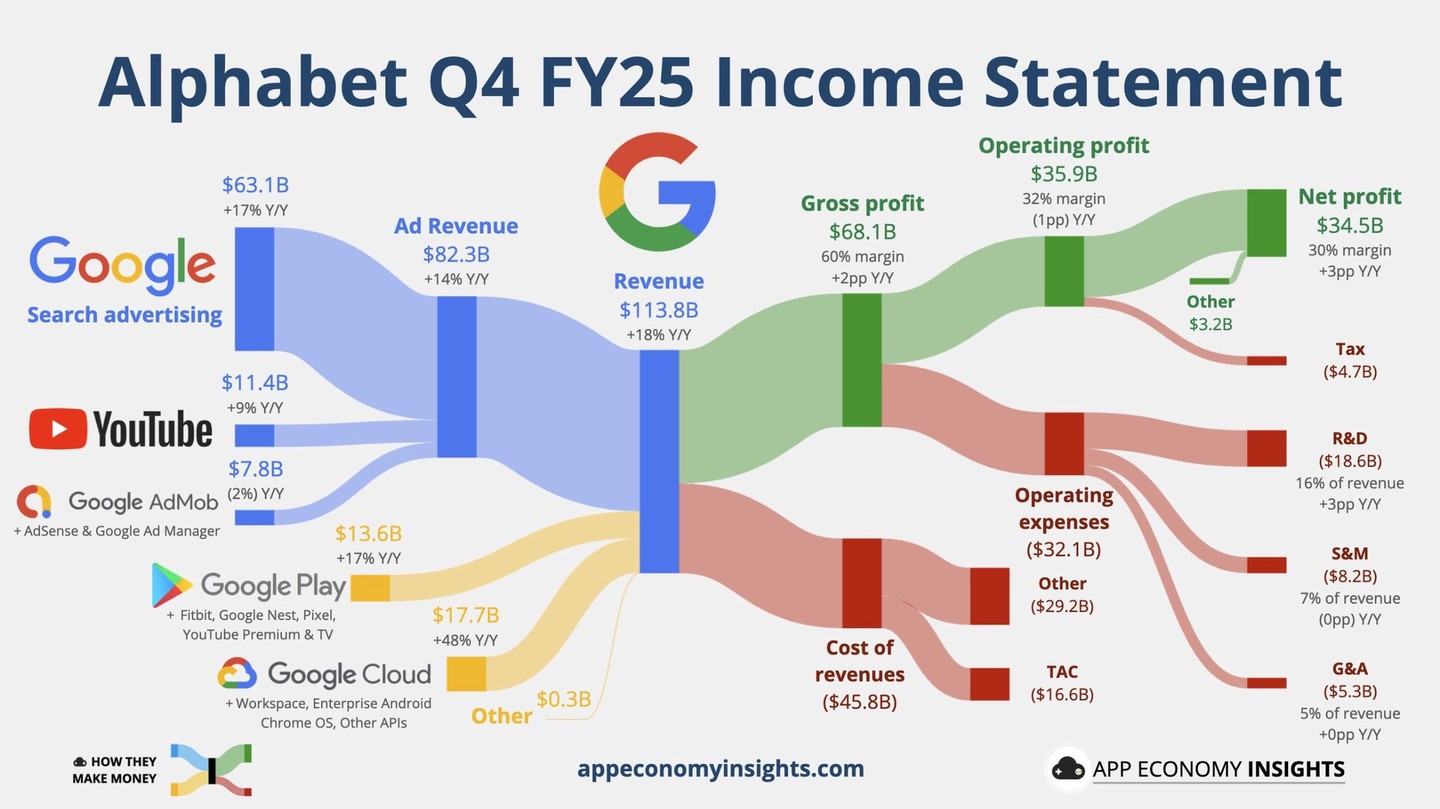
Despite a surge in R&D investment and the inclusion of Waymo's one-time compensation expense, the operating margin remains high, indicating that the profit contributions from search and cloud businesses offset the pressure from increased expenditures.
Net profit for the fourth quarter grew 30% year-on-year to $34.5 billion, attributed not only to operational improvements but also to a contribution of $3.18 billion from "other income."
Within other income, fair value changes in equity investments brought about approximately $2.3 billion in gains. This reflects the revaluation returns from Alphabet's holdings in non-public companies such as SpaceX and Anthropic. The company also noted that this item could significantly impact future periods' other income and EPS due to market fluctuations.

AI Investment Leads to 42% Surge in R&D Expenses, Waymo Drags Down Profit
The cost and expense figures present a clear signal of Alphabet's full commitment to AI. The company's operational loss expanded from $2.8 billion a year ago to $5.89 billion, far exceeding analysts' expected loss of $3.6 billion.
This figure reflects the company's large-scale R&D investment in the AI field. R&D expenses surged 42% year-on-year in the fourth quarter, primarily due to shared AI development-related costs The operating loss of Other Bets expanded to $3.62 billion, three times the loss of $1.2 billion a year ago, far exceeding analysts' expected loss of $1.3 billion. This was mainly due to a one-time employee compensation expense of $2.1 billion from the autonomous driving business Waymo. This expense significantly dragged down the overall operating profit performance.
The cost of customer acquisition was $16.6 billion, a year-on-year increase of 12%, slightly higher than the expected $16.2 billion. The total number of employees in the company was 190,800, a year-on-year increase of 4.1%, slightly below expectations.
In other words, Google's search and cloud are "making money," but the company is also investing more concentratedly in general AI and cutting-edge projects.

Performance of Various Business Lines: Cloud Computing Leads, Advertising Grows Steadily
Google Cloud became the brightest star this quarter, with revenue soaring 48% year-on-year to $17.7 billion, exceeding analysts' expectations of $16.2 billion and accelerating from a 34% growth rate in the third quarter.
The operating profit of the cloud business in the fourth quarter reached $5.3 billion, 2.5 times the profit of $2.1 billion a year ago, far exceeding analysts' expectations of $3.7 billion. This growth was mainly driven by strong demand from enterprise customers for AI infrastructure and AI solutions. The company disclosed that Google Cloud's annualized revenue at the end of 2025 has exceeded $70 billion.

Google Services revenue was $95.9 billion, a year-on-year increase of 14%, slightly above the expected $94.9 billion. Among them, advertising revenue totaled $82.3 billion, a year-on-year increase of 14%, exceeding the expected $80.9 billion. The advertising revenue structurally showed "strong search, platform differentiation":
- Search and other business revenue was $63.1 billion, a year-on-year increase of 17%, exceeding analysts' expectations of $61.4 billion, still the core engine driving total revenue. Alphabet's management stated that search usage reached an all-time high and emphasized the AI-driven "expansionary moment," reflecting demand expansion.
- YouTube advertising increased 9% year-on-year to $11.38 billion, with growth slower than search and below analysts' expectations of $11.78 billion, reflecting the ongoing impact of brand advertising and macro rhythms.
- Google Network revenue declined 1.6% year-on-year to $7.83 billion, showing that the monetization pressure from external website affiliates has not completely dissipated, but it was higher than analysts' expected $7.78 billion.
Subscription, platform, and device business revenue was $13.6 billion, a year-on-year increase of 17%, slightly below the expected $13.8 billion. The company disclosed that YouTube's total annual revenue (including advertising and subscriptions) has surpassed $60 billion, with the total number of consumer service paid subscriptions exceeding 325 million, mainly driven by Google One and YouTube Premium Revenue from other betting businesses was $370 million, a year-on-year decrease of 7.5%, nearly 16.7% lower than the analyst expectation of $444 million.

Capital Expenditure Soars, 2026 Guidance Exceeds Expectations by Over 50%
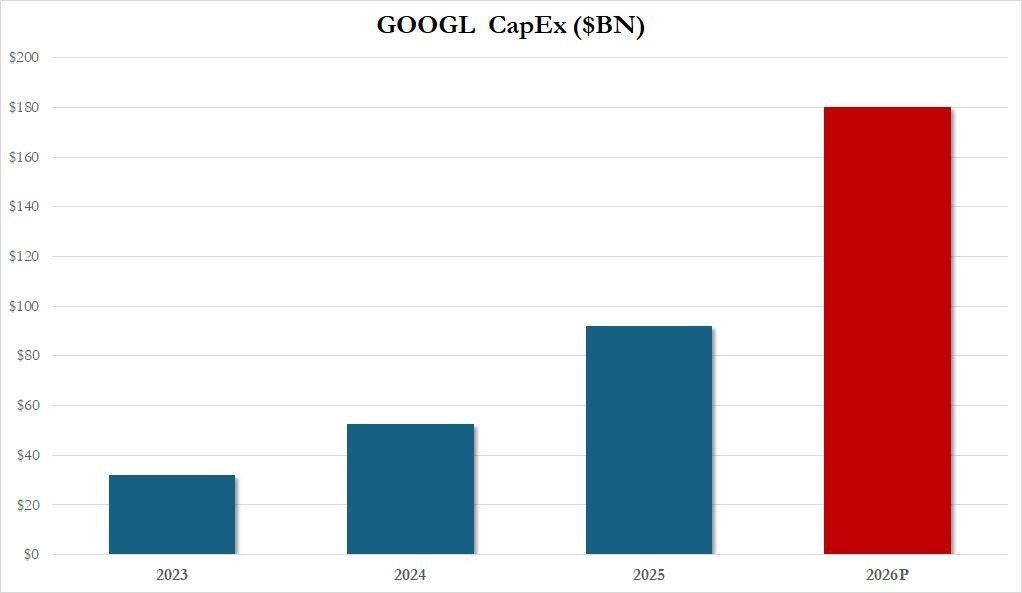
What truly shocked the market was Alphabet's capital expenditure data. In the fourth quarter, capital expenditure was $27.9 billion, nearly doubling from $14.3 billion in the same period last year, but slightly below the market expectation of $28.2 billion. For the entire year of 2025, capital expenditure reached $92 billion, with fourth-quarter spending accounting for 30% of that, exceeding the average quarterly spending level of $23 billion.
Even more striking was the spending guidance provided by Alphabet for 2026. Alphabet announced that capital expenditure is expected to be between $175 billion and $185 billion in 2026, with a median of $180 billion, nearly double that of 2025, and exceeding the market expectation of $119.5 billion by over $60 billion, nearly 51% higher than expected.
CEO Pichai explained in the earnings report, "We see AI investments and infrastructure driving revenue and growth across all business lines. To meet customer demand and seize the growing opportunities ahead, we expect capital expenditure investments in 2026 to be between $175 billion and $185 billion."
This astonishing spending guidance reflects Google's determination to go all in on the AI arms race. The company received market recognition following the release of the Gemini 3 AI model, which outperformed competitors in benchmark tests and even prompted rival OpenAI to declare a "code red." Coupled with a milestone partnership agreement with Apple, Alphabet has solidified its leading position in the AI competition.
Influenced by Meta's significant increase in spending guidance, analysts had already raised their expectations for Alphabet's capital expenditure this year before the earnings report was released. This high-intensity investment has become a focal point for the market.
Last week, Microsoft, which reported earnings, faced sell-offs due to slowing growth in its cloud business combined with high AI spending, while Meta proved the rationale for its spending with strong revenue prospects. Tim Ghriskey, a senior portfolio strategist at Ingalls & Snyder, believes that Alphabet's situation may be more like Meta's; as long as new products emerge and growth remains high, investors will be confident in accepting aggressive spending plans
