


With the Japanese election approaching, the Liberal Democratic Party is likely to achieve an "overwhelming victory," and hedge funds have already shorted the yen in advance!

Barclays report indicates that the Liberal Democratic Party is expected to win an overwhelming victory in the current House of Representatives election, and "high market trading" may occur in the short term. Meanwhile, hedge funds are refocusing on arbitrage trading and positioning to short the yen. However, Barclays believes that even if they win, the new government's fiscal expansion space will be limited due to pressure from the United States and yen depreciation, and they may be forced to return to fiscal discipline. The Bank of Japan is expected to raise interest rates in the future to stabilize the exchange rate, and the medium to long-term yield curve is likely to "distort and flatten." The dollar against the yen will also face intervention resistance above 150, making a full return to this trade difficult
The Liberal Democratic Party of Japan is expected to win an overwhelming victory in the House of Representatives election on February 8, and the "Kishida trade" is stirring!
According to the Wind Trading Desk, Barclays' latest report indicates that the Liberal Democratic Party of Japan is about to win an overwhelming victory in the House of Representatives election on February 8, but the market's expectation for the "Kishida trade" (i.e., stock rises driven by fiscal expansion, yen depreciation, and a steepening interest rate curve) is already very limited. According to Xinhua News Agency, Japanese Prime Minister Fumio Kishida stated at a press conference on January 19 that the House of Representatives election will be held on February 8, and the current term of the members of the House of Representatives is originally set to expire in October 2028.
The report believes that a significant victory in the election may actually compress the room for fiscal easing, as the continued weakness of the yen and political pressure from the United States will force the Kishida government to shift towards fiscal discipline. In terms of monetary policy, although the government tends to maintain easing, it will have to accept the Bank of Japan's shift to interest rate hikes under pressure from exchange rates and inflation. In the medium to long term, the yield curve of Japanese government bonds may show a "distorted flattening" pattern, while the dollar-yen exchange rate will face a clear policy intervention ceiling above the 150 range.
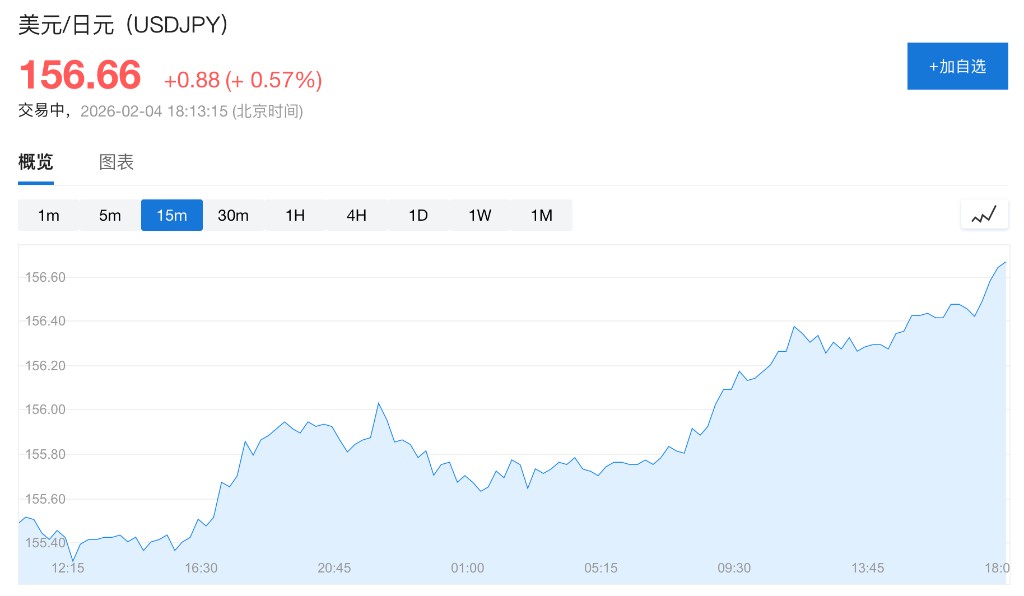
In contrast to this view, as the election approaches, actual trading still shows a short-term enthusiasm for the "Kishida trade," and the market has begun to position for a weaker yen. On Wednesday, the dollar-yen exchange rate rose to the mid-range of 156-157, reaching a nearly two-week high. Prime Minister Fumio Kishida has recently publicly stated that a weaker yen is beneficial for the economy, coupled with polls showing that his party is expected to win an absolute majority of seats, further strengthening market expectations for increased fiscal stimulus policies after the election.
The options market has already reflected this change in expectations. Data shows that on Tuesday, the trading volume of call options for the dollar-yen significantly exceeded that of put options, with a single-day trading volume exceeding $100 million, and this trend continued during the Asian session on Wednesday. As bullish demand rises, the one-month dollar-yen risk reversal indicator has fallen to a nearly two-week low, indicating a relative weakening in the demand for hedging against exchange rate downside risks.
Antony Foster, head of G-10 spot trading at Nomura International, pointed out that as speculative sentiment in the precious metals market gradually fades, hedge funds are refocusing on arbitrage trading and the "Kishida trade" logic. He stated:
"If Fumio Kishida wins a landslide victory in the election, market expectations for further increases in the dollar-yen exchange rate will be strengthened."
Election Outlook: The Liberal Democratic Party Moves Towards "Absolute Stable Majority"
The Barclays report points out that the current election situation for the House of Representatives in Japan is showing a highly clear one-sided trend. Recent surveys from several mainstream news agencies indicate that the ruling Liberal Democratic Party is expected to win more than half of the seats in this election alone.
The key goal is that the ruling coalition is even expected to reach the threshold of "absolute stable majority" with 261 seats in the House of Representatives. If this goal is achieved, the ruling coalition will have the right to hold the chair positions of all committees in the House of Representatives and occupy the majority of seats in each committee, thus fully controlling the pace of legislative agenda advancement
The latest polling data further strengthens this expectation. Although the support rate for the Koizumi cabinet fell slightly from 75% in December to 67% in January, it remains at a high level; meanwhile, the Liberal Democratic Party's (LDP) party support rate has risen to 42%, indicating a relatively solid voter base. 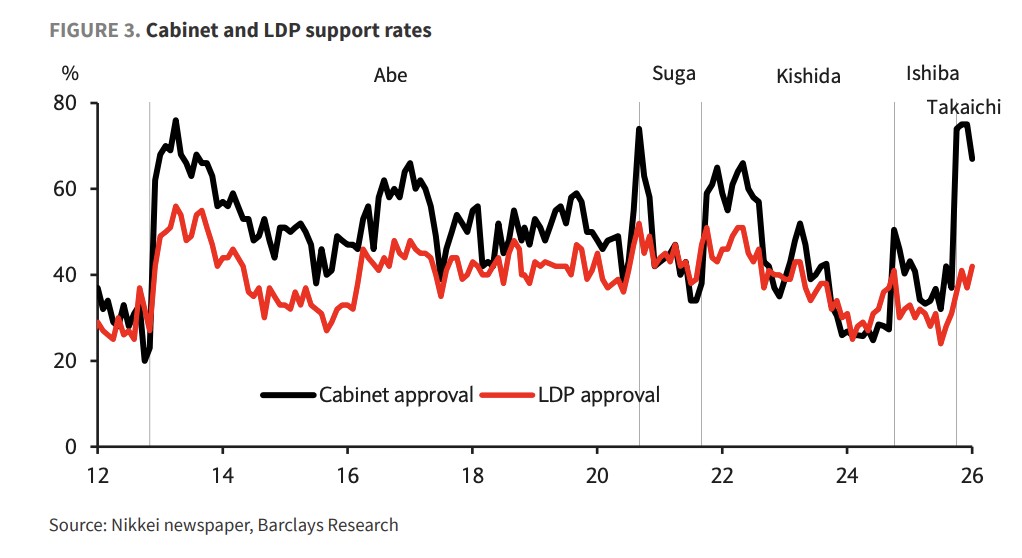
Although some voters have yet to clearly express their stance, market expectations have increasingly converged, with a general belief that the "LDP's overwhelming victory" will become the final result of this election, and the related political pricing is gradually reflected in asset prices.
Core Scenario: Policy Logic Restructuring After a Major Victory
Fiscal Constraints: External Pressures and Market Reactions Will Limit Expansion Intentions
Barclays analysis points out that if the LDP wins a landslide victory in the election, the Koizumi government is expected to initially promote more aggressive fiscal policies, including discussions on establishing a "National Committee" to study measures such as temporarily exempting food consumption tax. However, the actual fiscal expansion space will be significantly constrained, especially as further tax reduction measures may be difficult to implement.
Key constraints come from external factors. In the exchange rate report released by the U.S. Treasury on January 29, it explicitly listed "the new Japanese government may adopt more expansionary fiscal policies" as a core driver of yen weakness. This marks a shift in U.S. focus from Japanese monetary policy to its fiscal path, with the potential for expansion without fiscal discipline possibly triggering a clear counteraction from the U.S.
There are also obstacles on the internal implementation level. Taking the consumption tax reduction as an example, its scale is expected to reach about 5 trillion yen, facing significant practical challenges and revenue issues in execution. Barclays judges that this measure is likely to be postponed until the fiscal year 2027 or later, and even if it is ultimately implemented, the scale may be reduced.
It is noteworthy that changes in the political landscape may instead reinforce fiscal discipline. If the LDP reduces its reliance on the opposition due to an overwhelming victory, it will have more political space to pursue a more sustainable fiscal path when facing market pressures.
Monetary Policy: From Political Pressure to Realistic Compromise
In terms of monetary policy, although the new government may initially pressure the Bank of Japan to maintain stable interest rates, market reactions will quickly become the decisive force. If the yen weakens again due to policy differences and yields rise, it will force the government to adjust its stance.
The report indicates that the government will ultimately have to return to a position of "passively accepting interest rate hikes" to cope with the pressure of excessive yen depreciation and maintain stability in the macro economy and financial markets.
Market Outlook: Trading Rhythm and Key Levels
In the interest rate market, it is shifting from short-term steepening to medium-term flattening. Following the announcement of the election results, the interest rate market is expected to continue the "Koizumi trading" logic, showing a short-term steepening trend, particularly reflected in the rise of ultra-long-term bond yields. However, as the fiscal policy path becomes clearer, the market will gradually shift its focus to the sustainability of monetary policy tightening. Barclays pointed out that as the fiscal risk premium gradually diminishes due to reduced political constraints, and the Bank of Japan continues its interest rate hike cycle, the yield curve will enter a "distorted flattening" phase, where the upward pressure on short-term rates exceeds that on long-term rates. Currently, some large domestic life insurance companies in Japan have indicated that the current yield levels possess allocation value, and it is expected that institutional buying of ultra-long-term bonds will gradually return after fiscal uncertainties dissipate.
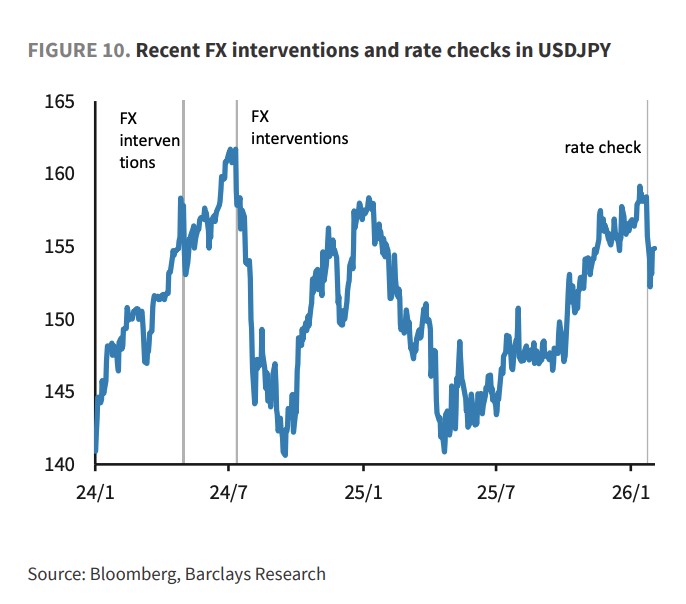
From the foreign exchange market perspective, the yen faces multiple constraints on its downside. Although the election results may trigger a short-term weakening of the yen, further depreciation space is limited. Barclays believes that the USD/JPY exchange rate will face significant resistance in the high range of 150. Key intervention alert levels include: 159, where Japanese authorities previously conducted exchange rate checks, the important psychological level of 160, and the 2024 peak of 162. From a fundamental perspective, Barclays' model estimates the fair value of USD/JPY to be at the high end of the 140 range, but considering the short-term impact of "high market premiums," it is expected that the exchange rate will find support around 150, forming the lower boundary of the recent volatility range.
Tail Risk Scenarios
Scenario Two: The Liberal Democratic Party narrowly wins with a slim majority
If the Liberal Democratic Party only secures a slim majority, the implementation of the high market government's policies will be significantly constrained. To maintain governing stability, the government may be forced to compromise on fiscal policy with the opposition, including adopting proposals to raise income security thresholds and stabilize energy prices, thereby prolonging fiscal expansion pressures.
At the market level, initially, there may be a mild unwinding of "high market trades," characterized by a slight decline in yields and a gradual appreciation of the yen. In the medium to long term, ongoing fiscal uncertainties will trap the market in a wide-ranging oscillation pattern, making it difficult to form a clear trend direction.
Scenario Three: The Liberal Democratic Party loses and the Reform Alliance governs
Once the center reform alliance led by the Constitutional Democratic Party comes to power, the political landscape will face high instability. This alliance tends to implement fiscal expansion policies centered on redistribution but lacks stable and reliable revenue support. In terms of monetary policy, it will respect the independence of the Bank of Japan more and may more proactively accept interest rate hikes to address inflation pressures.
As a result, the market will experience significant structural changes: "High market trades" will be rapidly and significantly unwound, leading to pressure on the stock market and a rapid strengthening of the yen. However, due to serious concerns about fiscal sustainability, the term premium on long-term government bonds may face an upward risk of about 30 basis points, pushing ultra-long-term yields sharply higher. In terms of exchange rates, the yen may enter a depreciation channel again after experiencing short-term appreciation due to deteriorating fiscal prospects.
The above exciting content comes from [Chasing Wind Trading Platform](https://mp.weixin.qq.com/s/uua05g5qk-N2J7h91pyqxQ)
For more detailed interpretations, including real-time analysis and frontline research, please join the【 [Chasing Wind Trading Platform ▪ Annual Membership](https://wallstreetcn.com/shop/item/1000309)】.
