


Is the gold bull still on? Analysts: The previous two bull markets experienced multiple significant corrections, and declines present good opportunities to increase positions

Analysts point out that despite last week's historic single-day plunge in gold prices, this is merely a typical technical correction in a long-term bull market. Major gold bull markets since 1971 have experienced multiple significant corrections, and the current decline actually provides investors with a rare opportunity to increase their holdings. The core logic supporting the long-term strength of gold—geopolitical uncertainty, continued central bank gold purchases, and expectations of a weaker dollar—has not changed
Despite experiencing a historic plunge last week, market observers believe that the bull market in gold is far from over. Analysts generally view the recent volatility as a temporary pullback within a long-term upward trend rather than a structural reversal, and historical data indicates that such corrections often present opportunities to re-enter the market.
The precious metals market has recently undergone significant fluctuations. After soaring 66% throughout 2025 and continuing into early 2026, gold prices faced a sharp decline last Friday, dropping nearly 10% in a single day, which also dragged down silver, palladium, and platinum significantly. The catalyst for this sell-off was the nomination of Waller as the next Federal Reserve Chairman, with the market interpreting this news as alleviating previous concerns about the Fed's independence. This marked the most severe single-day drop for gold in 13 years.
However, the market quickly entered a recovery mode. As investors reassessed the situation, spot gold rebounded strongly by over 6% on Tuesday, closing around $4,946.81 per ounce. The rebound momentum continued into Wednesday morning, and as of 3:45 AM Eastern Time, spot gold rose about 3% to $5,079.4, while New York gold futures surged 3.3% to $5,093.80.
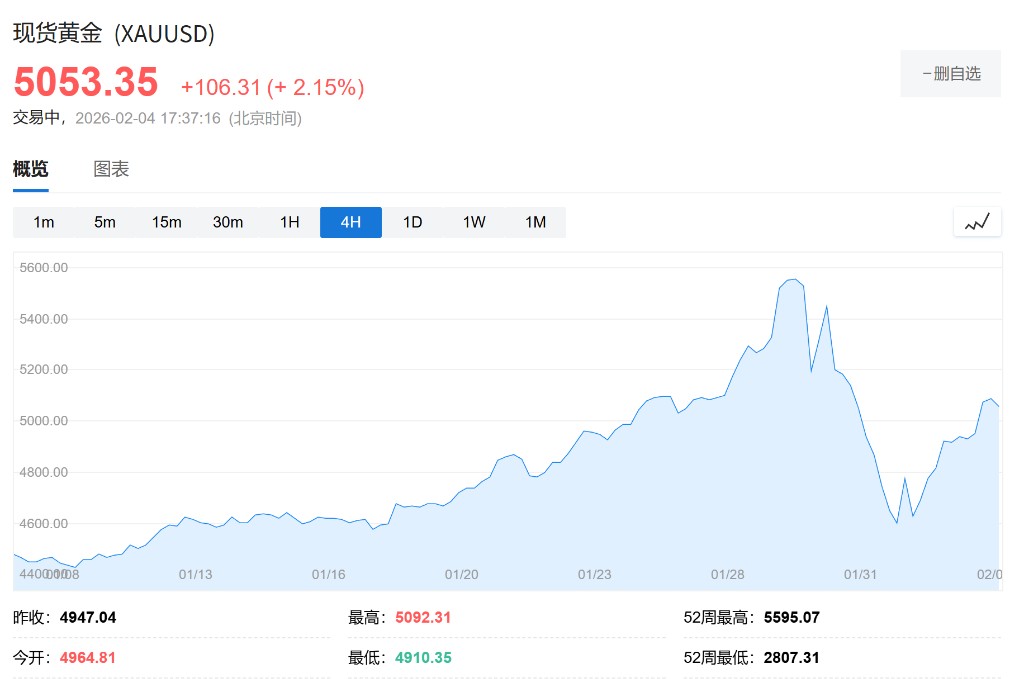
Institutional strategists pointed out that despite signals flashing "overvalued" on the screen, the geopolitical tensions, trade policy uncertainties, and concerns over debt that support gold prices have not dissipated. Several investment banks' analyses indicate that the current decline has not undermined the long-term investment logic and may actually represent a buying opportunity in this historic bull market.
History Repeats: Pullbacks Are Normal in a Bull Market
AJ Bell's Investment Director Russ Mould noted in a report on Monday that gold is currently in its third major bull market since 1971, with the previous two bull markets having experienced multiple significant pullbacks.
Mould analyzed that the bull market from 1971 to 1980 began when President Nixon severed the dollar's link to gold, followed by a surge in U.S. deficits, oil shocks, and soaring inflation, causing gold prices to rise from $35 per ounce to a peak of $835 in 1980. According to data from AJ Bell and LSEG, gold prices experienced multiple declines during this period, with the longest "adjustment period" lasting 105 days and the most severe drop reaching 19.4%.
Similarly, during the bull market from 2001 to 2011, data recorded five price corrections, each with declines of up to 16%. Mould believes the current bull market began in 2015 and had already undergone five corrections before last Friday's pullback, including a drop of over 20% in 2022. He emphasized that geopolitical uncertainties, stubborn inflation, and soaring government debt form the cornerstone of gold investment, stating, "Since these issues have not changed compared to last week, this sudden drop may be an opportunity to increase holdings."
Central Bank Demand and Valuation Premium
George Cheveley, portfolio manager of the natural resources team at global investment management firm Ninety One, told CNBC that from a historical perspective, gold's current strength is more in line with a late-cycle environment rather than the early stages of a speculative rebound. However, he added that there is a key differentiating factor in this cycle: the scale and persistence of central bank demand.
Cheveley stated in an email that central bank demand has become a more important market driver than ever before, providing structural support that was lacking in previous historical periods. Although data from the World Gold Council shows that net purchases of gold by central banks are expected to decrease from 345 tons in the previous year to 328 tons in 2025, Cheveley believes that as long as real yields remain low and uncertainties surrounding growth, debt, and geopolitics persist, gold will remain resilient.
Barclays strategists also noted in a report on Tuesday that although models indicate gold is "overvalued" relative to a fair value of about $4,000, this premium appears to be durable and does not indicate a bubble. They pointed out that historical cycles suggest that price mismatches with fair value can persist for years, with inflation, U.S. policy issues, and the long-term depreciation trend of the dollar supporting elevated gold prices.
The Federal Reserve's Credibility is Not the Only Ending Signal
UBS's Chief Investment Office pointed out in a report titled "Not the End" on Monday that gold bull markets typically do not end merely because fear subsides or prices are too high; they only end when central banks rebuild credibility and shift to new monetary policy mechanisms.
UBS analysis noted that the severe monetary policy implemented by Paul Volcker in 1980 effectively restored the credibility of the Federal Reserve, leading to a significant rise in real interest rates and a long-term appreciation of the dollar, thereby ending the gold bull market at that time. However, UBS strategists believe that since Kevin Warsh has not demonstrated the same level of credibility as Volcker, the current sell-off does not signal the end of the bull market. Over the past year, the dollar index has fallen more than 10%, reflecting market concerns about central bank independence and the White House's policy mix.
The UBS team believes that gold is currently in the mid-to-late stage of this bull market, transitioning from a sustained upward trajectory to a phase of continuous new highs accompanied by intermittent pullbacks of 5-8%. The report emphasizes that typical factors that would end a gold bull market—persistently high real interest rates, structurally strengthening dollar, geopolitical improvements, and fully restored central bank credibility—are currently absent. UBS predicts that gold prices will reach $6,200 next month, before falling back to $5,900 by the end of the year.
