


The biggest impact of AI on SaaS currently: AI is not consuming your product in terms of functionality, it is consuming your budget financially

The impact of AI on SaaS is not to replace products functionally, but to weaken budgets financially. Software stocks have fallen into a bear market, and market panic has intensified, with companies like ServiceNow and Microsoft seeing significant declines in stock prices. Despite claims that "AI agents are killing SaaS," the core value of enterprise software lies in long-term scalability, compliance, and maintenance, which AI cannot replace in the short term
Software stocks have just fallen into a bear market, and the market is in disarray.
The industry benchmark IGV has plummeted 22% from its peak, and last Thursday marked the most severe single-day decline in the software industry since the outbreak of the COVID-19 pandemic. Amid the panic, even the "top students" are not spared—ServiceNow, despite exceeding expectations for the ninth consecutive quarter, saw its stock price plummet by 11%; tech giant Microsoft also could not escape, with a single-day market value evaporating by as much as $360 billion.
In the face of such a grim situation, there is a common explanation circulating:
"AI agents are killing SaaS."
The emergence of new concepts like Claude Cowork and Vibe coding seems to announce the impending end of the enterprise software era we are familiar with.
But in reality, this line of thinking is fundamentally flawed.
01. Vibe coding has not killed Salesforce
In reality, almost no one is going to manually build a makeshift CRM on Replit to replace their running Salesforce.
In the past few months, Jason, the founder of SaaStr, has built over 10 applications using Vibe Coding, with usage exceeding one million, ranking in the top 0.1% on Replit. Projects that previously took the team six months can now be completed in just a few days.
But none of this can replace enterprise-level SOR systems (System of Record).
The biggest blind spot of the "Vibe coding threat" argument is that releasing a v1 version only accounts for 2% of the total workload in software engineering.
Even if someone really "cobbled together" a prototype of Salesforce over the weekend, what about the remaining 98%? Who will maintain and iterate it? Who will handle security audits? Who will integrate with the 500+ upstream and downstream tools of the enterprise?
The moat for building enterprise software lies not in "writing it out," but in long-term scalability, compliance, and maintenance. This is the barrier that Salesforce has accumulated over 20 years, and it is a gap that AI cannot cross in the short term.
Therefore, the argument that "agents are killing SaaS" sounds appealing, but in reality, it is a lazy way of thinking that cannot withstand scrutiny from practical operational logic.
The harsh truth is only one:
SaaS has not been "killed" by AI; it is simply being "starved" by budgets.
02. The truly important numbers
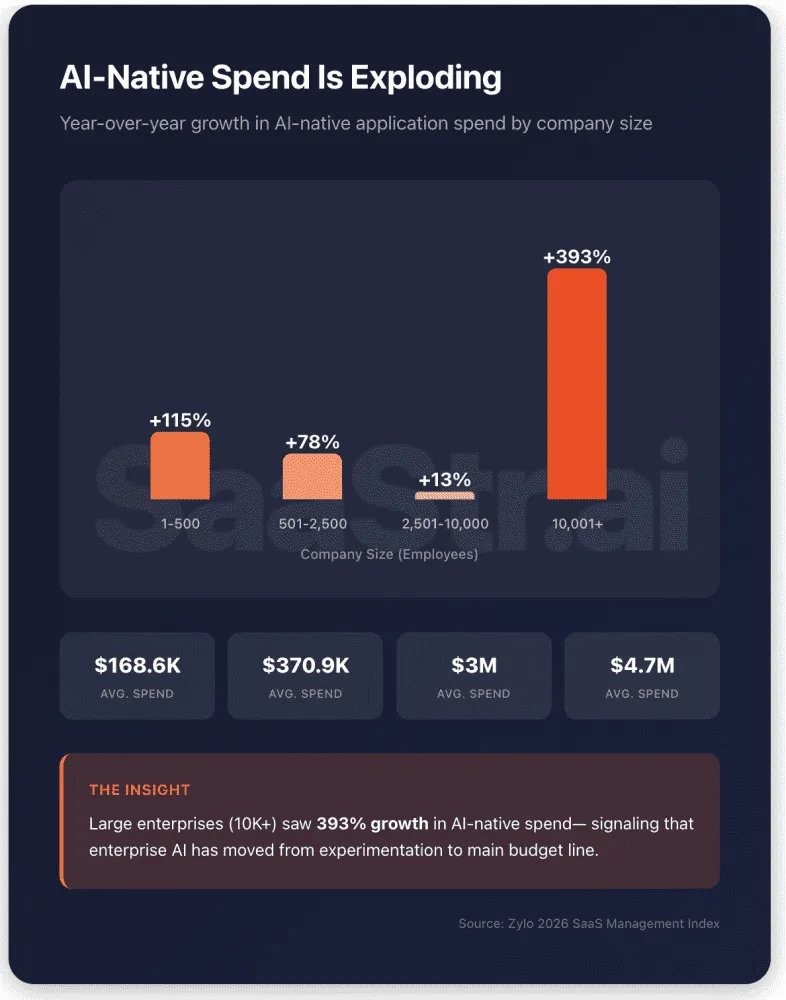
The current state of the enterprise IT field can be summarized with a set of very intuitive numbers:
- AI budget: Over 100% year-on-year (YoY) growth;
- Overall IT budget: Only about 8% growth;
- Number of applications: Remains flat, no longer increasing;
- Net new customers: Showing a downward trend;
- Seat count: Under significant pressure for reduction This calculation is quite simple: when companies double their budget for AI (an increase of over 100%), while the overall IT budget only grows moderately by 8%, where does the huge amount of money allocated to AI come from?
It cannot be created out of thin air; rather, it is squeezed out from the budget that originally belonged to traditional SaaS:
It comes from cutting seat fees (buying fewer accounts), stopping new application purchases, shrinking expansion deals, and those budgets that were previously used to drive growth through “adding another feature module.”
AI has not consumed your product functionally; it has consumed your budget financially.
03. Growth has been declining since 2021
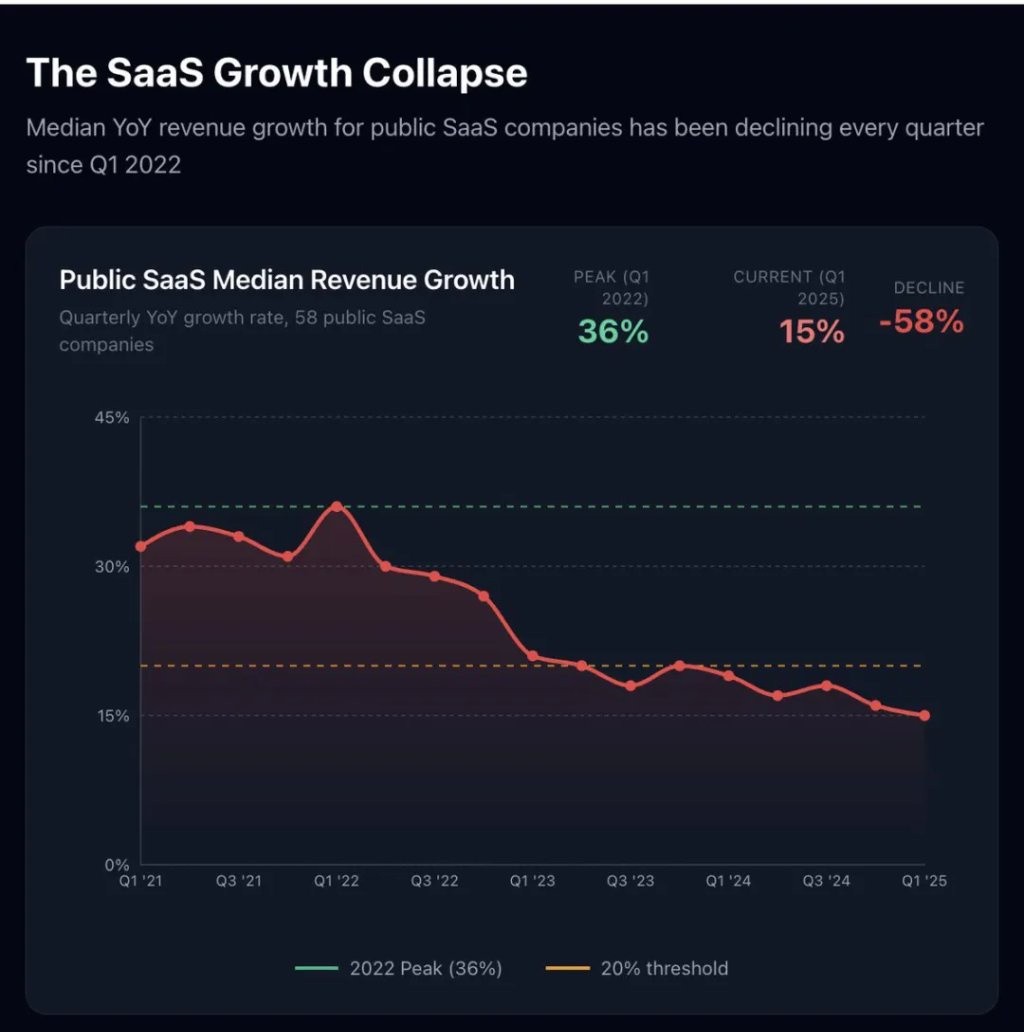
Here is a truth that the industry deliberately avoids: since the peak in 2021, the growth rate of SaaS companies in the secondary market has been declining every quarter.
This has been the case every quarter.
This is not new. The so-called “AI causing the crash” is merely an opportunity for the market to finally wake up and re-examine the data that has been screaming for three years.
Peeling back the packaging of financial reports, you will find that the so-called “growth” today mostly comes from:
- Price increases on existing contracts;
- Deepening and expanding existing customers;
- Not from net new customers.
To put it bluntly: this is not growth; this is harvesting.
The capital market is very realistic: the valuation multiples given to the “harvesting model” are worlds apart from those given to the “high growth model.”
Therefore, the decline in 2026 is not because AI murdered SaaS, but because the market has finally begun to reprice late for the growth decline that had already started in 2021.
The “crash” in the SaaS industry is not a first-time experience.
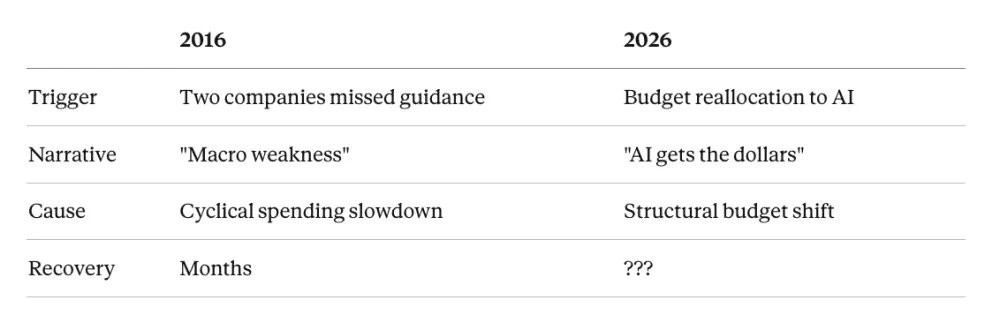
In February 2016, LinkedIn plummeted 44% in a single day, Tableau dropped 50%, and Salesforce also fell by 13%. At that time, the entire software sector was in disarray.
Everyone was panicking, but just a few months later, the SaaS industry rebounded. Microsoft even spent $26 billion to acquire LinkedIn four months later (although in hindsight, LinkedIn, which was highly profitable at the time, had no reason to sell itself then). Subsequently, the market surged until 2021 But the situation back then is different from this year:
The crisis in 2016 was cyclical, while that in 2026 is structural.
In 2016, CIOs simply tightened budgets temporarily, leading to a slowdown in corporate spending. However, the products themselves were not the issue—companies still needed CRM, still relied on data analysis, and still required collaboration tools. The core game during that collapse was about “when to buy” rather than “whether to buy.”
But by 2026, the problem has changed. The question is no longer whether companies will spend money on software, but rather:
Will they continue to spend money on your software—or will they reallocate that budget to buy AI?
04. The Five Forces Pressuring SaaS
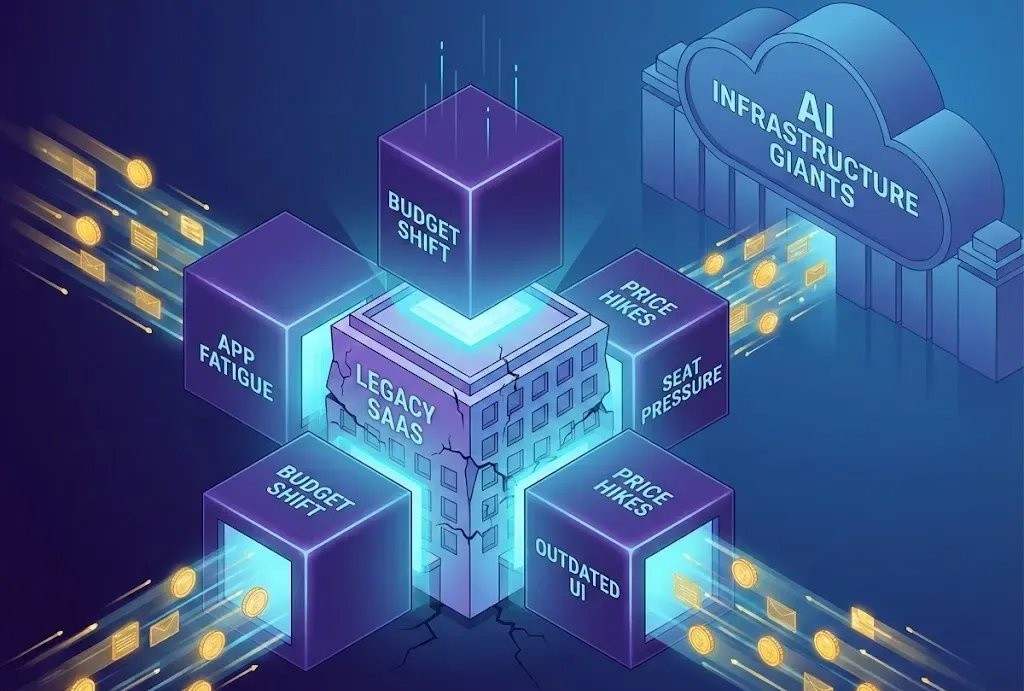
#1: Budget Reallocation
Every dollar a company spends on AI infrastructure, AI tools, or AI personnel means one less dollar spent on purchasing seats from Salesforce, modules from Workday, or components from ServiceNow.
Meta announced this year that its AI capital expenditures could reach $135 billion, while Microsoft spends $75 billion annually. Just among the major cloud service providers, investments in AI infrastructure will exceed $470 billion by 2026.
This money has to come from somewhere, and a significant portion is being reallocated from corporate software budgets.
#2: No One Wants More Applications
“Application fatigue” is a real phenomenon. CIOs are busy integrating resources rather than expanding purchases.
Today's companies want to reduce the number of vendors, not increase them. They want platforms, not fragmented solutions; they want to reduce complexity, not create chaos.
This trend existed before AI emerged, but AI has intensified the urgency.
#3: Seat Count Under Pressure (The Silent Killer)
As AI can perform the work of multiple people, the number of employees needed by companies decreases; with fewer employees, the number of software seats needed naturally declines.
This is a silent killer. It’s not that AI directly replaces software, but rather that AI reduces the number of employees using the software.
If 10 agents can do the work of 100 sales representatives, companies naturally no longer need to buy as many seats.
Moreover, everyone is controlling employee numbers. Shopify has maintained its employee count over the past three years while still achieving rapid growth. Microsoft’s current employee count has also surpassed its “peak.” This makes the model of driving performance through employee growth much more difficult than in the past.
#4: Much of the “growth” is actually price increases If we remove the price increase factor from the recent SaaS financial reports, what remains?
Actually, not much.
The net new customer data is broadly weak, and expansion is slowing down. The so-called "growth" mainly relies on suppliers raising prices for those locked-in old customers who cannot switch.
But this tactic will eventually lose its effectiveness. Once AI provides alternative solutions for these locked-in customers, this price increase game will no longer be sustainable.
#5: AI Makes Old Applications Seem Outdated
This point is subtle but very real. The 2019 version of SaaS applications is filled with static dashboards and manual processes, which look particularly outdated next to AI-native interfaces.
Users are now accustomed to using Claude, ChatGPT, and Copilot, and their expectations have changed. Everyone wants natural language interfaces, AI that can anticipate needs, and automation instead of manual form filling.
Most SaaS applications cannot meet these demands, and with each passing day, they appear more obsolete.
This does not mean that AI has replaced applications; rather, AI has raised the standard for "good products"—most SaaS just hasn't met the mark.
05. Key Action: Must Compete for AI Budgets
For those building B2B companies, one thing must be clear in mind:
Stop worrying about whether AI will replace this company; the real question is whether this company can get a piece of the AI budget.
The overall market pie has not grown; it is just being redistributed. If the product is not AI-native, it will be difficult to enter the core decision-making circle of enterprises; once excluded from this circle, it will be classified under "maintenance" budgets.
That represents two fundamentally different types of businesses.
Specifically, this means the following points need to be achieved:
- Sell outcomes, not seats. Companies that can secure funding now are saying, "We can free up three employees," rather than "We want to sell a few seats." Pricing based on consumption and outcomes may have been a nice-to-have in the past, but it is now a basic threshold.
- Tap into AI budgets, rather than "feeding" them. The key is whether the company is acquiring AI expenditures or if its budget is being harvested by customers to pay for AI. This is the current dividing line; it is essential to ensure you are on the right side.
- Redesign the product interface. If the product still looks like a 2019 SaaS, it will be in a precarious position. Users now expect an AI-native experience. This is not simply about adding a ChatBot to the product; it requires rethinking how work gets done.
- SoR can still survive, provided it can own or monetize the agents running on it. If it controls the data layer, the chances of success are high. Because agents need to read data from somewhere and write data to somewhere, a recording system is essential But if the product is just a UI interface, it becomes very fragile.
- Accepting the reality that growth is becoming difficult, the era of easy growth in the SaaS industry has ended, which actually concluded as early as 2021; the market is only now being forced to acknowledge this. Companies need to adjust their capital consumption, hiring plans, and psychological expectations accordingly.
06. What This Means for Investors
For investors, the core question now is no longer "Will AI eliminate this company?"
What they are really concerned about is: "Is this company actually capturing incremental AI spending, or is it digging into its own pockets to pay for AI spending?"
The winners in the market are those companies that can capture AI budgets, while the losers are those whose budgets are being harvested. This differentiation logic is happening in the secondary market and will subsequently transmit to the primary market.
Another question investors care about is: "If the current growth rate is maintained, what is the ultimate value of the company?"
Over the past three years, investors have embedded an expectation of "growth re-acceleration" in the valuations of SaaS companies that has never materialized. Now, this expectation has been shattered. The market is beginning to price based on actual growth rates rather than wishful fantasies.
Some companies can still enjoy valuation premiums, but this needs to be earned through tangible growth, not by making empty promises.
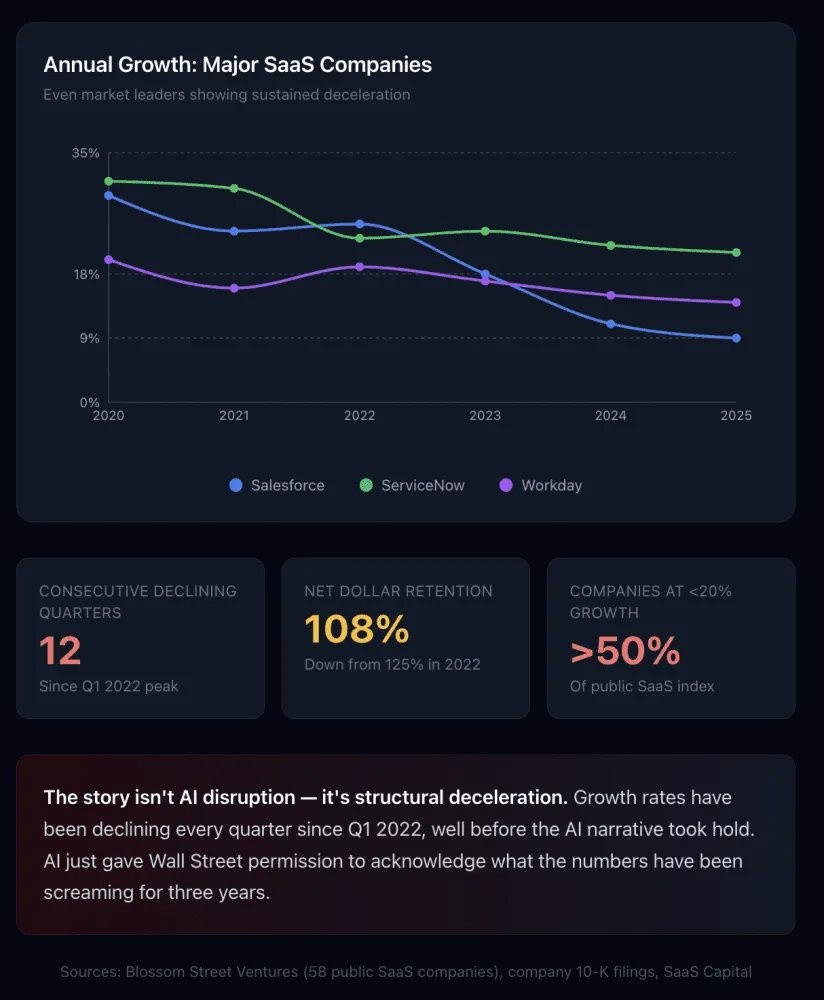
The decline of the SaaS industry in 2026 is real. But this is not because AI will replace Salesforce next quarter.
The real reason is: AI is consuming budgets, industry growth has declined for three consecutive years, and the market is finally no longer pretending not to see these issues.
Those companies that can survive and thrive are the strong ones that have adapted to the new reality:
- Capturing AI spending rather than supplying blood for AI
- Building AI-native experiences
- Mastering the data layer
- Pricing based on outcomes rather than seat-based pricing
Those companies that cannot adapt will slowly die from budget depletion and stagnant growth, ultimately losing market relevance.
This does not signify the end of the B2B industry; B2B spending is expected to reach a historical high in 2026.
However, this does mark the complete end of the "easy SaaS" era. Moreover, this trend has actually been brewing for a long time.
Risk Warning and Disclaimer
The market has risks, and investment requires caution. This article does not constitute personal investment advice and does not take into account the specific investment goals, financial conditions, or needs of individual users. Users should consider whether any opinions, views, or conclusions in this article align with their specific circumstances. Investment based on this is at their own risk
