


Market value surpasses 1 trillion USD! Walmart completes a "profound transformation of traditional retail companies," with stock price doubling in two years

Walmart's e-commerce business is rapidly expanding, with analysts expecting annual sales to reach approximately $140 billion. Last year, this business achieved profitability for the first time as an independent department. Walmart has now become a strong competitor to Amazon, although its market value is still far below Amazon's $2.6 trillion. It is worth mentioning that Walmart and Berkshire Hathaway are the only two non-tech companies in the United States with a market value exceeding $1 trillion
Walmart's market value surpassed $1 trillion on Tuesday, becoming the first traditional retailer to reach this milestone, joining an elite club previously dominated by tech giants. The retail giant, headquartered in Arkansas, has seen its stock price more than double over the past two years, outperforming the S&P 500 index.
Currently, there are nine publicly traded companies in the United States with a market value exceeding $1 trillion, with Walmart and Berkshire Hathaway being the only two non-tech companies in the U.S. to surpass this threshold, while the rest are tech firms.
This achievement marks the success of Walmart's decade-long transformation. The company has invested billions of dollars in developing its e-commerce business, which has now become a strong competitor to Amazon. Its online business turned profitable for the first time last year, and it is expected that annual e-commerce sales will reach approximately $140 billion when it reports earnings this month.
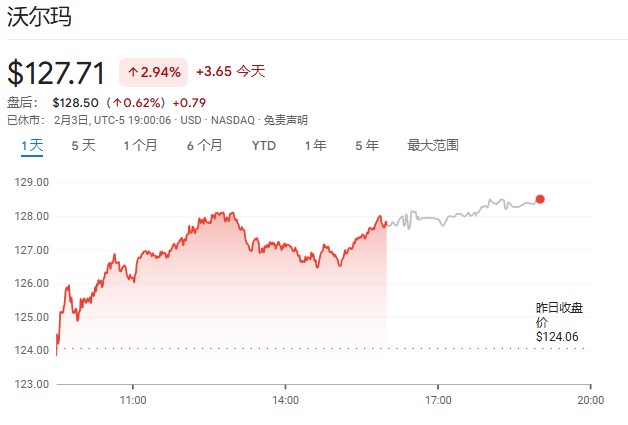
Walmart's stock price rose 2.9% on Tuesday to $127.71, bringing its market value to $1.018 trillion. This milestone coincides with the first week of new CEO John Furner's tenure, who succeeded Doug McMillon, who had led the company for over a decade.
E-commerce Business Becomes Growth Engine
The core of Walmart's transformation lies in the rapid expansion of its e-commerce business. Analysts expect that the company’s annual revenue will exceed $700 billion when it reports earnings this month. However, according to Visible Alpha data, Amazon's revenue is expected to surpass Walmart's for the first time.
Nevertheless, Walmart has made significant progress in the e-commerce sector. The company currently offers same-day delivery services to 95% of U.S. households. Last year, its e-commerce business became profitable as an independent division for the first time, a moment investors have been waiting for.
Morgan Stanley retail analyst Simeon Gutman stated that Walmart's changes over the past decade "represent the most profound transformation we've seen in a retail company." He noted that Walmart's growth poses challenges to competitors like Amazon.
Technology Investments Drive Valuation Reassessment
Walmart is actively embracing artificial intelligence and automation technologies, attracting investor enthusiasm for tech stocks. The company has partnered with OpenAI and Google to integrate online shopping into their search chatbots. Walmart's app features a built-in chatbot named Sparky that recommends products based on queries and assists customers in making purchases.
David Schick, managing partner at research firm Optimal Advisory, stated that Walmart's "combination of labor, procurement, and technology" supports its success. He added that the company benefits from "investing during uncertain times" while competing against "strong" rivals like Amazon and Costco.
The company's investments in automation have resulted in cost savings. Despite revenue growth, Walmart has maintained its global workforce at around 2.1 million in recent years. In December, Walmart moved its stock from the New York Stock Exchange to Nasdaq and joined the Nasdaq-100 index, which is populated by tech stocks, attracting passive funds that track this benchmark
Ten Years of Transformation to Alleviate Investor Concerns
Ten years ago, Walmart's success was not a foregone conclusion. At that time, Amazon was rapidly growing, and the new CEO McMillon invested billions of dollars to raise employee wages, improve stores, and develop online business. Investors were watching to see if these investments would yield returns.
By the end of 2016, Walmart's market value was only $212 billion. According to insiders, Warren Buffett's Berkshire Hathaway sold most of its long-held Walmart shares that year and completely exited in 2018. When Buffett called McMillon to inquire about the reason for the sale, he stated, "The retail industry is changing too much, and I don't think my understanding of it is as deep as I need it to be."
Since then, Walmart's sales have soared, first driven by e-commerce, then by the pandemic, and recently by consumers seeking low prices in an inflationary environment. The company has worked to offer more products appealing to high-income shoppers, such as stylish small appliances and private label foods.
Valuation Still Below Tech Giants
Walmart's market value is still far below e-commerce giant Amazon's $2.6 trillion. Among the trillion-dollar club, Nvidia leads with a market value of about $4.4 trillion, followed by Apple, Microsoft, Amazon, Alphabet, and Broadcom.
As a major importer of goods in the U.S., Walmart has been dealing with the tariffs imposed by President Trump over the past year. According to Jefferies, Walmart and its suppliers absorbed about two-thirds of the tariff costs on general merchandise but passed on the remaining one-third to consumers. Walmart executives stated that its lower prices present an opportunity to gain market share from competitors.
The surge in the company's valuation will increase the wealth of the Walton family, the largest shareholders of the company. They collectively hold 44% of Walmart's shares, currently valued at over $440 billion. Founded by Sam Walton in 1962 as a single-store retailer, the company has now expanded to nearly 11,000 stores worldwide
