


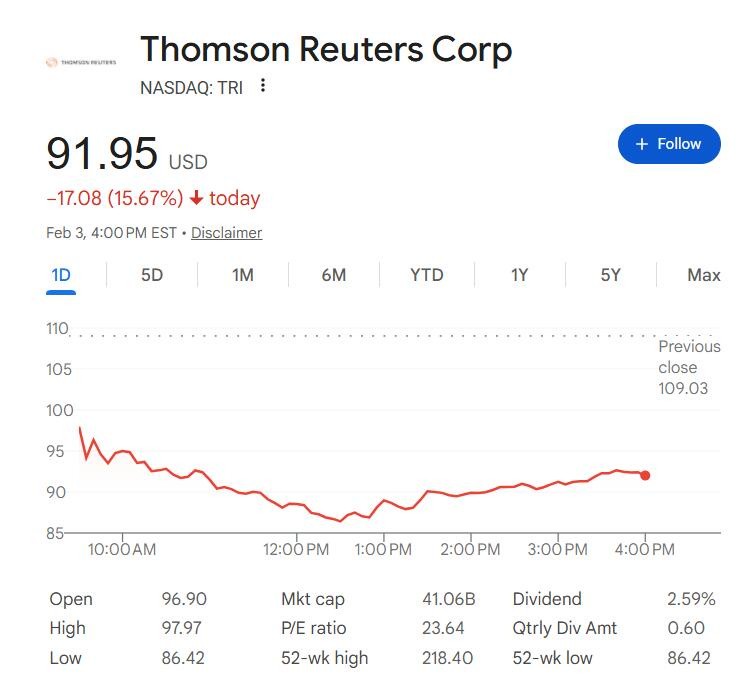
US stocks erupt in AI panic! Anthropic's new tool triggers software stock sell-off, Reuters drops over 20% intraday

In this round of sell-off, legal software and data service companies are at the forefront. Morgan Stanley analysts believe that the new features launched by Anthropic for the legal field have intensified competition in the industry. Jefferies traders stated that SaaS stocks are facing an apocalyptic sell-off, "people are just selling everything, regardless of price"; if Microsoft is struggling, one can imagine how bad the situation is for companies that are more susceptible to disruptive technological impacts
The new automation tool launched by AI startup Anthropic triggered a panic sell-off in software stocks on Tuesday, causing all three major U.S. stock indices to retreat. During the trading session, the S&P 500 index fell by more than 1.6%, the Nasdaq Composite index's decline widened to about 2.4%, the Nasdaq 100 index also dropped over 2%, and the Dow Jones Industrial Average fell nearly 1.2% at its lowest point. This round of selling broke the market's rebound momentum from Monday, with the Nasdaq and S&P retreating from recent highs.
In Tuesday's sell-off, legal software and data service companies were hit hardest. Thomson Reuters (TRI) saw its intraday decline reach 20.7%, Legalzoom.com (LZ) also fell over 20%, the London Stock Exchange Group's UK shares dropped 12.8%, and its U.S. pink sheet shares fell over 10% during the session, while CS Disco (LAW) also dropped over 10%.
The iShares Expanded Tech-Software Sector ETF (IGV), which tracks the tech software sector, hit a new intraday low, falling 5.6% during the day, marking its sixth consecutive trading day of decline, with a total drop of over 14% in six days. This ETF has fallen about 15% since January, marking its worst monthly performance since 2008.
Investors are concerned that the core business of software companies is facing the threat of being replaced by AI technology. Analysts at Morgan Stanley, including Toni Kaplan, pointed out in a research report that the new features launched by Anthropic for the legal field have intensified competition in the industry, stating, "We see this as a signal of increased competition, which could have negative implications."
Panic sentiment has also spread to business development companies (BDC), with BDC stocks, including Blue Owl Capital Corp., declining as market concerns about companies with significant exposure to the software industry intensified. Media reports indicate that concerns about such industry turmoil have triggered turbulence in the global credit market, leading to a drop in loan prices in the syndicated loan market for software companies last week.

The software sector's performance during earnings season has also lagged behind the overall tech industry. Media compilation data shows that among the S&P 500 software component companies that have reported earnings in the current earnings season, only 71% of companies had quarterly revenues exceeding Wall Street expectations, while the overall tech industry's revenue exceeded expectations at a rate of 85%.
Stephen Yiu, Chief Investment Officer of Blue Whale Growth Fund, stated, "This year will be a critical year in determining whether companies are AI winners or losers, and the core skill lies in avoiding the losers. Standing against AI before the dust settles is a dangerous move."
Software Stocks Encounter SaaS Apocalypse-style Sell-off
Wall Street's pessimism towards software stocks has evolved from caution to apocalyptic panic. Jeffrey Favuzza, a trader on Jefferies' equity trading team, stated, "We call it the 'SaaSpocalypse,' the end of software as a service (SaaS) stocks. The trading style is entirely a 'get me out' type of sell-off."
The anxiety escalated further on Tuesday after AI startup Anthropic released a productivity tool aimed at in-house corporate lawyers. This tool triggered a sharp decline in the stock prices of legal software and publishing companies, with sell-off pressure sweeping across the entire sector.
These concerns have been brewing for months. In January, Anthropic launched the Claude Cowork tool, significantly intensifying fears of industry disruption. Last week, video game stocks were also caught up in the sell-off as Alphabet began rolling out Project Genie, a tool that creates immersive virtual worlds through text or image prompts. The S&P North American Software Index has fallen for three consecutive weeks, plummeting 15% in January, marking the largest monthly decline since October 2008.
Favuzza remarked, "I ask clients, 'Where is your breaking point?' Even with a massive capitulation sell-off, I haven't heard any clear answers. People are just selling everything, regardless of price."
These concerns have also spread to the private equity sector. On Tuesday, it was reported that companies including Arcmont Asset Management and Hayfin Capital Management are hiring consultants to examine businesses in their portfolios that may be affected. Apollo has nearly halved its software exposure in its direct lending fund by 2025, significantly reducing it from about 20% at the beginning of the year.
Anthropic's Unique Advantage Raises Market Concerns
Anthropic is one of many AI startups developing tools for the legal industry, but its unique position has heightened market worries. Long before the launch of Anthropic's plugins, startups like Legora and Harvey AI had already flooded the legal industry with tools claiming to relieve lawyers of burdensome tasks. For over two years, investors have been pouring money into AI products for the legal sector, with Harvey AI reaching a valuation of $5 billion in June last year and Legora raising funds at an $1.8 billion valuation in October last year.
What sets Anthropic apart is that it builds its own models that can be customized according to industry-specific needs. As a major model developer, its position in the AI ecosystem gives it a unique advantage in disrupting traditional legal news and data services as well as emerging legal AI players. Companies like Legora rely on underlying models developed by firms like Anthropic.
On its plugin website, the legal tools launched by Anthropic can automate tasks such as contract review and legal briefs. The website states, "All outputs should be reviewed by a licensed attorney." Last week, the launch of Project Genie by Alphabet and products from other companies intensified the sell-off. "This year is defining whether companies are AI winners or victims, and the key skill is to avoid the losers," said Stephen Yiu.
Microsoft's Decline Highlights Industry Dilemma
Even software giants are not escaping AI scrutiny. Microsoft reported robust earnings last week, but investors focused on the slowdown in cloud sales growth, leading to a new round of scrutiny on its AI spending, causing its stock price to plummet 10% last Thursday and drop over 3% during intraday trading on Tuesday, marking its fourth consecutive day of decline.
January of this year was the worst month for Microsoft's stock performance in over a decade. Meanwhile, the earnings reports from ServiceNow and SAP provided investors with more reasons to remain cautious about the growth prospects of software companies.
Thomas Shipp, head of equity research at LPL Financial, which manages $2.4 trillion in brokerage and advisory assets, stated, "The fear brought by AI is intensified competition, increased pricing pressure, and the shallower competitive moats, which means they are more easily replaceable by AI. The range of outcomes for their growth is widening, making it harder to allocate fair valuations or see what is cheap."
These AI-related concerns prompted Piper Sandler to downgrade ratings for software companies such as Adobe, Freshworks, and Vertex on Monday. Analyst Billy Fitzsimmons wrote, "We are concerned that seat compression and vibe coding narratives may set a ceiling on valuation multiples." Vibe coding refers to using AI to write software code.
Despite all software stocks exceeding earnings expectations this earnings season, this is almost irrelevant in the face of concerns about long-term prospects. According to Bloomberg compiled data, only 67% of S&P 500 software companies have exceeded revenue expectations this earnings season, while the overall tech sector's ratio is 83%.
Palantir Becomes a Rare Bright Spot
Despite the significant market decline, most S&P 500 constituents still rose. FedEx, as an economic barometer, continued its record-breaking rally, and Walmart's market capitalization surpassed $1 trillion.
Steve Sosnick, chief strategist at Interactive Brokers, stated that U.S. stocks are "undergoing sector rotation. The tricky question is whether this is a benign reconfiguration of exposures or a signal of some underlying instability."
Among AI concept stocks, big data analytics company Palantir Technologies surged against the trend. The company reported after the market closed on Monday that its fourth-quarter revenue grew by 70%, exceeding Wall Street expectations, while also providing a significantly better-than-expected annual revenue guidance for this year. Its stock price rose nearly 7% on Tuesday.
Some investment professionals view the sell-off in software stocks as an opportunity. The European open-end fund Sycomore Sustainable Tech, which has outperformed 99% of its peers over the past three years, bought Microsoft shares during the downturn, anticipating that the company will ultimately become an AI winner Microsoft's current valuation appears quite attractive, with a price-to-earnings ratio of less than 23 based on estimated earnings, marking the lowest level in about three years. From a technical perspective, its 14-day relative strength index is at an oversold level. More broadly, the valuation multiples of the software index are at multi-year lows, and its RSI indicator also shows oversold conditions.
Jonathan Krinsky, Chief Market Technician at BTIG, wrote in a report to clients last week that the software sector "may have been oversold enough to rebound." However, he also stated, "Repairing and building a new foundation will take a long time," and "given the deterioration in relative strength that truly accelerated in the fourth quarter of last year, we are not very optimistic about software."
The core issue facing investors is distinguishing between AI winners and losers. Clearly, some of these companies will thrive, meaning their stocks are actually on sale after recent sharp declines. But it may still be too early to determine who the winners are.
Favuzza from Jefferies stated:
"A pessimistic view suggests that, in terms of growth prospects, the software industry will become the next print media or department store. Market sentiment is so extreme in favor of selling everything that it indicates there will be some very attractive investment opportunities. We are all waiting for growth to accelerate, and when I look at the data for 2026 or 2027, it’s hard to see upside potential. If even Microsoft is struggling, one can only imagine how bad it could be for companies that are more susceptible to disruptive technological impacts or lack that kind of market dominance."
