


120 times return, hundreds of billions of dollars in floating profits, the hidden big winner of SpaceX's IPO - Alphabet!

The acquisition of xAI has paved the way for SpaceX to sprint towards a $1.5 trillion valuation IPO. For Google, which holds about 7.4% of SpaceX shares, this initial investment of only $900 million is expected to soar in book value to $111 billion, yielding a return of over 120 times. By entering SpaceX early and holding shares in Anthropic, this tech giant has quietly secured a dual dividend in the fields of space infrastructure and cutting-edge artificial intelligence without directly participating in operational risks
Google's controversial venture capital investment from ten years ago is evolving into one of the most profitable bets in Silicon Valley history. With SpaceX announcing the acquisition of the artificial intelligence company xAI and integrating its vast business landscape, Google, as a major external shareholder of SpaceX, is reaping huge returns from this capital feast.
According to an earlier article from Wall Street Watch, Elon Musk's SpaceX has completed the acquisition of the artificial intelligence company xAI, with a transaction value of up to $250 billion. This not only creates the world's most valuable private tech entity but also paves the way for SpaceX's IPO aiming for a valuation of $1.5 trillion.
For Google, which holds about 7.4% of SpaceX's shares, this initial investment of only $900 million is expected to soar in book value to $111 billion, yielding a return of over 120 times. In addition to its 14% stake in Anthropic, this tech giant has quietly secured dual dividends in the space infrastructure and top-tier artificial intelligence sectors without directly participating in operational risks.
The Gamble from Ten Years Ago Bears Fruit
Looking back to January 2015, when Google and Fidelity teamed up to invest $1 billion in SpaceX (with Google investing about $900 million), the market was filled with skepticism.
At that time, SpaceX was valued at only $12 billion, the Falcon 9 had not yet achieved routine recovery, and Starlink was still in the conceptual stage. Musk was burning cash to prove the feasibility of reusable rockets.
The Wall Street Journal expressed doubts about this investment, pointing out that "a major technical and financial challenge facing the project is the cost of installing ground antennas and computer terminals to receive satellite signals," and questioned "how SpaceX plans to transmit internet signals to Earth, as the company is believed not to control the rights to the radio frequency spectrum."
But Google saw a huge opportunity: a company with an effective monopoly in large-scale space launches, a founder with boundless faith, and a business model that becomes increasingly valuable as global data and computing demands explode.
As Starlink transitioned from PowerPoint to reality and was widely applied, along with the maturation of rocket recovery technology, SpaceX's valuation curve showed near-vertical growth—from $36 billion in 2020 to $350 billion by the end of 2024, and then to the IPO target of $1.5 trillion.
According to Bloomberg's data analysis, if SpaceX goes public at the planned valuation of $1.5 trillion, the value of Google's shares will skyrocket from the initial $900 million investment to about $111 billion. This means that every dollar Google invested has brought in about $123 in returns.
Earlier last year, Google's financial report recorded $8 billion in "non-marketable equity securities" income, which Bloomberg confirmed was derived from the revaluation of SpaceX, accounting for 25% of Google's net profit in the first quarter. It is worth noting that this $111 billion in earnings was previously completely hidden from ordinary observers, as SpaceX, being a private company, has had Google's shares essentially sitting at cost on its balance sheet for the past decade.
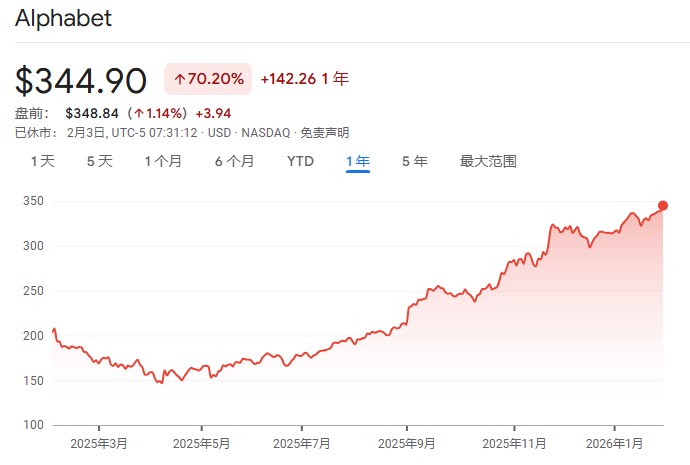
However, once SpaceX goes public, this $111 billion position will become a reality and will appear in financial reports, fundamentally changing perceptions of Google's investment value. For a company with a market capitalization of $4.1 trillion that has seen its stock price rise nearly 70% over the past year, this will still be a huge catalyst.
Possible Variable: Starlink's Separate Listing
It is noteworthy that Musk has repeatedly stated that he will not let SpaceX go public before the regular flights of the Mars colonization transport system, as the Mars colonization plan may not be profitable for years or even decades, making it difficult to gain support from public market shareholders.
However, Musk has also mentioned multiple times the possibility of separately listing SpaceX's Starlink satellite internet subsidiary. SpaceX's Chief Operating Officer Gwynne Shotwell confirmed in 2020 that "Starlink is the right type of business for us to go public." Musk himself stated in 2021 that once the Starlink business becomes "fairly predictable," an IPO might occur, and in 2022, he mentioned that this could happen "in three to four years."
Starlink generates almost all of SpaceX's current profits, potentially accounting for up to 76% of SpaceX's $15.5 billion revenue in 2025. If it is ultimately Starlink that goes public rather than SpaceX as a whole, investors will still have access to SpaceX's cash machine without having to bear the expensive burden of "colonizing Mars," while the parent company can use the funds raised from the IPO to finance Musk's Mars colonization plan.
Regardless of the form in which it eventually goes public, Google's investment in 2015 will become one of the most successful venture capital investments in history
