


Where has AI e-commerce reached?

We are at a critical turning point in e-commerce. Morgan Stanley predicts that by 2030, the total merchandise transaction volume of agency commerce will reach between $190 billion and $385 billion, with AI agents accounting for 10% to 20% of the U.S. e-commerce market. Market competition is showing a dual-track system, with general large model platforms like ChatGPT and Gemini coexisting with dedicated AI tools from retail giants. The popularity of general AI platforms is steadily rising, with young user groups being the main force; ChatGPT has a usage rate of 65%-75% among the 16-34 age group. The conversion rate of commercial behavior is high, indicating that people are using AI for shopping
We are at a critical turning point in e-commerce, marking the dawn of the so-called "agent commerce" era. Morgan Stanley believes that this trend is not just empty hype, but is transforming into tangible trading data. Although the current adoption rate seems slow, the underlying logic is being restructured.
According to the Chasing Wind Trading Desk, Morgan Stanley's latest research report on February 1st points out that for investors, the most critical number is: it is expected that by 2030, the total merchandise transaction volume (GMV) of agent commerce will reach approximately $190 billion (base scenario) to $385 billion (optimistic scenario). In other words, by then, 10% to 20% of the share in the U.S. e-commerce market will be driven by AI agents.
The current market landscape presents a "dual-track" competition: on one side are the general large model platforms represented by ChatGPT and Gemini, which have a large traffic and young user base; on the other side are the specialized AI tools launched by retail giants like Amazon and Walmart, which, although have a smaller user base, boast extremely high conversion rates. For targets like Google, Amazon, Meta, and Walmart, whoever can seize users' minds and payment gateways in this early stage will gain significant excess returns in the next five years.
Large model platform penetration approaching 50%, young groups are the absolute main force
The research report indicates that the penetration rate of general AI platforms is steadily rising. As of January 2026, the monthly usage rates of ChatGPT and Gemini reached 47% and 33%, respectively, showing slight growth from 45% and 32% in October 2025. Although this growth is not explosive, it demonstrates an irreversible trend.
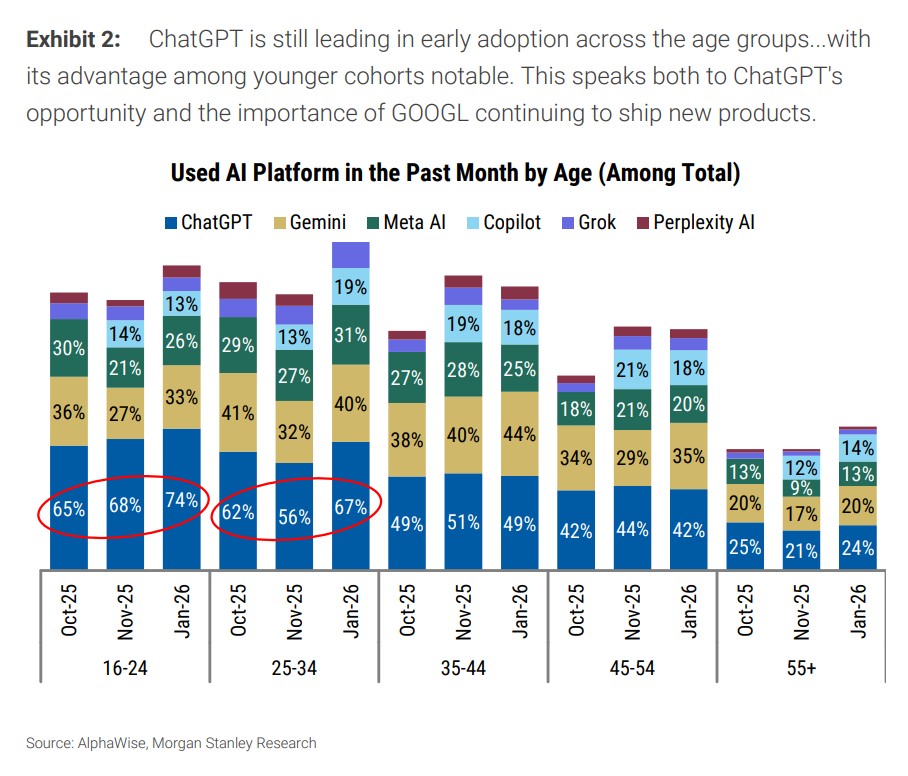
More critically, there is a generational difference. ChatGPT dominates among young groups, with usage rates exceeding 65% to 75% among those aged 16-34. In contrast, Gemini's growth mainly comes from the 35-44 age group. This "age gap" is a clear strategic signal for Google: if it does not quickly bridge the product gap among young users, its user base may face the risk of loss in the coming years.
From "chatting" to "trading": the conversion rate of commercial behavior is surprising
The question investors are most concerned about is: Are people really using AI to shop? The data from the research report provides a positive answer.
Current commercial behaviors show a high degree of stability. Approximately 40% to 55% of AI platform users are utilizing these tools for product research and price comparison. More importantly, about 30% to 40% of agent users ultimately completed a purchase.
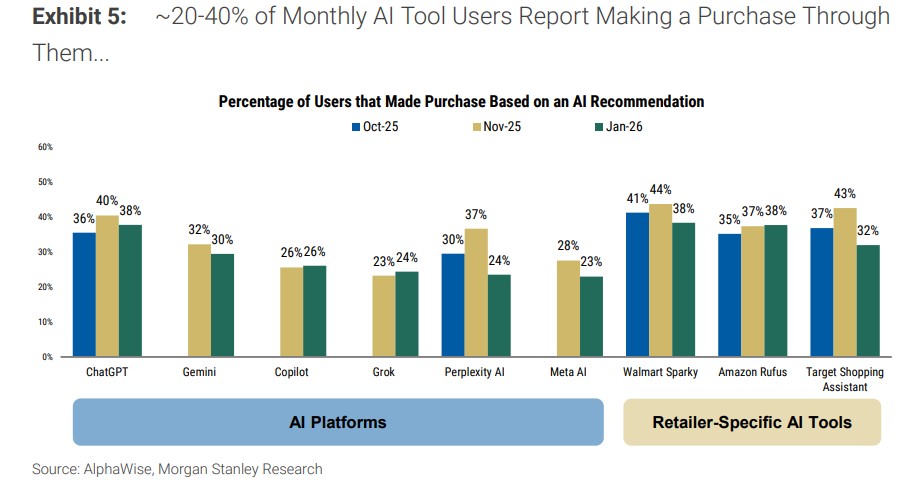
This is a highly explosive early signal. If we convert this ratio to the penetration rate across the entire U.S. population, it means that in just the past month, about 18% of Americans have completed shopping through ChatGPT, and about 10% have shopped through Gemini. Considering that the current product forms are still in their early stages, this early purchasing penetration rate indicates significant growth potential in the future. 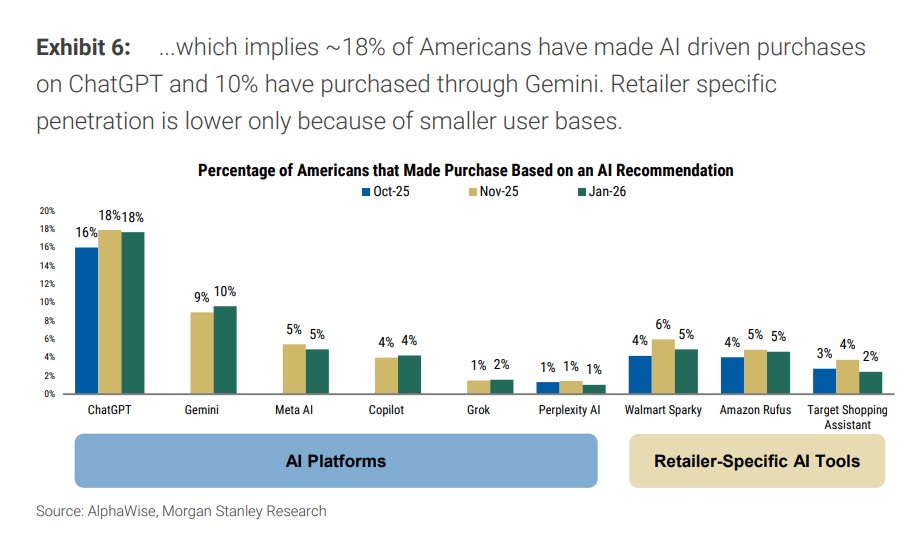
Retailers' Counterattack: Small Base, High Conversion
Although general large models occupy the traffic high ground, retail giants have not sat idly by. Walmart's Sparky, Amazon's Rufus, and Target's shopping assistant currently have a monthly user penetration rate at a low double-digit level, far below general platforms, but their users have a strong purchasing intent.
Research data shows that the purchasing conversion behavior of retailer-specific agent tools reaches or even exceeds that of general platforms. This indicates that for Amazon and Walmart, the opportunity lies in leveraging their large existing user base to increase the consumption frequency and average transaction value of core users through AI tools. As long as they can promote the popularity of agent tools, they can effectively regain the initiative from general platforms.
Category Landscape: Grocery and Fast-Moving Consumer Goods as the "Trojan Horse"
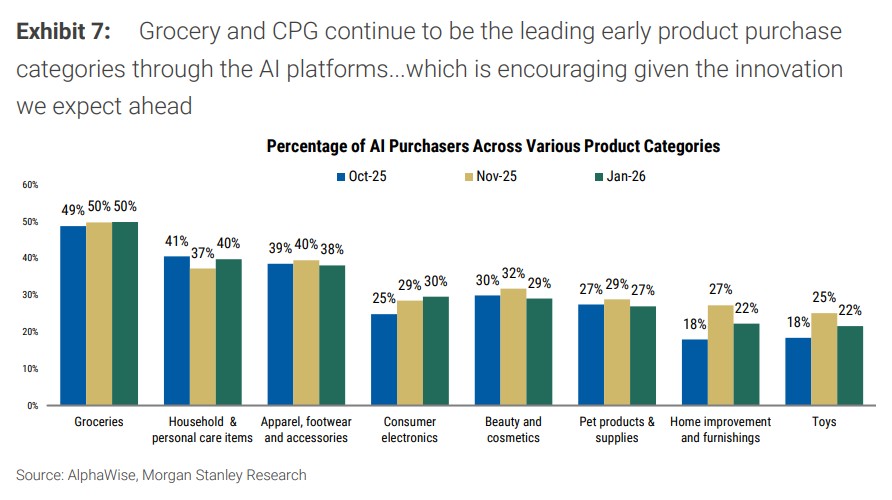
In specific consumer categories, high-frequency consumer goods are becoming the breakthrough point for AI e-commerce. Data shows that among users shopping through AI platforms, 50% purchased groceries, a ratio that has remained stable since October last year. Household goods and personal care products follow closely behind.
This is a very critical strategic pivot. Morgan Stanley believes that the grocery category will be the largest unlocking area for agent commerce in the next five years. Whoever masters the high-frequency grocery entry will master user habits.
Risk Warning and Disclaimer
The market has risks, and investment requires caution. This article does not constitute personal investment advice and does not take into account individual users' specific investment goals, financial conditions, or needs. Users should consider whether any opinions, views, or conclusions in this article align with their specific circumstances. Investing based on this is at one's own risk.
