


Disney's Q1 revenue for fiscal year 2026 increased by 5% year-on-year, while net profit declined by 6%, with the entertainment and sports segments dragging down profitability | Financial Report Insights

In the first quarter of fiscal year 2026, Disney's revenue increased by 5% year-on-year to reach USD 25.98 billion, while net profit fell by 6% to USD 2.4 billion. The growth was primarily driven by the experiences segment (theme parks and cruise business), which accounted for over 70% of operating profit; profits from the entertainment and sports segments declined by 35% and 23%, respectively, due to rising content costs, weak advertising, and subscription pressures. Cash flow contracted due to concentrated tax payments and increased content investments, while the company maintained a proactive approach to shareholder returns and focused on content renewal risks and multiple legal litigations
Disney's latest quarterly report shows steady revenue growth, but profits are dragged down by rising costs and tax burdens.
On February 2, Disney's fiscal year 2026 first-quarter financial report showed that the company's revenue achieved a year-on-year growth of 5%, reaching $25.98 billion, while net profit attributable to the parent company decreased by 6% year-on-year to $2.4 billion, with diluted earnings per share of $1.34, a year-on-year decline of 4%. The profit side was mainly affected by rising entertainment content costs, increased sports copyright fees, and one-time tax adjustments.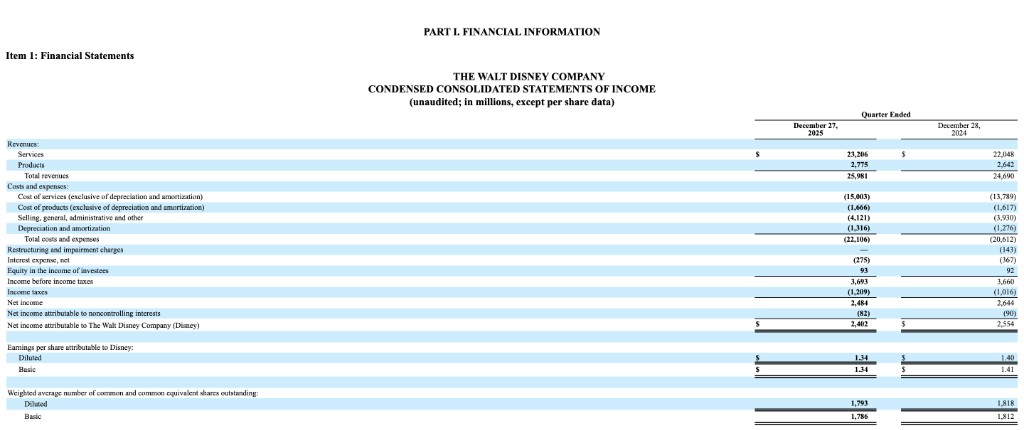
From a business structure perspective, the "Experience" segment (theme parks, resorts, and cruise businesses) remains the core profit engine, with revenue growing by 6% year-on-year to $10.01 billion, and operating profit also increasing by 6% to $3.31 billion, accounting for over 70% of the company's overall segment operating profit ($4.6 billion).
In contrast, the operating profit of the "Entertainment" segment saw a significant year-on-year decline of 35% to $1.1 billion, while the "Sports" segment's operating profit decreased by 23% year-on-year to $191 million, which negatively impacted overall profit quality.
This quarter's financial report was significantly affected by two structural adjustments: first, the consolidation of Fubo (formed by merging part of Hulu Live TV's assets with Fubo) starting from October 2025 brought in approximately $300 million in new revenue, but also generated $307 million in non-cash tax expenses, causing the effective tax rate to rise from 27.8% in the same period last year to 32.7%; second, after the completion of the Star India transaction in India, it was accounted for using the equity method, and its joint venture still recorded an equity method loss of $28 million for the quarter.
In terms of cash flow, operating cash flow significantly decreased from $3.21 billion in the same period last year to $735 million. Management pointed out that the main reasons were concentrated tax payments (including the repayment of deferred taxes related to California wildfires) and increased spending on entertainment and sports content. Nevertheless, the company continued to strengthen shareholder returns, completing $2.03 billion in stock buybacks during the quarter and raising the dividend to $0.75 per share (with total dividends of approximately $2.65 billion for the quarter).
Entertainment Segment: Rising Content Costs Erode Profit Margins
The revenue of the entertainment segment was $11.61 billion, a year-on-year increase of 7%, but operating profit decreased by 35% year-on-year to $1.1 billion, mainly affected by increased theatrical distribution and marketing expenditures, as well as rising content costs related to streaming.
Revenue growth was primarily driven by subscriptions and revenue-sharing fees, which amounted to $7.25 billion, an 8% year-on-year increase. The growth was mainly propelled by effective rate increases, contributions from the consolidation of Fubo, and subscriber growth, although it was partially offset by the impact of the Star India transaction and a temporary suspension with a certain distributor.
Advertising revenue was $1.78 billion, a year-on-year decrease of 6%, mainly dragged down by the dual impact of the Star India transaction and rate reductions. Although increased impressions and the consolidation of Fubo provided some hedge, the reduction in political advertising also put pressure on performance during the same period Content sales revenue was $1.94 billion, a year-on-year increase of 22%, mainly driven by theatrical releases. Key films this season include "Zootopia 2," "Avatar: The Way of Water," "Predator: Prey," and "Tron: Legacy."
On the cost side, program production and content costs rose 15% year-on-year to $6.31 billion, with the increase mainly coming from costs related to theatrical releases, Fubo consolidation, and rising licensing fees for streaming subscription revenue sharing. Selling and administrative expenses grew 14% year-on-year to $2.63 billion, primarily due to increased marketing expenditures for theatrical and streaming businesses. Management clearly pointed out that the core reason for the decline in operating profit is the "weaker performance of theatrical distribution compared to the same period last year," compounded by the structural increase in content and marketing costs.
Sports Segment: Advertising Recovery Fails to Offset Subscription Decline and Copyright Cost Pressure
The sports division's revenue was $4.91 billion, a slight year-on-year increase of 1%, but operating profit fell 23% year-on-year to $191 million. Subscription and revenue-sharing fees amounted to $2.98 billion, a year-on-year decrease of 2%, mainly affected by a reduction in subscribers, a temporary suspension with a certain distributor, and the impact of the Star India deal. Although an effective rate increase provided a 6% hedge, it was not enough to fully offset the decline. Advertising revenue was $1.48 billion, a year-on-year increase of 10%, mainly driven by an 8% increase in rates.
Program and production costs rose 2% year-on-year to $4.13 billion, mainly due to contract rate increases and new sports copyright costs, but the reduction in NBA regular season games and the timing of recognizing event copyright costs under new agreements provided some buffer to the cost growth this season. Overall, the short-term performance of the sports business is more akin to a "race between pricing and copyright costs": the rebound in advertising pricing helps improve revenue, but in the context of ongoing subscription business pressures from industry cuts in cable television and channel friction, profit elasticity remains constrained by rigid cost pressures.
Experience Segment: Ticket Prices and Per Capita Spending Rise, New Cruise Capacity Drives High Growth in "Accommodation and Vacation"
The experience division continued its steady growth trend, with revenue reaching $10.01 billion, a year-on-year increase of 6%, and operating profit also growing 6% to $3.31 billion.
Revenue growth was mainly driven by contributions from multiple segments: theme park ticket revenue was $3.30 billion, a year-on-year increase of 7%, primarily driven by a 4% increase in average ticket prices and a 2% increase in visitor numbers; resort and travel revenue was $2.41 billion, a year-on-year increase of 9%, with core growth coming from the new "passenger days" from cruises, corresponding to the "Disney Treasure" set to launch in December 2024 and "Disney Destiny" set to launch in November 2025; park merchandise and dining revenue was $2.35 billion, a year-on-year increase of 8%, mainly driven by a 3% increase in per capita spending and a 2% increase in visitor traffic and sales.
In terms of key operational metrics, visitor numbers at domestic parks increased by 1% year-on-year, with per capita spending up 4%, and hotel occupancy rates at 87% (compared to 85% in the same period last year); international park visitor numbers increased by 6%, per capita spending grew by 2%, and hotel occupancy rates were also 87% (compared to 86% last year) In terms of costs, operating expenses increased by 6% year-on-year, primarily driven by inflation's impact on labor and infrastructure costs, as well as rising operational and support costs for new projects. Depreciation and amortization expenses rose by 12% year-on-year to $759 million, with the company clearly stating that the increase was mainly due to higher depreciation from Disney Cruise Line.
Cash Flow, Content Investment, and Capital Expenditure: Concentrated Tax Payments Pressure Operating Cash Flow, FY2026 Investment Guidance Raised
Operating cash flow was $735 million, significantly down from $3.21 billion in the same period last year. In addition to the impact of concentrated tax payments, the company also pointed out that increased investment in entertainment and sports content has put pressure on cash flow. Content asset amortization for the quarter totaled $7.21 billion (compared to $6.61 billion in the same period last year), and the company expects total production and copyright content spending (including sports copyrights) for FY2026 to be approximately $24 billion.
In terms of capital expenditure, $3.01 billion was invested in parks, resorts, and other property investments during the quarter (compared to $2.47 billion in the same period last year), with the incremental investment mainly directed towards cruise capacity expansion and new park projects. The company expects capital expenditure for FY2026 to rise to approximately $9 billion (up from $8 billion in FY2025), with growth primarily coming from the expansion of parks and resorts and the introduction of new attractions.
Capital Operations and Shareholder Returns: Accelerated Buybacks, Increased Dividends, Short-term Debt Rises but Liquidity Remains Sufficient
The company repurchased a total of 18.46 million shares this quarter, costing a total of $2.03 billion. As of the end of the period, the remaining shares authorized for repurchase by the board were approximately 321 million. The company has clearly set a buyback target of $7 billion for FY2026. In terms of dividends, a quarterly dividend of $0.75 per share was announced (up from $0.50 per share in FY2025), reflecting a total declared dividend of approximately $2.65 billion for the quarter, corresponding to two dividend distributions made during the period.
Regarding debt, the total borrowings at the end of the period amounted to $46.64 billion, with $10.82 billion of that being due within one year or classified as current liabilities, which is a significant increase from the end of the previous quarter. The company disclosed that it has $12.25 billion in unused bank credit lines and emphasized that its interest coverage ratio covenant "still has significant safety margin."
Transactions and Integration: Fubo Consolidation Brings Revenue and One-time Tax Impact, ESPN Introduces NFL Assets as Future Variables
The Fubo transaction was completed and consolidated on October 29, 2025. Disney merged part of its Hulu Live TV assets with Fubo, holding 70% of the economic rights and voting power in the merged entity, along with majority board appointment rights. The initial valuation of the transaction was approximately $1.3 billion, generating about $1.5 billion in goodwill and $400 million in identifiable intangible assets. The consolidation contributed approximately $300 million in revenue to Disney for the quarter, while also recognizing a non-cash tax expense of $307 million, significantly impacting the earnings per share (EPS) for the quarter.
As a subsequent event, ESPN reached an asset transaction with the NFL in January 2026, trading a 10% non-controlling interest for designated assets such as the NFL Network. This transaction is valued at approximately $3 billion and includes options for repurchase or increased equity stakes after 2034 Although this transaction is not directly reflected in this quarter's profit and loss, it will change ESPN's equity structure (Disney's effective ownership ratio will decrease to about 72%), further strengthening the company's layout in the sports content and distribution field.
In addition, the Indian joint venture in which Disney holds a 37% stake recorded an equity method loss of $28 million this quarter, which still slightly drags down investment income.
Risks and Litigation: Renewal Risks of Channels Rise, Antitrust and Securities Litigation Ongoing
The company updated its risk factors in the latest filed documents, placing "uncertainty in the renewal of long-term content procurement and distribution contracts" in a more prominent position, and specifically pointed out that the renewal of multiple MVPD (multichannel video programming distributor) agreements in fiscal year 2026 may lead to short-term or even long-term service interruptions. For example, this quarter, YouTube TV experienced a temporary suspension due to unsuccessful renewal negotiations.
In terms of litigation, the company still faces multiple legal pressures. On one hand, the securities class action lawsuit involving Disney+'s subscription growth and cost disclosures has entered the evidence disclosure stage, with a trial date set for August 2027; on the other hand, regarding the packaging and bundling terms of virtual multichannel video programming distributors (vMVPDs), the company is dealing with antitrust lawsuits, some of which have entered the settlement process but require court approval, while lawsuits related to fuboTV subscribers and the counterclaim filed by DISH are still ongoing.
Additionally, the company emphasized in its intellectual property risk warning that the expiration of certain copyrights (such as "Steamboat Willie") and the trend of AI tools lowering the threshold for content infringement may have a lasting impact on the long-term monetization ability of IP and the costs of rights protection.
