


Was this silver crash manipulated by humans?

Former investment banker Felix analyzed that multiple signs indicate that the recent plunge in silver prices has a man-made aspect: the Chicago Mercantile Exchange suddenly raised margin requirements during the Asian market's off-hours; institutions like JP Morgan simultaneously closed short positions at the lowest price point; the London Metal Exchange and HSBC's systems also "coincidentally" experienced interruptions. Such operations are essentially a "liquidity cleansing" of excessively crowded long trades
The following are the key points extracted from Felix Prehn, a former investment banker, corporate lawyer, and founder of Goat Academy, during the program on February 1st:
The recent plunge in precious metals coincides closely with a series of market events. At the end of January 2026, the price of silver plummeted 35% from $120 to $78 within 24 hours, while gold fell 12%, resulting in a market value evaporation of approximately $3 trillion. Notably, this crash coincided with simultaneous disruptions in the London Metal Exchange (LME) and HSBC banking system, as well as a sudden increase in margin requirements by the Chicago Mercantile Exchange (CME), precisely during the Asian market's weekend closure.
This silver crash is a meticulously planned market cleansing. Core evidence includes: JP Morgan precisely closing short positions at the lowest price point; the CME suddenly raising margin requirements significantly, leading to a chain reaction of liquidations among leveraged traders and triggering algorithmic sell-offs; and a false report by Reuters (claiming the U.S. would terminate strategic metal support, later denied by officials) that fueled the selling frenzy.
Historical data shows that similar patterns of extreme volatility have occurred multiple times in 1980, 2011, and December 2025: When silver prices rise rapidly, exchanges often raise margin requirements, forcing leveraged traders to liquidate, which in turn leads to significant price declines. This crash marks the fourth occurrence of this pattern, with the magnitude of volatility significantly expanded.
There is a clear divergence between the futures market and the physical market. The price of paper silver is highly susceptible to margin adjustments and algorithmic trading, leading to sharp fluctuations, while physical silver continues to face structural shortages, with global silver supply experiencing an average annual shortfall of about 200 million ounces for five consecutive years. The spot silver premium on the Shanghai Gold Exchange once exceeded $40 per ounce, confirming the resilience of physical demand. This price crash did not alleviate the physical shortage; rather, it created conditions for commercial shorts to cover by cleaning up leveraged positions.
Investors should rationally distinguish between the superficial and substantive aspects of market volatility. The market attributed the crash to the nomination of the Federal Reserve Chairman, whereas margin adjustments and market structure are the key driving factors; leveraged ETFs fell by 66% during this decline, highlighting the risks of excessive leverage. It is noteworthy that the demand from industries such as solar energy, artificial intelligence, and electric vehicles continues to support the long-term fundamentals of silver, and the issue of physical shortages has not changed due to price fluctuations. Historically, after the crash in 1980, recovery was slow, but the adjustments in 2011 and December 2025 rebounded within weeks. Given the current tight supply-demand dynamics, the market recovery speed may be faster.
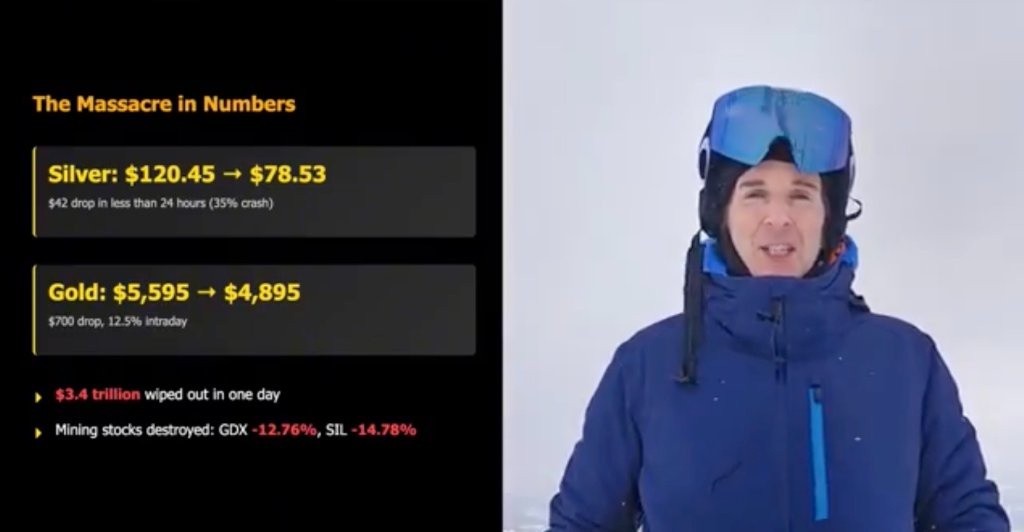
On January 30, 2026, the global precious metals market experienced a "Black Friday." The price of silver plummeted from a historical high of $120 per ounce to $78, with a single-day drop of 35%, marking the largest single-day decline since 1980. Gold prices also fell by 12%, resulting in a loss of approximately $3 trillion in market value for precious metals in a single day In response to this rare crash, former investment banker, corporate lawyer, and founder of Goat Academy, Felix Prehn, analyzed on the program on February 1st, stating that this is not a natural market adjustment, but a typical "liquidity liquidation event." He believes that the excessively crowded long positions in the market, the strong dollar expectations triggered by Kevin Walsh's nomination as Federal Reserve Chairman, and the significant increase in margin requirements by exchanges collectively triggered this collapse.
Felix particularly emphasized that although there have been violent fluctuations in paper markets such as futures, the fundamentals of physical silver have not changed. The demand from the photovoltaic industry, electric vehicles, and artificial intelligence data centers remains strong, and the global silver market has been in a supply shortage for the fifth consecutive year. He pointed out that unlike the long-term downturn after 1980 or 2011, the market recovery this time may be closer to the pattern of December 2025.
Regarding the nature of the crash, Felix believes this is an orderly cleaning of high-leverage positions. As the Chicago Mercantile Exchange (CME) raised margin requirements, leveraged traders were forced to liquidate their positions, leading to a chain sell-off triggered by algorithmic trading. He warned investors that attempting to "catch the bottom" or panic selling at this time is merely following the rhythm of the "market maker's game," and understanding this mechanism is key to grasping subsequent trends.
"Crowded Trades" and Margin Hunting
The core mechanism of this crash lies in the inherent structure of the market. Felix pointed out that before the crash occurred, precious metals had become "the most crowded trading targets globally": gold prices had risen 66% over the past year, while silver surged by as much as 135%, with both institutional investors and retail investors holding large long positions. This highly consistent market expectation itself accumulated conditions for the outbreak of a "liquidity event."
Analysis suggests that the CME's increase in margin requirements became the direct trigger. When margin requirements are rapidly raised, leveraged traders who are fully invested are unable to add funds and can only be forced to liquidate their positions. This immediately triggers a chain reaction: a trader's forced sell-off depresses prices, triggering the next margin call, which further leads to price declines, creating a vicious cycle.
Felix described this process as an exchange-led "market reset." He emphasized:
"Comex cleans up over-leveraged traders by raising margin requirements... This operation essentially makes it difficult for traders to maintain their original positions, which is similar to what happened in 1980 and 2011."
Key Time Points and "Coincidences"
Felix highlighted a series of time points and market anomalies in this crash that are highly "coincidental."
First is the precise timing arrangement. The crash occurred on a Friday, at which point the Asian markets had already entered the weekend break, and the relevant trading systems of the London Metal Exchange (LME) and HSBC experienced simultaneous interruptions Felix analyzed that this arrangement further amplified market volatility during periods of already weak liquidity.
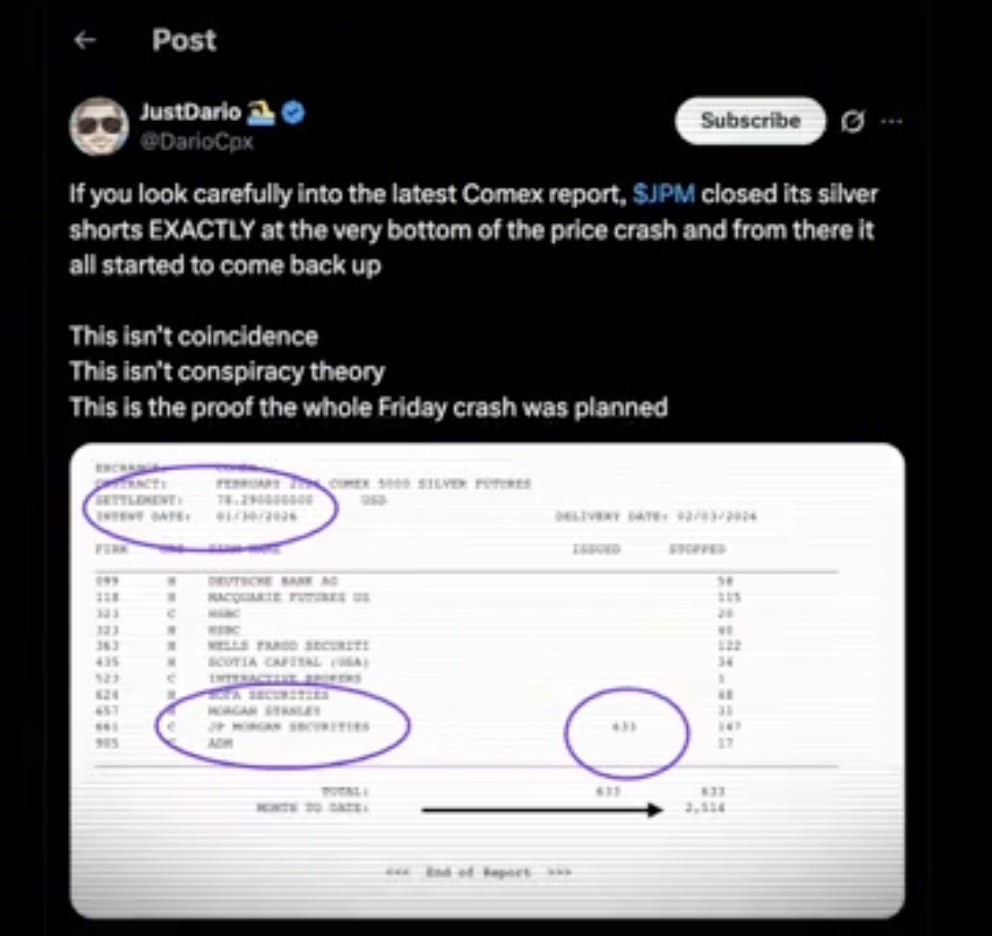
Secondly, there is the synchronized operation of key institutions. According to his observation, JPMorgan precisely closed its silver short positions when the market hit its lowest point on Friday. He meaningfully stated:
"If you believe in coincidences, you might also believe there could be planning involved; it all depends on how you interpret it."
In addition, the incentive from the news—Trump's nomination of Kevin Walsh as the new chairman of the Federal Reserve was widely interpreted by the market as a hawkish signal, driving the dollar sharply higher, which in turn suppressed the prices of precious metals denominated in dollars. However, Felix emphasized that this is merely the "spark that ignites the fuse," while the real "gunpowder" lies in the margin adjustments by exchanges and the subsequent chain reaction of algorithmic trading.
Discrepancy Between Paper Reset and Physical Shortage
Despite the severe sell-off in the futures market, Felix emphasized that the underlying fundamental logic of physical silver remains unchanged. He pointed out that this plunge "neither resolved the supply shortage of silver, nor created more silver out of thin air, nor weakened actual industrial demand."
Currently, the global silver market has been in a state of annual supply deficit for the fifth consecutive year, with a cumulative deficit of up to 1 billion ounces. Meanwhile, the spot silver premium on the Shanghai Gold Exchange remains at historically high levels, confirming the strong physical demand.
Felix further analyzed that this round of plunge not only cleared retail leverage but also provided an opportunity for commercial shorts represented by banks to cover positions and reshape market sentiment. He summarized:
"This is a sudden 'cardiac arrest' for the paper silver market... but physical silver ultimately cannot be printed out of thin air."
Market Retrospective: From 1980 to 2026
Felix placed this plunge in a historical context, comparing it with the Hunt brothers incident in 1980, the silver crash in 2011, and the adjustment in December 2025.
1980: The exchange imposed one-way trading restrictions (only allowing selling and prohibiting buying), leading to an 80% drop in silver prices. Due to a lack of actual demand support, the market fell into a prolonged slump lasting several years.
2011: The Chicago Mercantile Exchange raised margin requirements five times within two weeks, causing silver prices to halve, with a lengthy recovery period afterward.
December 2025: After silver reached a new high of $84 per ounce, a correction occurred due to two margin increases by CME. However, supported by demand from industries such as photovoltaics and electric vehicles, the market returned to an upward trajectory within just a few weeks Felix pointed out that the current situation is more similar to the model of December 2025. Despite a significant price pullback, "the fundamentals are stronger than at any time in the past." He believes that unless there is a large-scale technological substitution leading to a collapse in industrial demand for silver, the market will present more valuable allocation opportunities after this round of leveraged bubble clearing.
He summarized:
"This crash has completed the cleanup of excessive leverage through margin increases and algorithmic sell-offs, which is an embedded 'functional reset' in the system, rather than an accidental 'glitch.'"
The original video text is as follows, translated with AI assistance:
JP Morgan just happened to close their silver short positions at the market bottom on Friday, then shifted the blame onto the Federal Reserve Chairman, and I wasn't planning to make this video. Honestly, I'm currently skiing in Japan. I was sitting on the ski lift, thinking about what just happened in the silver market, and I got furious. The mainstream media is telling you the wrong story. I believe you have the right to know the full truth. Here's the thing, JP Morgan—I had the editor switch the screen to the charger side, or show you the screen—you can see that they indeed sold at the absolute low point on Friday.
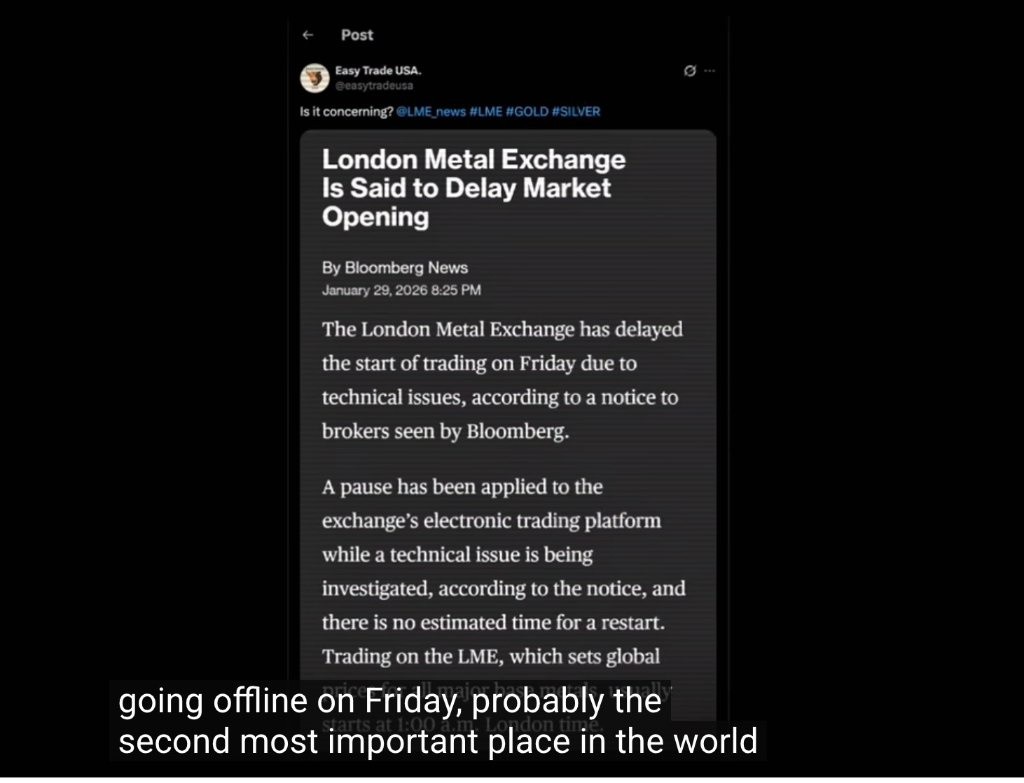
That's the first point. We also encountered a wonderful "coincidence": the London Metal Exchange went offline on Friday, which is probably the second most important silver trading venue in the world. Then there's HSBC—the second largest short holder in the London Bullion Market Association. Guess what? Their system also went offline at the same time. Meanwhile, the Chicago Mercantile Exchange (Comex)—our "lobby" in Chicago—raised margin requirements to shake out leveraged traders. Then they waited for the Asian market to close for the weekend, as Asia is 12 hours ahead of the East Coast. Then they stirred the market slightly with a new piece of news, and you got this whole pile of "coincidences." If you believe in coincidences, then you believe in conspiracy theories, well, that's entirely up to you. Of course, I'm not blaming Comex or JP Morgan or anyone else; they are all working for the public good, just like Bill Gates and his antibiotics and his quantitative rationing friends. That story is true and very interesting.
If you haven't seen it, check it out on X. But listen, if you hold silver, gold, mining stocks, or any kind of ETF or anything, then the largest silver crash in 44 years just happened, right? It dropped 35% within 24 hours. This could be a great buying opportunity before silver rises to, you know, $150 and so on, or it might make you hesitant to act now because you're scared. So let's take a step back. I hope my camera doesn't fall into the snow.
On Thursday, silver hit a high of $120. On Friday, it plummeted to $78. I'm a bit worried about this selfie stick. This is the worst day for silver since 1980, and gold dropped 12%. We lost $3 trillion, just in market value, but the mainstream media won't tell you this. This is not a market failure; this is a planned cleanup, and I think we should call it that. So I checked the margin data from CME, and I could hardly believe my eyes I searched the internet and found that no one has written a single word about it. I searched again on Friday morning, and it was the same. However, discovering this piece of news completely changes your understanding of what just happened.
If you understand this, you can position yourself for the potentially huge, wonderful, and shiny opportunities that may arise.
I am Felix, dressed a bit oddly, but I used to be an investment banker. I have been studying these things for many years. I am also the founder of Goat Academy, where we have taught over 20,000 students, and I am a co-founder of Trade Vision on IO, where we provide you with data that people like me, ordinary folks, and the data that Wall Street doesn’t want you to see. A month ago, I made a video about the December silver crash, when we reached $84, and I showed you that pattern: 1980, 2011, 2025. The same script, the same players, believe it or not, the same result. Some of you watched, some listened, and some didn’t. Well, they came again, but this time it was ten times worse. So I carefully studied all the data over the weekend; I was supposed to be skiing and didn’t plan to make a video about this, but I felt you should understand.
First of all, if you really want to take this seriously and learn this pattern, recognizing that Wall Street has a very simple three-step system that allows them to discover opportunities and tells them exactly where to exit. I will hold a live meeting for you on Saturday.
It has a bit of humor, but it is also based on facts, so I will break it down for you in the next few minutes; it won’t take too long because it’s really cold outside.
I will analyze three key points for you. First, what exactly triggered this massacre, and who really won? Let me confirm, we are indeed recording, yay. Second, my previous argument is actually stronger now, not weaker; this crash did not solve any issues regarding the shortage of silver or gold. Third, you might want to take some action now, and I will share that with you. You’re not just getting news and noise, you know, CNBC, I probably shouldn’t say this, right? They are lovely. I’m sure the people at CNBC are great, but they talk too much; we are trying to give you insights, then actionable insights. So let me clarify.
First, we have the historical highest price of silver at $120. By Friday, we reached $78. That’s a drop of $42, or 35%, right? Gold had a similar situation, dropping by 12%, which is $3 trillion evaporated, that’s half of the U.S. GDP disappearing in a day just because someone went a bit crazy in trading. Mining stocks were destroyed, so the gold miner ETF dropped by 12%, the Global X silver miner ETF dropped by nearly 15%, and the world’s largest gold miners, new news. Did they lose all the gold on the ground?
No, but they are down 12% now too. If you watched my last video, I know it’s always annoying to say this, but you didn’t watch. But you know, if you’ve heard it, it might sound a bit familiar, what happened, right?
This is the fourth time we have seen the same pattern. In 1980, we had silver... we had the lovely Hunt brothers trying to corner the silver market, and silver reached $50. The exchanges implemented their rules. New rules. Rule 7, which we will discuss later. It limited buying. Only selling was allowed. If you have the power to create that kind of hype, it's a wonderful thing; silver crashed by 80%. The little guys were, of course, kicked out and squeezed out.
Then in 2011, after the financial crisis, silver reached $49. The CME raised margin requirements five times in two weeks, causing a 48% drop. The same script. In December 2025, we reached $84. What did the CME do? They raised margin requirements twice during a very thin trading holiday period, causing silver to crash about 13%, as I told you. Now this, in my humble opinion, is also artificially designed. I'm not blaming anyone, not even JP Morgan. So what happened in January? Silver touched $120, and Trump nominated Kevin Walsh as the new Federal Reserve Chairman, a traditional hawk, possibly signaling a reduction in money printing. Money printing is beneficial for gold and silver.
What happened? Well, on Friday, the leveraged positions received margin calls, and stop losses were triggered. There was an algorithmic cascade, and silver plummeted wildly. So we have now seen this situation four times, the same pattern, the same players, the same results. The only difference is they used a slightly different excuse.
So how do you know, Ben, how do you know the bottom has been reached if silver might drop to $55 next week or bounce back to $100? Well, some people will panic sell after such a crash. I'm out, this is too risky. That makes some sense, but it's also how you lock in losses. Then there are those who think they can ignore the fundamentals and just follow... I don't know what noise, but these are all artificially designed events, and all that technical analysis becomes ineffective because it doesn't matter; someone is manipulating it, right?
So if you are trying to trade silver, or use leverage, or try to precisely time the market bottom, or panic sell, you are playing their game. They want you to do that. And in their game, guess what, the house always wins.
I know a bit about this; one of my mentors, a great person and also the head of our Goat Academy, used to be a market maker at the London Metal Exchange. He was one of those running the casino. But what Wall Street doesn't want you to know is that this crash did not solve the supply problem for silver; it did not create more silver, nor did it reduce industrial demand. The demand for solar panels, electric vehicles, and AI data centers has not changed the fact that we are in a massive supply shortage of 200 million ounces each year for the fifth consecutive year. Add that up, and you get a total supply gap of 1 billion ounces. And in my investigation, I found that the CME, the Chicago Mercantile Exchange, is where futures trading happens, and I guess, well, they aggressively raised margins, forcing other traders out of that contract. So with a big stroke or a push of a button, they made it impossible for traders to hold their positions, which is exactly what I told you happened in 1980 and 2011 And this explains what is happening now.
Paper silver is disappearing. This is a reset for Comex, the paper market where people trade silver contracts. They do not actually own it, and the silver does not actually exist. It has essentially been dismantled, yes, the losers, you and me. But the key is, they can manipulate the paper price. Of course, I won't say or claim they are, they certainly are not, they are honest, upright annual figures, all those good words, right?
It's Bill's friends, but they still can't conjure physical silver out of thin air. So this crash has just cleaned out the leverage, a massive amount of retail leverage, with leveraged silver ETFs down 66%. Don't leverage on this stuff anymore, it's too crazy. What happens when the market goes down? So, who is bearing the pain of rising silver prices? It's the banks, the commercial shorts, they can cover their positions and reset market sentiment before the next round of increases. So this is a function, not a flaw, this is how this system has operated for decades. If you understand what has happened—the discovery of margin, the reset of the paper market, and more importantly, what will happen in the next 30 or 90 days—then your positioning could be an excellent buying opportunity before silver goes crazy again.
I am not a financial advisor, nor any type of advisor. Besides the ski resort staff here, I am not registered anywhere, so draw your own conclusions. But as I said, if you want to understand the patterns that happen over and over again, and how to position yourself regardless of what happens—whether it's this market, or the next crash, or rebound, or whether the Federal Reserve Chairman is good or bad. I am talking about the Federal Reserve, not the ski lift.
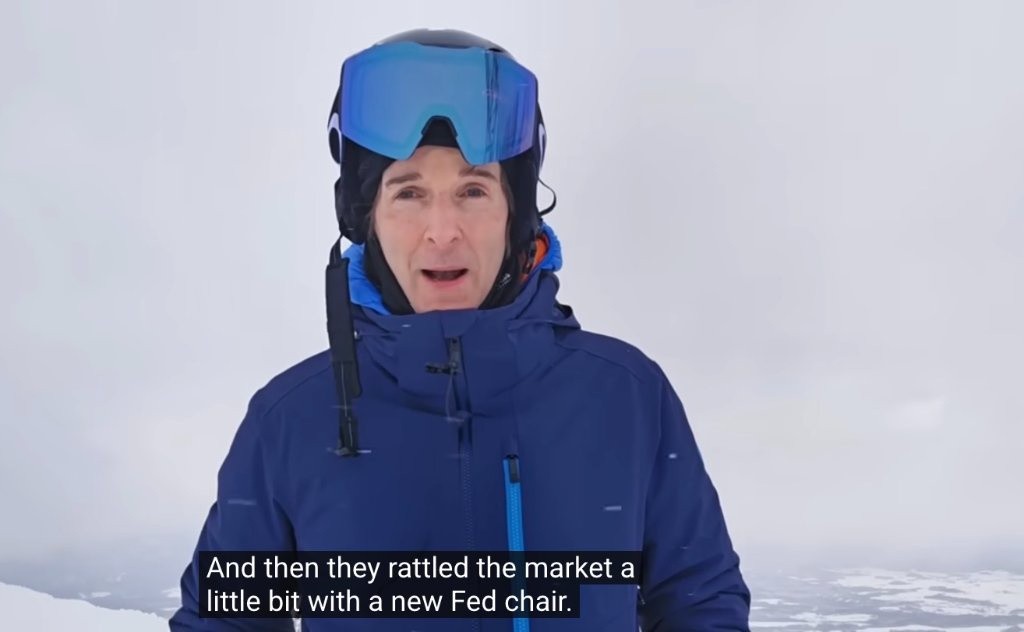
The mainstream media keeps talking about Kevin Walsh crashing the market, right? We mentioned it. Well, that was like lighting the fuse. Trump nominated Walsh to replace Powell as Federal Reserve Chairman, and strangely enough, Powell was also appointed by Trump, and Walsh was seen as a hawk, someone more focused on fighting inflation rather than printing money. He doesn't care about making the market happy.
The story will be told ahead, the market has priced in a "poodle" Federal Reserve Chairman, and I have been saying we would get a poodle. He used to be, what do you want me to do? You know, that kind of person. So what do you get? Well, look, did his nomination crush that narrative? So the news says the dollar soared by one percent. So why is this important?
Gold and silver are priced in dollars. When the dollar strengthens, for foreign banks like me that have to buy dollars, the metals become more expensive, so demand decreases, and prices fall. And the problem is, this is the most crowded trade on the planet. Gold was up 66% last year, and silver was up 135%. Everyone and their grandmother, including Uber drivers, are investing in precious metals, retail investors, hedge funds, institutions, everyone suddenly going long.
When you have such a crowded trade, a small catalyst can trigger what Wall Street calls a "liquidation event." Leveraged positions get margin calls, stop losses get triggered, algorithmic trading processes start, and they begin to sell off. Of course, if you are the one responsible for all the trades, because you are the broker or exchange, you are fully aware at what price levels all of this will be triggered Of course, Comex will never look at that data, and you know, quietly tell friends or abuse it in any form. They are honest, upright members of society. I want to make this very clear, okay?
Just like everyone in Chicago, including that little bank that just went under, by the way, they have nothing to sell, they are just generally crazy. So what? Usually, it is orderly, like taking profits, and then it turns into panic, right? Besides that, I mean, think about all these coincidences, all happening on the same day, Friday, just before the market closes, when the Asian markets are closed, and so on.
Reuters released a report claiming that the U.S. is terminating support for strategic metals. Now, the Department of Energy says the government claims this is false and deliberately misleading (regarding strategic metals). The government says this is deliberate misinformation. Why would you deliberately mislead unless you are harming someone with a stake in the outcome? But the algorithmic trading systems have already triggered, a large number of sell orders have impacted the CME, and then there’s the discovery of margin, you know, all of this. So, in the midst of all this chaos, look for the mechanisms they used to force liquidation, the actual tools.
That’s how I stumbled upon the silver margin data. That feeling, you know, is not entirely unexpected, but also not entirely, oh, they did a great job. Again, aren’t they lovely people?
Financial news websites, trading forums, analysts, nothing, not a single person is really talking about this? In my humble opinion, this could be called manipulation. Of course, I wouldn’t use such wording because I believe, you know, those respectable people in Chicago. But essentially, if someone is a cynic, they might say they use Walsh as a cover, but the weapon is actually the increase in margin.
This is the same script we’ve seen for decades. So this time you have a hawkish Federal Reserve chair nomination, a stronger dollar, crowded trades, and forced liquidations due to increased margins, algorithms. So they will do their thing. They know at what levels, they do their thing. And then you add a little fake news on top of that. You know, you’ve prepared a delicious big cake for those shorting, and they can cover and enjoy this flash crash.
Okay, let’s start with the basics. Silver trades in two markets. There’s the paper market and the physical market, right? The paper market is where most of the trading happens, which seems a bit strange in the Silver 101 show, but it’s important. So the paper market consists of futures contracts, which trade on the Comex part of the CME Group. So you’re not buying silver; you’re buying a contract that says you have the right to receive silver at some point in the future. The paper market uses leverage. Let’s say you want to buy $100,000 worth of silver, well, you actually don’t need to put out $100,000, no, you just need to put out maybe $10,000, with 10 to 1 leverage, right? This means if it goes up, the money you make is 10 times.
Now, the key part is here, let me write it down, let me explain how margin requirements work because you can use them as a weapon, because the exchanges, our friends at Comex, they can change margin requirements at any time They can say that, in fact, we no longer want 10%, Felix, we now want 20% or 30% or 40%, and they know where the margin levels are, that is, how much margin is being used.
So, what happens when margin requirements increase? Well, as a trader, you have two options: Option one, you add more money to your account to meet the new requirements. Option two, you sell your silver position because you are caught. Now, when the silver price is at $120, most traders are fully leveraged, and they have exhausted all their margin, and the exchange knows this data. I am not implying that they will use or abuse that data, because, as I said, it’s the prominent members, you know, the Chicago community and so on, of course. But when they raise margin requirements—this time they did it very aggressively—traders can’t have more money. So they are forced to sell, having exhausted all their funds.
Then what happens? It creates a cascading effect. Like dominoes falling, one person's forced sale drives down the price, triggering the next person's margin call, which forces the price to drop further and forces more selling, and so on in a cycle. It’s a vicious cycle, again and again. Like a huge snowball rolling down.
So, what does it matter that they are stifling the paper market by raising margin requirements so high that traders cannot participate? They are driving everyone out of paper contracts. This is what I mean by a form of reset at Comex. They are dismantling the paper market for ordinary people. Yes, they can manipulate the paper market. Of course, I’m not implying they ever would, because, you know, the prominent members of Chicago and so on, there, you know, banks don’t go bankrupt, but they can create paper, but they cannot create physical silver.
The physical silver market is different. That’s actual silver bars, actual coins. You buy it, you own it, you store it. I suggest you put it in privately owned storage facilities, but that really depends on you. The physical market changes more slowly based on supply and demand, but what happened on Friday, the paper market had a heart attack, allegedly because of the Federal Reserve Chairman, by now you should understand that’s not the real reason.
The physical market still has supply issues, right? The physical silver premium, which is the additional amount people pay above the paper market price. So the paper price, the official price, that’s the price they pay. Beyond that, it’s at a historical high, over $40 higher than the market price. So yes, you could manipulate the paper market, I’m not making any such, you know, accusations. But, you know, if you have margin increases, a bit of fake news and a little algorithmic selling, that’s a possibility. But the silver market, well, you can’t print silver. So what happens?
You’re just creating these trading opportunities for Wall Street’s lobbyists. And that’s ultimately why my argument for metals is stronger. After the crash, the paper market is being dismantled. Ultimately, what remains is only the physical. And we are lacking in physical. Now, you might ask me, what happens next, Felix?
So, before we start shaking, let's review some historical precedents, shall we? This coat is really warm, thank goodness. So what will happen? Because history does tend to repeat itself, note the rhyme, so pay attention to the pattern of margin requirements. I'm here to walk you through it, okay? In the 1980s, the Hunt brothers tried to corner the silver market; they bought a massive amount of physical silver and futures contracts, and silver went up about tenfold, then the exchanges intervened and said, "No, you can't buy, you can only sell." So the Hunt brothers couldn't meet the margin call requirements, and silver crashed by 80%. Now that was a problem; the Hunt brothers were trying to manipulate the market, and there was no fundamental supply crisis at the time, so when it crashed, it took years to recover because there really wasn't much demand for it back then. In 2011, that was after 2008, people inexplicably lost confidence in banks.
I don't know why; I have some very good friends who worked at Lehman Brothers, and they seemed like responsible people you would want to give your money to, at least that's what they told me, and you know, the big bottles of champagne in the nightclubs, but after 2008, people lost confidence in the financial system, right? Because that was complete fraud, and they flocked to gold and silver. So at that time, silver went from $18 to $49, and what did the CME do? They raised margin requirements five times in two weeks. Why did they do that? Well, I guess most banks—this is my theory—most banks are always shorting silver; that's what they do. That's their trade. So they raised the margin requirements, and leveraged traders got washed out, and silver crashed nearly 50%. Now, again, this is a fear trade; after the fear subsides, we all forget that bankers are greedy guys. I used to be one of them, and it took years to recover.
What happened in December, just in December 2025, silver hit an all-time high. At that time, it was $84. The CME raised margin requirements twice during the very thin trading holiday period, right? Silver crashed.
I made a video saying this might be artificially designed, emphasizing again, absolutely no intention to blame JP Morgan or anyone in Chicago. But the difference this time is that there is fundamental demand. Solar panels, electric vehicles, AI data centers, they all need silver, and we are in a supply shortage. So silver recovered in weeks, unlike the 1980s, which took years. So in 2011, it recovered in weeks, and then we continued to rise to $120. So now, well, but still here, right? We just experienced a crash. We caught them; some might say caught them red-handed. So what about the fundamentals, guess what? They are stronger than ever.
So the question, of course, is will this take years to recover like in the 1980s? Or will it recover in just weeks like in December? Personally, I think it will be the latter, but again, I emphasize, I am not giving you financial advice in any form; you know, am I qualified to do so? Even if I’m skiing in the snow right now, that’s certainly not where you find your financial advisor, not someone like me, but you will see more of these situations
I told you before, in fact, my market maker mentor mentioned at the end of the last video that we might see 30 of these crashes or more, because you have a slight understanding of how this works, until we reach a point where silver is no longer in such demand, or there are alternatives. By the way, there are some alternatives, such as those from the solar industry. I'm not saying there aren't, until God changes, we won't need as much silver because silver is so expensive that it makes no sense for industrial purposes. I think before that, it's a pretty strong market. But if you can't handle it, I completely understand. I think gold will be a bit less volatile. You saw that on Friday, right? One dropped 30%, the other about 10% to 12%.
So you have to consider your time frame, how long you want to hold it, and what your goals are. You need it to live off of. At some point, you have to sell it, and position yourself accordingly. Most importantly, the most important risk management rule is actually position size.
If you invest in something so much that it keeps you awake at night, you've invested too much. If you get some value from this, join me on Saturday, share this video, because very, very few people understand how this works. If you ask me, what mainstream media tells you about this is complete nonsense. I look forward to seeing you in the live stream on Saturday, I'm not going to continue. I don't know how much you can see because it's snowing heavily, but somewhere down there is a beautiful snow trail, and I'm going to try to find it, try to find my friends. Best of luck to you all. Watch the gaps, if your 401K savings account, bonds, or cash stock ETFs... what I'm about to reveal to you could mean the difference between preserving this wealth through the biggest currency shift
