


Is the storage chip just a wrongful kill? DRAM price increase expectations are violently raised again

Goldman Sachs believes that the market decline on Monday is a misreading of the fundamentals: there is a significant price gap between spot prices and futures (contracts), with the high-priced spot market currently in a "price without a market" state, while the contract market, which truly determines corporate profits, remains in a strong upward channel. TrendForce has raised its forecast for Q1 2026 PC DRAM contract prices to a quarter-on-quarter increase of 105-110%, a figure that is much higher than Goldman Sachs' previous estimate of 80-90%, suggesting that there is further upside potential in the market
On Monday, the global memory chip sector faced a severe impact from market sentiment. Influenced by expectations of tightening overseas liquidity and the first decline in DRAM spot prices in months, the stock prices of South Korean memory giants plummeted, and the A-share memory sector also performed weakly under emotional pressure. The market's concerns mainly stem from the panic that "a decline in spot prices indicates the peak of the cycle."
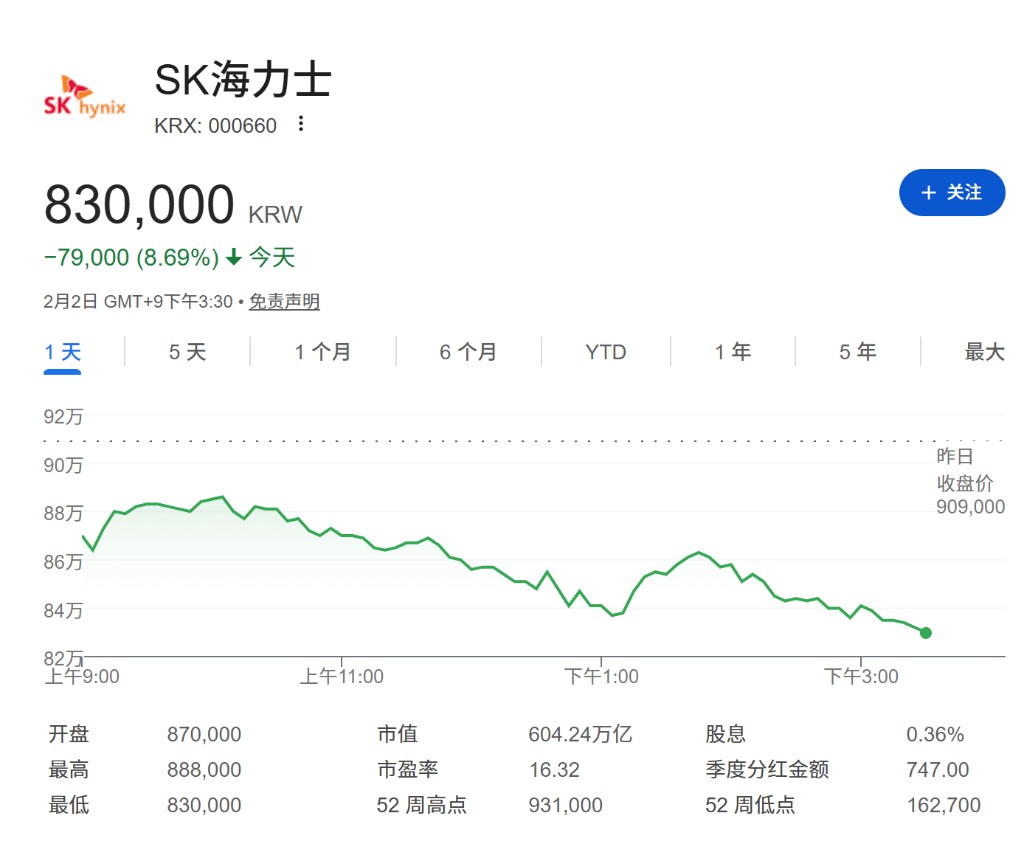
However, Goldman Sachs strongly refuted this pessimistic expectation in its latest research report released on February 2. The report pointed out that despite fluctuations in the spot market, the contract prices of DRAM not only did not decline but instead welcomed a stronger expectation of price increases. Goldman Sachs significantly raised its forecast for the increase in DRAM prices in the first quarter of 2026, expecting a quarter-on-quarter increase of as much as 90-95%, far exceeding previous market and its own expectations.
Against this backdrop, the current market decline is seen as a misreading of the fundamentals. There is a huge price gap between spot prices and futures (contract) prices; currently, the high-priced spot market is in a state of "high price but no market," while the contract market, which truly determines corporate profits, remains in a strong upward channel. Goldman Sachs reiterated its "buy" rating on Samsung (SEC) and SK Hynix, believing that negative news has interfered with the performance of tech stocks, which is actually a "misjudgment" of memory chips.
DRAM Contract Price Expectations Soar: Potential Surge of 95% in Q1
Goldman Sachs analyst Giuni Lee's team noted in the report that the DRAM pricing forecasts for major application areas in the first quarter of 2026 have been significantly raised. In particular, the overall pricing of traditional DRAM is expected to achieve a further quarter-on-quarter increase of 90-95% on the basis of a 45-50% quarter-on-quarter increase in the fourth quarter of 2025. This forecast data is significantly higher than Goldman Sachs' previous expectation of a 77-82% quarter-on-quarter increase for Samsung and SK Hynix, and also exceeds Wall Street's consensus expectations.
For mobile NAND (eMMC/UFS), the contract price in the first quarter of 2026 is also expected to increase by 55-65% quarter-on-quarter, which is basically consistent with Goldman Sachs' previous forecast of a 45-70% quarter-on-quarter increase for overall NAND pricing. Although consumer electronics demand has weakened in the off-season, the strong demand for enterprise SSDs (eSSD) and AI-related storage has led to limited supply quotas for smartphone and PC customers, thereby continuing to push up prices in these sub-markets.
PC and Server DRAM: Supply Shortages Drive Premiums
In the segmented fields, the price increase momentum for PC DRAM and server DRAM is particularly strong. TrendForce has raised its forecast for PC DRAM contract prices in the first quarter of 2026 to a quarter-on-quarter growth of 105-110%, while maintaining a forecast of 20-25% quarter-on-quarter growth for the second quarter. This data is far higher than Goldman Sachs' previous estimate of 80-90%, indicating that there is further upside potential in the market Specifically, in January, the price of DDR4 8GB modules increased by 83% month-on-month to $85, while the price of DDR5 8GB modules rose by 90% to $75. As some price negotiations extended until January and supplier inventories remain tight, there is still a possibility of further price increases for the remainder of this quarter.
The server side is also facing a supply-demand imbalance. Although suppliers have shifted some capacity from PCs and smartphones to servers, supply remains constrained, supported by strong demand from cloud service providers (CSPs) in North America and China, and suppliers maintain strong pricing power. TrendForce has raised its forecast for server DRAM contract prices in Q1 2026 to a month-on-month increase of 88-93%, slightly higher than Goldman Sachs' previous expectation of 75-80%. Notably, the premium of DDR5 over DDR4 is narrowing, with the premium for DDR5 64GB modules compared to the same specification DDR4 dropping to 9% in January.
Mobile DRAM: AI Demand Crowding Out Capacity
The mobile DRAM market is not isolated. TrendForce has significantly raised its price forecast for LPDDR5X in Q1 2026 from a previous month-on-month increase of 45-50% to 88-93%.
The logic behind this aggressive price increase expectation lies in capacity constraints: the strong demand for memory chips from server customers is expanding the supply-demand gap in other application areas. As suppliers prioritize meeting the higher profit margins from server and AI-related demands, the supply of mobile DRAM has become increasingly tight, forcing prices to rise significantly. This latest forecast is also notably higher than Goldman Sachs' previous expectation of a 75-80% month-on-month increase for Samsung and SK Hynix in this area.
Valuation and Target Price: Reiterate Buy Rating
Based on strong price increase expectations, Goldman Sachs has reiterated its positive outlook on the two major memory giants in South Korea. For Samsung, Goldman Sachs has set a target price of 205,000 KRW for common stock based on the EV/EBITDA valuation model for 2026, with main downside risks including deterioration in storage supply-demand and contraction in smartphone profit margins.
For SK Hynix, Goldman Sachs has set a 12-month target price of 1,200,000 KRW. Analysts point out that, given Hynix's significant growth in HBM (High Bandwidth Memory) revenue, it should enjoy a 30% "AI premium" relative to Samsung. This target price is calculated based on a target price-to-book ratio (P/B) of 2.8, referencing the valuation peak during the last strong pricing upcycle (2009-2010).
In summary, although the price fluctuations in the short-term spot market have caused panic among investors, data from Goldman Sachs and TrendForce indicate that the contract prices in the memory chip industry are currently in one of the most intense upcycles in recent years. Concerns about the "peak of the cycle" may be a misjudgment caused by information asymmetry.
