


When it rains, it pours! The Indonesian stock market plummeted 6% due to a sharp decline in commodities

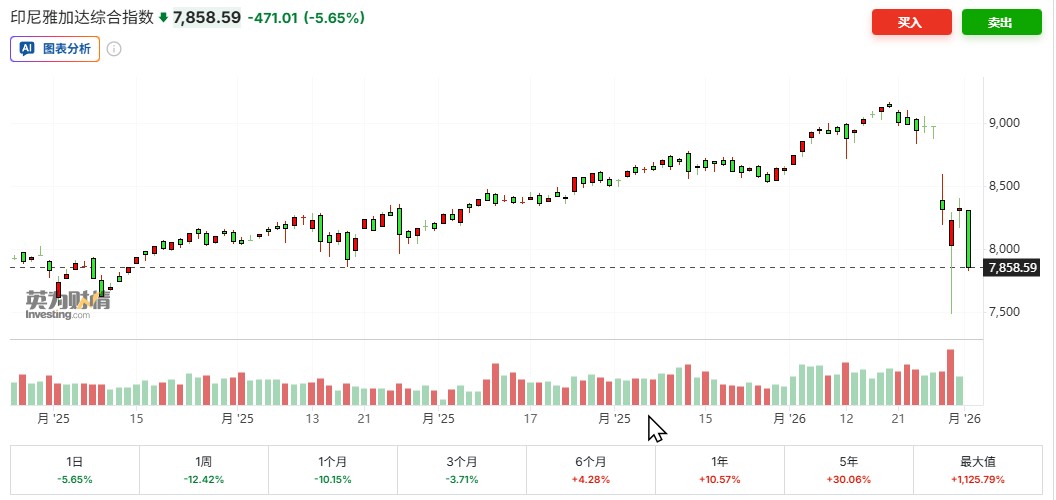
The Indonesian stock market plummeted 6% on Monday, becoming the worst-performing market in Asia, primarily due to weakening commodity prices, with mining and energy stocks leading the decline. The market confidence restoration measures recently initiated by regulators are facing challenges, and MSCI has warned of a potential downgrade for the Indonesian market. Despite the introduction of reform measures, there remains uncertainty about whether the market can meet MSCI's requirements, with Nomura Securities and Goldman Sachs having downgraded Indonesian stock ratings. The continued weakness in commodities may force regulators to adjust their reform strategies, emphasizing short-term stability
The Indonesian stock market continued to plummet on Monday, with the benchmark Jakarta Composite Index dropping 6% during the session, making it the worst-performing market in Asia. This decline is attributed to weakening commodity prices, with mining and energy stocks leading the fall, posing a severe test to the market confidence restoration efforts recently initiated by regulators.
This new round of sell-off comes as Indonesian regulators are intensively rolling out reform measures. Following MSCI's warning last week that it might downgrade the Indonesian market to frontier market status, the Indonesian stock market experienced a "black week," plummeting 16% over two days, with a market capitalization loss exceeding $80 billion, leading to the resignation of exchange CEO Iman Rachman.
Regulators promptly announced a series of reforms, including directing the sovereign wealth fund Danantara to guide its asset management companies to buy stocks and planning to double the minimum free float ratio to 15%.
The drop on Monday followed risk-averse sentiment in Asian markets, with metal prices crashing and the dollar strengthening, after Trump nominated a new candidate for the Federal Reserve chair. The continued weakness in commodities may force regulators to adjust their reform strategies, placing greater emphasis on short-term stability.
Nomura Securities became the latest brokerage to downgrade its rating on Indonesian stocks, citing additional risks, following Goldman Sachs' downgrade last week. Although the reform measures briefly boosted market rebounds last Friday, there remains uncertainty about whether these initiatives can meet MSCI's requirements.
Commodity Price Plunge Intensifies Market Pressure
Monday's sell-off complicated the efforts of Indonesian regulators to stabilize the market. The Jakarta Composite Index briefly fell 6%, with mining and energy stocks being the biggest drag. As a significant commodity-exporting country, Indonesia's stock market is highly sensitive to commodity prices.
Gary Tan, a fund manager at Allspring Global Investments, stated that the ongoing sell-off in commodities may force regulators to "reformulate their plans more defensively, placing greater emphasis on recent stability and buffer measures." He warned that this could slow the momentum of reforms and complicate efforts aimed at improving Indonesia's long-term investability.
Regulatory Reforms Recognized by Institutions but Prospects Uncertain
Despite facing new selling pressures, some institutions hold a positive view of the recent reform measures introduced in Indonesia. Citi Group strategist Ferry Wong stated in a report on February 2 that the newly appointed regulatory head "has practical experience in key areas emphasized by MSCI, such as trading, clearing, settlement, and custody, and should be able to advance execution quickly." Citi believes that a coordinated policy response is "reliable and timely, reducing the risk of MSCI taking more severe follow-up actions."
Oki Ramadhana, CEO of PT Mandiri Sekuritas, stated, "I am 100% confident that with the implementation of transparency measures, our market will be better in the future. It takes time, but we have already seen the government's and Danantara's commitment to encourage a better price discovery mechanism based on supply and demand." David Sutyanto, the chairman of the Indonesian Stock Analysts Association, believes that the "boldness" in the announcement on Sunday is that Danantara will act as a market stabilizer, which may boost market sentiment.
Valuation Discount Cannot Hide Structural Concerns
Morgan Stanley analysts, including Derrick Y Kam, pointed out in a report on January 30 that the MSCI Indonesia Index is currently cheap relative to historical levels, with a 12-month forward price-to-earnings ratio of 11.3 times, which is a 20% discount to emerging markets. However, they warned that "given the slowdown in dollar-denominated earnings growth and the trend of ROE erosion, we believe valuations may remain subdued for some time."
Nomura strategist Chetan Seth downgraded the rating of Indonesian stocks from overweight to neutral, citing investability risks and outflows from passive funds. He stated, "The MSCI warning about a possible downgrade to frontier market status surprised us and the market." Nomura's previous positive stance was based on attractive relative valuations, stabilization of economic and corporate earnings expectations, and low market expectations after a prolonged period of underperformance.
Downgrades from institutions like Goldman Sachs, along with uncertainties in macro policies, have made foreign investors cautious about the Indonesian market. Although regulators have introduced reforms directly addressing MSCI's core concerns, whether this can restore market confidence in the short term remains to be seen.
Risk Warning and Disclaimer
The market carries risks, and investments should be made cautiously. This article does not constitute personal investment advice and does not take into account the specific investment objectives, financial situation, or needs of individual users. Users should consider whether any opinions, views, or conclusions in this article align with their specific circumstances. Investment based on this is at one's own risk.
