


Finding Shovel Sellers Under the Desktop Agent Dividend

OpenClaw is an emerging desktop agent that can deeply access users' computer systems and perform complex tasks, such as comparing car prices, sending emails, and processing insurance claims. It has long-term memory capabilities and can proactively send reminders and briefings, attracting widespread attention. As it gains popularity, more and more users are starting to build their own "Jarvis," while domestic models and cloud vendors have become the invisible winners behind the scenes. The design philosophy of OpenClaw is to run locally to ensure privacy and system security
The surprises in the AI circle continue to emerge.
Recently, a product named OpenClaw (originally called Clawdbot/Moltbot) has rapidly gained popularity in both domestic and international tech communities and social media.
As a deep interactive agent that can run on its own computer and deeply access the user's computer system, files, applications, and chat records, users can issue commands and communicate with the AI in the most natural chat interface.
In the use cases shared by developers, this desktop agent can perform complex tasks such as comparing quotes from dozens of car dealerships, automatically sending emails, tracking replies, and organizing price differences. It can also handle everyday tasks like bulk unsubscribing from emails, processing insurance claims, booking flights, and automatically checking in.
Importantly, it has long-term memory context; it can remember local projects, repetitive tasks, and personal preferences, and can proactively send briefings, reminders, or alerts without needing to be triggered, being described in the industry as a "24/7 standby Jarvis."
Founders, developers, and tech enthusiasts are all trying it out, and overnight, "OpenClaw nanny-level deployment tutorials" have become a traffic secret on Xiaohongshu and Bilibili. Industry insiders say this is the ChatGPT moment for desktop agents.
With the help of network effects and word-of-mouth, more and more people are trying to build their own "Jarvis," while beneath the surface, domestic model players and cloud vendors have quietly become the invisible winners behind desktop agents.
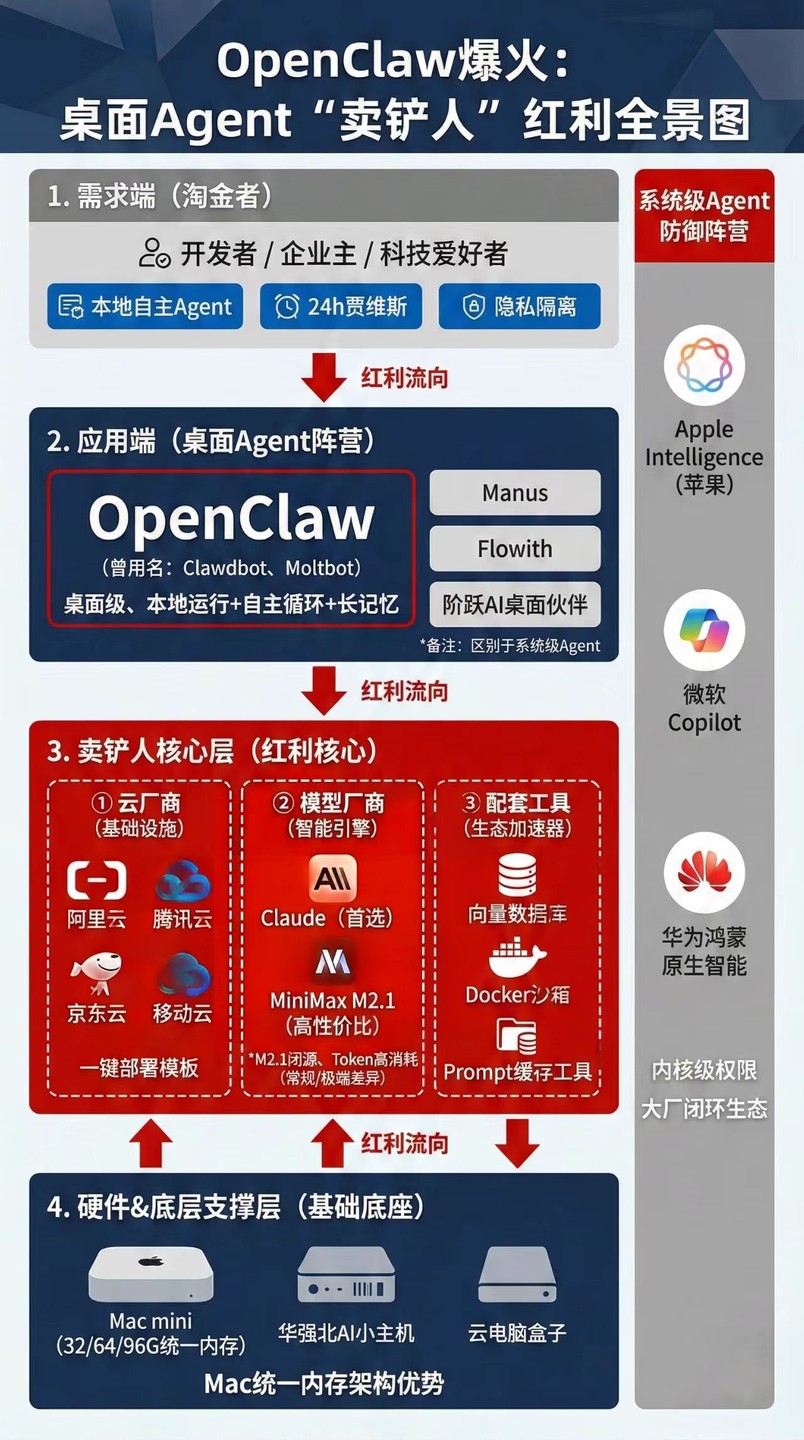
The Shovel Sellers of "Jarvis"
OpenClaw is not the first capable agent on the market, but it has reignited market sentiment after manus, Qianwen Assistant, and "Doubao Phone."
With the explosive popularity of OpenClaw, MacMini has also suddenly become a "financial product," with many early adopters in the community claiming to have purchased large quantities of MacMini to run OpenClaw. Logan Kilpatrick, the head of Google's AI products, is one of them.
The core design philosophy of this desktop agent is local operation, so deploying it on a separate MacMini can avoid mixing with the main work computer, maximizing privacy and system security.
However, as more people learned about this project, another voice quickly emerged: under super high permissions, OpenClaw is more suitable to run in an isolated environment from the main computer, and cloud servers that can be deployed with one click quickly became the "chosen" solution.
On January 28, sensing the opportunity, Alibaba Cloud quickly launched a full suite of dedicated cloud services and provided detailed deployment tutorials;
Tencent Cloud's lightweight application server Lighthouse has also launched OpenClaw application templates, pre-configured with the environment needed to run OpenClaw Subsequently, JD Cloud, Mobile Cloud, and UCloud also joined the ranks.
An AI application architect told Wall Street Insight that trying OpenClaw on a cloud server is a faster and more cost-effective choice, and cloud servers naturally support 24/7 operation, which aligns well with OpenClaw's positioning.
However, if "Jarvis" runs without using local open-source models, it inevitably needs to connect to model APIs, and OpenClaw's "burn rate" quickly becomes apparent.
"OpenClaw has a huge appetite; I originally planned to use over a million tokens in ten days to half a month, but I used them all up in just half an hour." An independent developer from Shenzhen told Wall Street Insight that he recently used OpenClaw to clone a classic Snake game.
"At first, I thought it was powerful; OpenClaw writes code, runs it, and fixes bugs on its own, and I felt like a boss watching it work, but when I saw the API bill, my smile disappeared," the developer said.
Traditional chatbots operate on a "you ask, I answer" basis, often consuming only a few hundred tokens per interaction.
However, the Agent model represented by OpenClaw is "self-cycling." To fix a small rendering error, OpenClaw engaged in over 40 self-dialogues and code attempts within half an hour.
An executive from a modeling company pointed out that applications like OpenClaw heavily rely on two core capabilities: ultra-long context and cost-effective reasoning ability. "Agents need memory; the mainstream approach now is to store context in memory, bringing along previous questions and answers with each new question, which makes the agent's input grow larger and larger."
Therefore, to run this super-powered "Jarvis," an efficient response, hardcore performance, and affordable large model are required.
Under the strong recommendation of project author Peter Steinberger, the M2.1 model from domestic AI unicorn MiniMax, which excels in long text and logical reasoning, has been successfully popularized.
Peter Steinberger stated in an interview, "Currently, I can run MiniMax M2.1 on it, and I believe it's the best model available right now. However, Kimi was just released recently, and I will also try it when I have the opportunity."
In addition, for an Agent to think like a human, it relies on prompt orchestration tools like LangChain, which define the logic for AI to mobilize tools; to remember thousands of file details and historical operations, vector databases like Pinecone or Weaviate become essential external "hippocampi."
The key issue is that when AI has the authority to delete files and modify systems, security becomes the number one challenge. Therefore, Docker containers and various security sandbox technologies become necessities to ensure that AI does not accidentally delete your system disk while working. Although these middleware solutions are not directly user-facing, they form the invisible backbone that supports the stable operation of Agents Just like those in the gold rush, regardless of whether the applications developed by desktop agents ultimately succeed, the profits of the "shovel sellers" behind them are securely pocketed first.
Agent Dividend Diffusion
The emergence of OpenClaw has brought AI "working for people" closer to reality. The appearance of such desktop agents has made the industry realize that future AI will no longer be just an app, but a shadow butler that transcends apps.
Following this pattern, the software landscape will shift from the previous "battle of a thousand models" to a "battle of a thousand endpoints."
Currently, agent players are flourishing everywhere. In addition to Manus, which addresses complex scenario needs, and the recently popular OpenClaw, products like Coze Workflow, Flowith, CherryStudio, MiniMax Agent, and JieYue AI Desktop Partner are all rushing to launch.
It should be noted that agents and models typically complement each other. Manus is backed by a multi-model architecture that includes Claude and Qianwen, and the construction of OpenClaw also requires the selection of models. This reveals a principle: the foundational capabilities of agents are still demonstrated by underlying large models.
When the interaction dividends of desktop agent applications explode, competition will also, to some extent, return to the models themselves. Other foundational model startups, both domestically and internationally—whether OpenAI or domestic companies like DeepSeek and Kimi—have already positioned agents as a focal point: by directly "internalizing" agent capabilities into the models.
This means that in the next six months to a year, more "Jarvis" will emerge both domestically and internationally.
On the other hand, as the embedded system operators, giants like Apple, Android (Google), and Microsoft will not relinquish system entry to desktop robots.
Industry insiders believe that Apple's Apple Intelligence and Microsoft's Copilot are likely to evolve into comprehensive agents at the system level.
After all, they possess permissions that third parties cannot match: difficult-to-obtain screen recording permissions, no need to simulate mouse clicks, and direct interface calls at the system kernel level.
In China, Huawei's HarmonyOS Next with its "native intelligence," Doubao Assistant, and Alibaba's Qianwen Assistant are also working on this.
This is an AI defensive battle belonging to the system providers.
When the built-in assistants not only can converse but also help users with food delivery and sending red envelopes, the penetration space for OpenClaw-like applications in the Chinese mobile and PC markets will also be significantly narrowed.
It can be said that both large model players and major endpoint manufacturers will actively participate in the competition for desktop agents.
At the same time, the hardware market for terminals will also welcome a window of opportunity.
The Mac mini, which has been popularized by OpenClaw, is not due to the performance arrangement of Apple's hardware, but rather stems from the advantageous configuration of the Mac system and memory architecture, as well as the convenience of the MacOS system, coupled with the power consumption advantages of its self-developed ARM architecture SOC But the Mac mini is just the optimal solution "at this moment" and not the endgame.
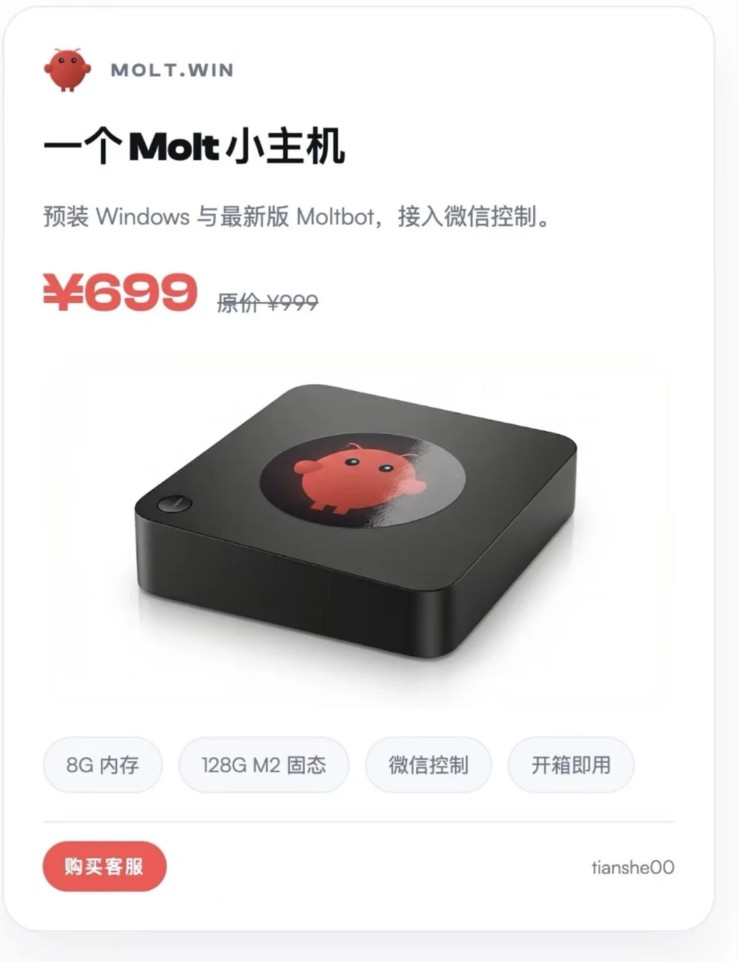
Hardware manufacturers are sniffing out new opportunities. Right now, the fast-moving Huaqiangbei is entering the market with AI mini-hosts pre-installed with desktop Agents.
These small boxes, similar to NUC or Mac mini, run 24/7 and connect to your main machine via a local area network.
Edge computing vendors are also ready to "intercept."
The "cloud computer boxes" being launched by Alibaba, Tencent, and China Mobile are essentially thin clients, with computing power in the cloud. For users who only need lightweight Agents, a cloud box costing a few dozen yuan a month may provide a better experience than buying a Mac mini.
From this perspective, as Cowork and OpenClaw gain traction, a large cake centered around desktop Agents is rapidly taking shape.
The future competitive landscape is gradually becoming clear. At the software layer: third-party open-source Agents will emerge like mushrooms after rain; at the model layer, companies like minimax and Kimi will become the behind-the-scenes shovel sellers; finally, at the hardware layer, a batch of more cost-effective, domestically designed "large memory Mini hosts" or "cloud AI boxes" specifically for AI Agents are on their way.
A battle for desktop control combining software and hardware seems to be about to begin.
Risk Warning and Disclaimer
The market has risks, and investment requires caution. This article does not constitute personal investment advice and does not take into account the specific investment goals, financial situation, or needs of individual users. Users should consider whether any opinions, views, or conclusions in this article are suitable for their specific circumstances. Investing based on this is at your own risk.
