


Reviewing half a century of data: What usually happens when gold's short-term increase exceeds 20%?

Deutsche Bank analyst Michael Hsueh pointed out that when the gold price rises more than 20% over two weeks, the probability of continued price increases in the next six months drops sharply to 38%. The average increase is only 11%. Meanwhile, the probability of a decline reaches 62%, with an average drop of 1%. Deutsche Bank's average gold price forecast for the fourth quarter of 2026 remains at $6,000
Gold prices surged 20% in two weeks, reaching $5,536 per ounce. Such a rapid increase has only occurred a few times in the past fifty years, and each time, the market reached a crossroads.
According to a report from the trading desk, on January 29, Deutsche Bank analyst Michael Hsueh pointed out that a 20% increase in gold over two weeks is a historical dividing line, distinguishing whether gold prices will continue to surge or consolidate.
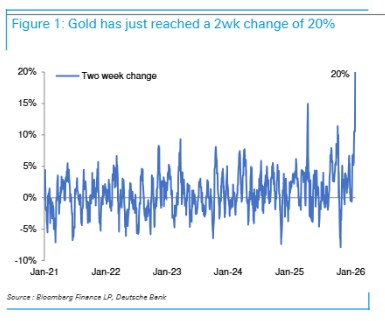 (The two-week increase in gold reached 20%)
When the two-week increase in gold surpasses the 20% threshold, the probability of gold prices continuing to rise in the next six months drops sharply to 38%. The average increase is only 11%. Meanwhile, the probability of a decline rises to 62%, with an average decline of 1%.
Data from half a century shows that similar rapid increases were mostly concentrated in the 1970s and 1980s, a time of rampant inflation where gold price fluctuations were closely tied to inflation cycles. However, today's situation is different. Hsueh wrote in the report:
Current inflation is not the core issue, and the motivations for investors to buy gold are more complex. Historical scripts may not necessarily repeat.
The Faster the Increase, the Worse the Subsequent Performance
Deutsche Bank believes that as the two-week increase in gold accelerates, the probability of further price increases shows a downward trend.
Performance in the 10-15% Increase Range: When the two-week increase in gold is in the 10-15% range, the probability of higher prices six months later is 63%, with an average increase of 21%; the probability of higher prices twelve months later is 67%, with an average increase of 31%. This range shows a relatively healthy subsequent trend.
Performance in the 15-20% Increase Range: When the increase expands to the 15-20% range, the probability of higher prices six months later drops to 60%, with an average increase of 16%; the probability twelve months later drops to 50%, with an average increase of 35%. The probability of further increases has clearly declined.
Performance in the 20-25% Increase Range: Once it breaks through the 20% increase and enters the 20-25% range, the situation takes a sharp turn.
The probability of higher prices six months later plummets to 38%, with an average increase of only 11%; the probability twelve months later falls to 33%, with an average increase of only 2%. This means that at the current price level, the probability of gold declining in the next 6-12 months exceeds 60%.
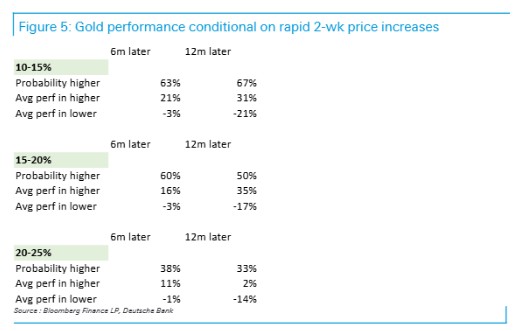
It is worth noting that in the case of a decline, the average decline in the 10-15% increase range over six months is 3%, and the average decline over twelve months reaches 21%; while in the 20-25% increase range, the average decline over six months is 1%, and the average decline over twelve months is 14%.
Rapid surges often indicate excessive consumption of momentum. Historically, the larger the increase, the lower the probability of subsequent rises. Deutsche Bank's report maintains its average gold price forecast at $6,000 for the fourth quarter of 2026. For investors holding long positions in gold, now may be a time to consider taking moderate profits. For those on the sidelines, waiting for a price correction before entering may be a wiser strategy
