


Is a major reversal in oil prices coming? Barclays: "The surplus crisis" is an illusion, and a bull market in crude oil is about to begin!

Barclays believes that the "excess narrative" itself is untenable, and the so-called "4 million barrels per day surplus" has not materialized in reality. The true demand is underestimated, and refinery profits and futures structure are "voting with their feet." By 2028-2030, the annual increase in non-OPEC oil supply may approach zero. With demand still present and spare capacity disappearing, oil prices can only seek balance upwards
According to the Wind Trading Platform, amidst the consensus that "oil will face an epic surplus," Barclays has provided a markedly contrary market judgment: the current concerns about supply surplus are overestimated in scale and exaggerated in duration, while the truly significant changes will occur after 2026.
In Barclays' view, the current situation is not the starting point of an oil bear market, but rather resembles the "last emotional mismatch" before a multi-year upward cycle.
Why is the market misjudging? The "surplus narrative" itself is untenable.
Over the past year, the market has repeatedly cited the supply and demand forecasts from the IEA and EIA, believing that a supply surplus of 400,000–4 million barrels per day will emerge in the global oil market by 2026. However, Barclays emphasizes that if a surplus truly exists, it should first be reflected in inventories.
However, real data does not support this judgment, and Barclays believes that the reality does not support this judgment.
First, the so-called "4 million barrels per day surplus" has not appeared in reality.
Whether in onshore commercial inventories, offshore floating storage, or in-transit crude oil, all are significantly below the levels implied by these models. The price itself provides the answer—Brent crude prices have not fallen into the 40–50 dollar range repeatedly anticipated by the market, but have shown significant resilience.
Second, the issue is not "disappearing crude oil," but rather the underestimated real demand.
Barclays points out that the market is not "miscalculating supply," but is systematically underestimating the absolute level of demand. Different institutions have a discrepancy of over 2 million barrels per day regarding the "starting point" of oil demand in 2026. The so-called "missing barrels" have not disappeared but are obscured by statistical standards and data lag.
Third, refinery profits and futures structure are "voting with their feet."
Even in the seasonally weakest winter window, global refining profits remain at a considerable level, sufficient to incentivize refineries to continue operations; the Brent and WTI futures curves have long maintained a backwardation, which typically means that the spot market is still paying a premium for immediate supply rather than being suppressed by a surplus.
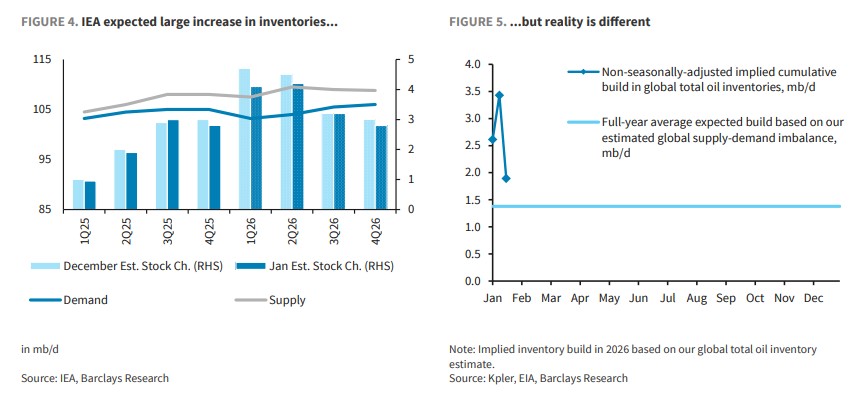
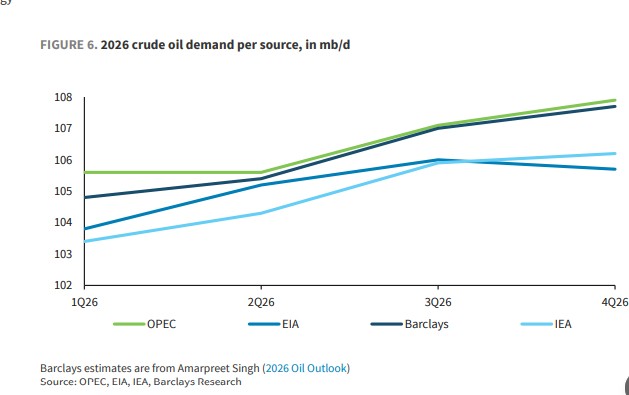
In Barclays' view, these three points collectively point to one conclusion: there may be a short-term surplus, but the scale is closer to 1.5 million barrels per day, and the duration is very limited.
The real turning point is not now, but after the "non-OPEC supply paradigm" changes.
If the short-term divergence stems from a misreading of "inventories and demand," then Barclays' underlying logic for being bullish on oil points to changes in the supply structure after 2026 Over the past decade, there has been an implicit premise in the global crude oil market: as long as oil prices rise, U.S. shale oil will quickly fill the gap. However, this premise is now failing.
The latest EIA forecast shows that U.S. crude oil production is expected to reach a historical high of approximately 13.6 million barrels per day in 2025, but will see almost no growth in 2026 and may even slightly decline to around 13.3 million barrels per day in 2027. This indicates that the supply elasticity of "oil prices rise, production immediately follows" seen in the past decade is clearly weakening.
Barclays points out that as core blocks mature, costs rise, and the industry becomes highly concentrated, it has become increasingly difficult for U.S. crude oil production to play the role of an "automatic regulator." According to Barclays' estimates, in the next five years, U.S. crude oil supply is more likely to show "essentially flat or even slight fluctuations," rather than continuous growth.
Although there are many new international projects, their pace is much slower than the market imagines. Deepwater projects in Brazil and Guyana will indeed contribute to new production in the coming years, but these projects have a clear "start-up - ramp-up - steady state" process, making it difficult to respond quickly like shale oil. More importantly, against the backdrop of a continuously rising natural decline rate, new projects are more about "filling gaps" rather than creating net increments.
Within this framework, Barclays provides a striking judgment: by 2028-2030, the annual net increase in non-OPEC crude oil supply may approach zero.
When demand remains and spare capacity is disappearing, oil prices can only seek balance upwards
The real danger of changes on the supply side is that it is rapidly eroding OPEC+'s "safety cushion."
Barclays' calculations show that if the demand path lies between the IEA and OPEC forecasts—this is a relatively mild but more realistic assumption—then OPEC+'s available idle capacity will significantly decline around 2027, potentially nearing limit levels by the end of this decade.
What does this mean? It means that the future crude oil market will shift from a "price-driven cycle" back to a "supply-constrained cycle":
- Geopolitical conflicts, extreme weather, and political risks will be amplified quickly;
- The volatility range of oil prices will be elevated overall;
- The market will require higher long-term oil prices to re-incentivize capital expenditure and supply return.
In this sense, Barclays believes that the efficiency improvements brought by AI, and even potential production capacity, are not reasons to suppress oil prices, but rather a "just enough" patch. Even with the full implementation of AI, the additional production it can contribute will only be a part of the future supply gap.
This is not a "trading rebound," but the starting point for cycle repricing
Based on the above judgments, Barclays has a very clear attitude towards energy assets: we are not at the end of the cycle, but rather in the "undervalued pricing phase" of a multi-year upward cycle.
This is also why, even though oil prices have not fully broken through, energy stocks have already outperformed—markets are beginning to price in the new assumption of "higher oil prices lasting longer," but valuations still remain far below historical cycle peaks More importantly, differentiation is occurring:
- The quality of upstream resources and the lifespan of reserves have once again become the core of valuation;
- The oil service sector, due to long-term high visibility, possesses stronger "cyclical extensibility";
- The traditional labels of "high dividend, defensive" are being replaced by "supply scarcity."
In summary: According to Barclays, the market is still debating the "theoretical surplus of 2026," while the truly important changes have quietly occurred within the structure of supply.
If this judgment holds, then the next story for crude oil is not "where it will drop to," but "where the multi-year bull market will begin to be confirmed."
