


The US dollar experiences its largest decline since the tariff turmoil in April last year! Traders anticipate further depreciation

The unpredictability of U.S. policies—including Trump's threat to take over Greenland, the risks of pressuring the Federal Reserve, concerns about the fiscal outlook and debt burden, and political polarization—are eroding market sentiment and dampening investor interest in U.S. assets. The Bloomberg Dollar Spot Index has seen its steepest four-day decline since April of last year, with the options market betting on further declines in the dollar, and the premiums for short-term contracts betting on a weaker dollar have risen to the highest level since Bloomberg began compiling data in 2011
The US dollar is experiencing its most severe sell-off in nearly four years, with traders betting that the dollar will weaken further. The Bloomberg Dollar Spot Index has seen its steepest four-day decline since the announcement of comprehensive tariffs in April last year, and the cost investors are paying to hedge against deeper sell-offs has reached a record high.
The decline of the dollar has propelled other major currencies to multi-year highs. The euro and the pound have both risen to their strongest levels in about four and a half years, while the yen has rebounded significantly after Japanese officials hinted at possible intervention to support the currency, marking its best three-day gain since the global arbitrage trading collapse last August.
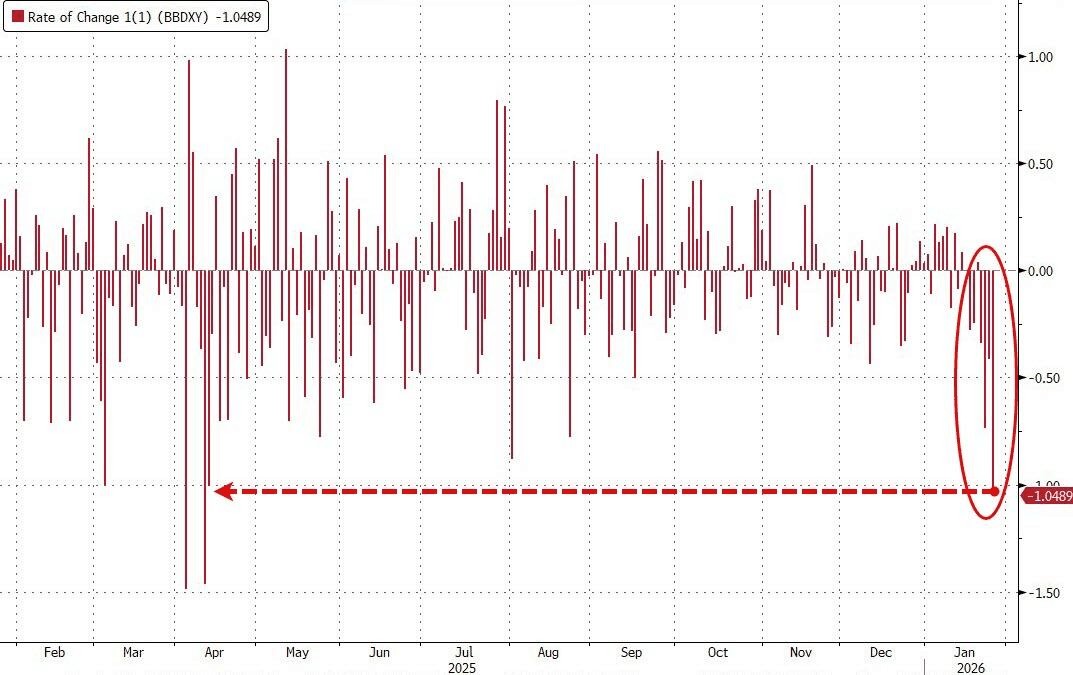
This round of declines is driven by multiple factors. The unpredictability of US policy—including Trump's threat to take over Greenland, which shocked European allies, the risks of Trump pressuring the Federal Reserve, concerns about the US fiscal outlook and debt burden, and political polarization—are all eroding market sentiment. James Lord, head of emerging markets currency strategy at Morgan Stanley, stated, "Unconventional catalysts are driving the dollar weaker," and policy uncertainty is undermining investor interest in US assets.
The Bloomberg Dollar Index fell to its lowest level since March 2022 on Tuesday, continuing its weakness after experiencing its worst annual performance since 2017.
Expectations for Yen Intervention Rise
The surge in the yen has become a key factor putting pressure on the dollar. Traders revealed last Friday that the New York Fed contacted financial institutions to inquire about the yen exchange rate—this preliminary step is typically taken before intervention, reigniting market speculation about coordinated currency intervention.
George Catrambone, head of fixed income at DWS Americas, stated that the Fed officials' inquiry into the dollar-yen exchange rate "further depressed the dollar." The yen rose to 152.43.
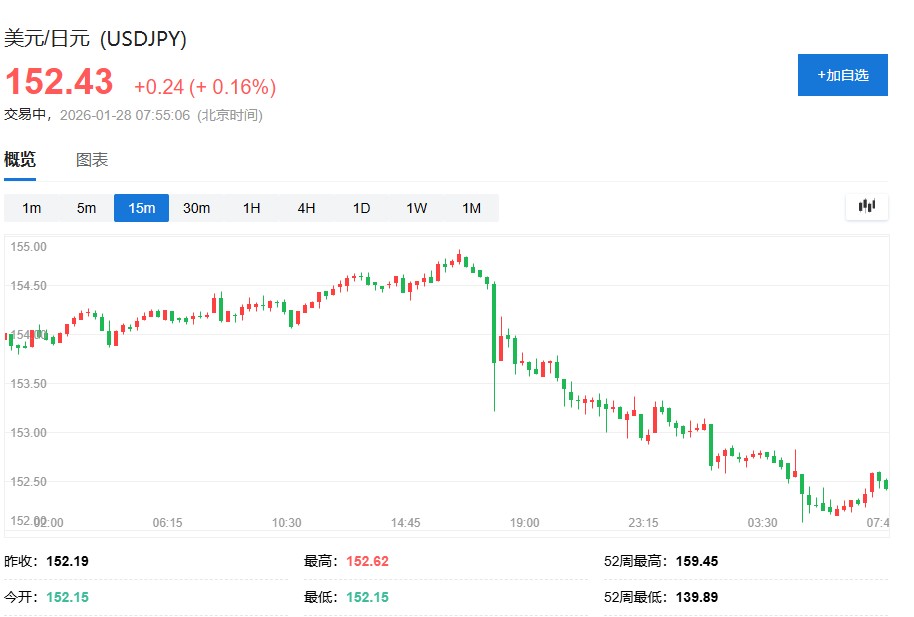
Japanese Finance Minister Shunichi Suzuki confirmed after the G7 meeting on Tuesday that the government would closely coordinate with US authorities to take appropriate action against exchange rate fluctuations if necessary. This statement reinforced market expectations for potential intervention.
Major Currencies Strengthen Across the Board
The weakness of the dollar has provided broad support for global currencies. The euro reached $1.1990, its strongest level since 2021. The pound rose 0.8% to $1.3791, also a new high since 2021. The Swiss franc surged 1.4% to $0.7660, reaching its strongest level since 2015.
The emerging market currency index has risen for the fourth consecutive day, reaching a historical high after accounting for interest returns. Karl Schamotta, chief market strategist at Corpay, noted that "Washington's shift towards protectionism and weakened security commitments are prompting other countries to increase defense spending and strengthen competitive focus, compressing the growth and interest rate differentials that previously favored the dollar."
Options Market Bets on Further Decline of the Dollar
The options market shows that investors' expectations for the depreciation of the dollar are heating up. The premium on short-term contracts betting on a weaker dollar has risen to the highest level since Bloomberg began compiling data in 2011. The bullish expectations for other currencies have also reached multi-month highs, approaching or equating to levels seen after the tariff introduction in April last year.
Bloomberg strategist Mark Cranfield stated, "The huge trading volume in G-10 currency options this week supports the view that the theme of dollar depreciation is gaining traction among investors. Whether the Fed's rate inquiry marks the beginning of the so-called 'Mar-a-Lago agreement,' macro traders are independently judging that the dollar is in a declining channel."
Trading volume has been exceptionally active. On Monday, the volume through the Depository Trust Clearing Corporation reached the second-highest level on record, second only to April 3, 2025.
Policy Risks Continue to Ferment
Despite robust performance in U.S. economic data, traders expect the Fed to maintain interest rates on Wednesday, but the market still anticipates nearly two rate cuts of 25 basis points this year, contrasting with many other major central banks that are expected to remain unchanged or even raise rates.
Trump's pending choice for the next Fed chair is also impacting the dollar, with market speculation that the new chair may be more inclined to lower borrowing costs. Another risk of a federal government shutdown is brewing, as Democrats vow to block the congressional spending bill unless Republicans remove funding for the Department of Homeland Security.
Barclays analysts Mitul Kotecha and Lhamsuren Sharavdemberel wrote on Tuesday, "We are seeing the risk premium on the dollar accumulate again," noting the dollar's poor performance following Trump's Greenland threat.
Bank of Nassau Chief Economist Win Thin stated, "The ongoing momentum of dollar selling this week is fierce, indicating that there is still some room for the dollar to decline."
