


Japanese Finance Minister: Will coordinate with the U.S. on exchange rate actions if necessary, yen rises in the short term

Japan's Finance Minister Shunichi Suzuki stated that if necessary, they will coordinate with the United States to take appropriate exchange rate actions to push the yen higher against the dollar in the short term. Market expectations for a possible joint intervention by the U.S. and Japan have increased, as the New York Federal Reserve previously inquired about USD/JPY quotes from several institutions, which is seen as a potential sign of intervention. Although short-term depreciation pressure has eased somewhat, institutions generally believe that USD/JPY may seek a new equilibrium in the mid-term around the 147-149 range
Japan's Finance Minister Katsunobu Kato stated that if necessary, appropriate actions will be taken in close coordination with U.S. authorities regarding exchange rate fluctuations. Following this statement, the yen appreciated against the dollar in the short term.
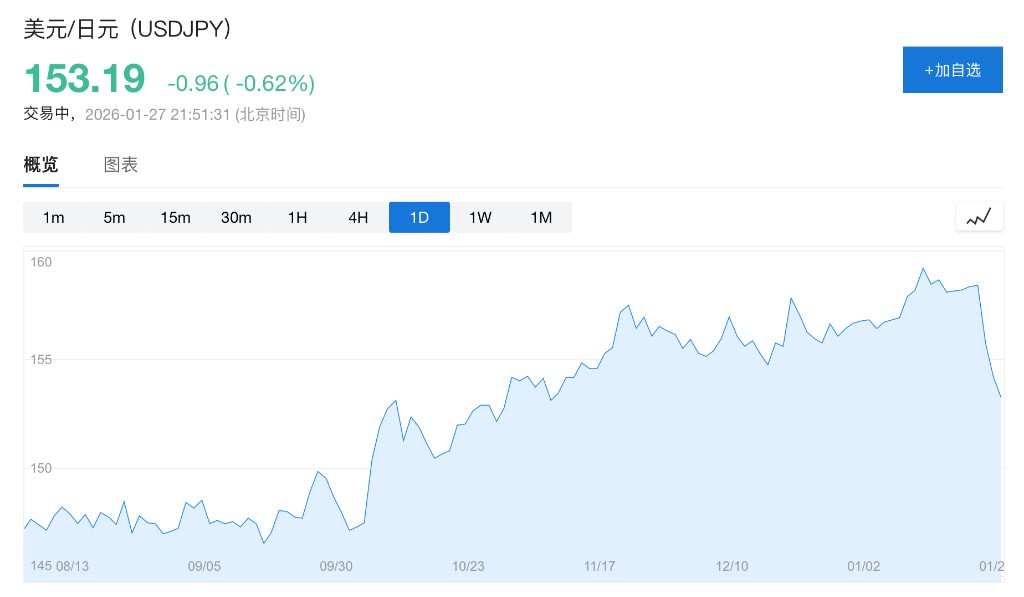
Kato made the remarks after the G7 finance ministers' meeting. When asked whether the Japanese government had intervened in the market or conducted exchange rate checks, she responded that appropriate actions would continue to be taken as needed and that they would strictly adhere to the spirit of the joint statement by the U.S. and Japanese finance ministers from last September, maintaining close cooperation with the U.S., but she declined to comment on the specific exchange rate movements of the day.
The yen rose more than 1 yen against the dollar on Tuesday evening, as market expectations grew that Tokyo might soon take measures to buy yen. As of the time of writing, the dollar-yen exchange rate was reported at 153.19.
Expectations of U.S.-Japan Joint Intervention
Last Friday's unconventional market operation sparked heightened attention to the possibility of U.S.-Japan joint intervention in the foreign exchange market. According to informed sources, the New York Federal Reserve, under the direction of the U.S. Treasury, consulted several major financial institutions for real-time exchange rate quotes for the dollar-yen pair.
Such inquiries are typically seen as a precursor signal that authorities are considering direct market intervention, and some analysts believe this could be an important indication that the U.S. intends to assist Japan in stabilizing the yen's exchange rate. The market reacted quickly, generally interpreting this as a consensus between the two countries to curb the yen's depreciation, triggering a large-scale short covering of the yen.
It is worth noting that direct U.S. intervention in the foreign exchange market is extremely rare. According to publicly available information from the New York Federal Reserve, the U.S. has only intervened in the foreign exchange market on three different occasions since 1996, with the most recent instance occurring after the 2011 Japan earthquake, when the U.S. acted in concert with other G7 countries to stabilize market order by selling yen.
Yen Depreciation Pressure Eases, 147-149 Becomes Mid-term Focus
The yen showed a corrective trend during today's Asian trading session. Earlier, driven by expectations of possible U.S.-Japan coordinated intervention in the foreign exchange market, the yen significantly appreciated. However, market analysis pointed out that the recent rebound has partially alleviated the depreciation pressure on the yen, which may weaken the urgency for authorities to take emergency intervention actions in the short term.
Previously, the yen had continued to weaken, nearing the critical psychological level of 160 yen per dollar. The government of Suga Yoshihide announced plans to freeze the food consumption tax for two years, raising market concerns about its debt sustainability. The fluctuations in the yen's exchange rate and the Japanese government bond market are intertwined, putting the incumbent government, which is facing an upcoming election, under dual pressure to maintain market confidence.
As intervention expectations continue to influence market sentiment, several institutions are analyzing and assessing the new equilibrium range that may be established for the dollar/yen exchange rate. The market is gradually forming a key consensus: the 147-149 range is expected to become an important technical area that attracts substantial buying support in the mid-term. Goldman Sachs trader Kristian Brauten-Smith pointed out that considering the potential intervention may have more lasting effects, and that other G10 currencies have appreciated against the US dollar by about 10% from previous levels, the USD/JPY exchange rate may need to fall back to the 147-149 range to attract firm allocation buying again. This technical judgment is also supported by fundamentals—Goldman Sachs' calculations show that the level around 147 is basically consistent with the fair value of the exchange rate implied by the difference in 10-year real interest rates
