


The power supercycle has erupted, and the real opportunity is not at the generation end?

The core contradiction of the power supercycle has shifted to improving electricity usage efficiency. Bernstein's analyst team pointed out that the United States is expected to face a power supply gap of 50 gigawatts by 2030, and the global power industry supercycle has begun. Despite the soaring stock prices of power generation companies, companies focused on distribution and power management have seen a decline, reflecting the market's limited understanding of the power supercycle. Technological innovations such as 800-volt data center architecture and 765-kilovolt transmission lines can effectively enhance electricity efficiency and fill the supply-demand gap. The annual growth rate of electricity demand is expected to reach 3.5%, with the speed of the supply-demand gap widening exceeding expectations
The core contradiction of the power supercycle has shifted from "how to increase power generation capacity" to "how to improve power usage efficiency."
According to the Chasing Wind Trading Desk, the analyst team led by Chad Dillard at Bernstein pointed out in their latest research report that as the United States is expected to face a power supply gap of 50 gigawatts by 2030, a supercycle covering the global power industry has fully commenced. However, the capital market's reaction reveals a significant cognitive bias: over the past 12 months, stocks of power generation companies such as Caterpillar and Cummins have surged 80% relative to the S&P 500 index, while companies focused on distribution and power management, such as Eaton, Schneider, and ABB, have seen their stock prices decline by 10%, significantly underperforming the market.
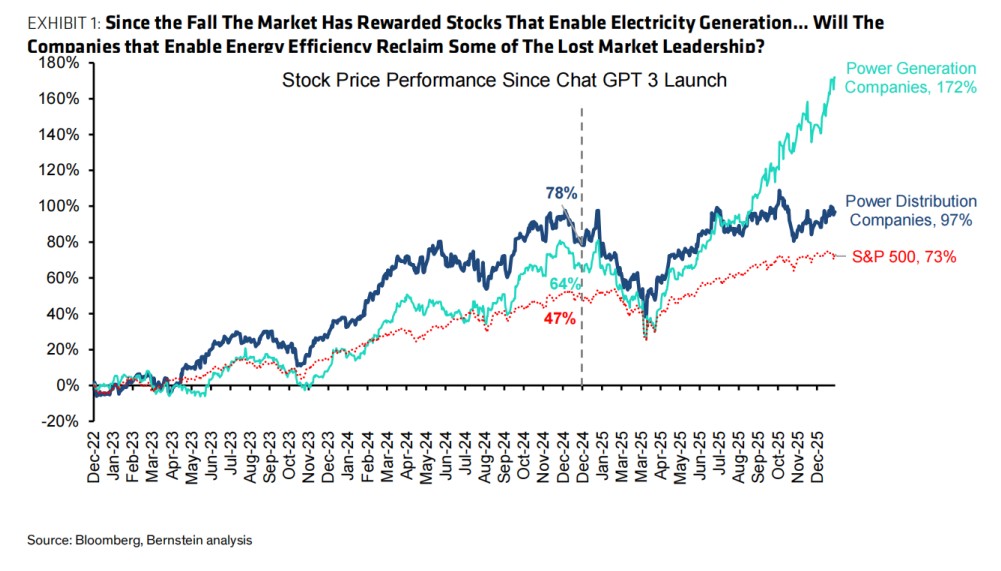
This valuation divergence reflects the market's limited understanding of the power supercycle. Most investors are fixated on the brute-force expansion logic of "building more power plants," neglecting the optimal solution to address power shortages: enhancing power efficiency through technological innovation without increasing generation capacity.
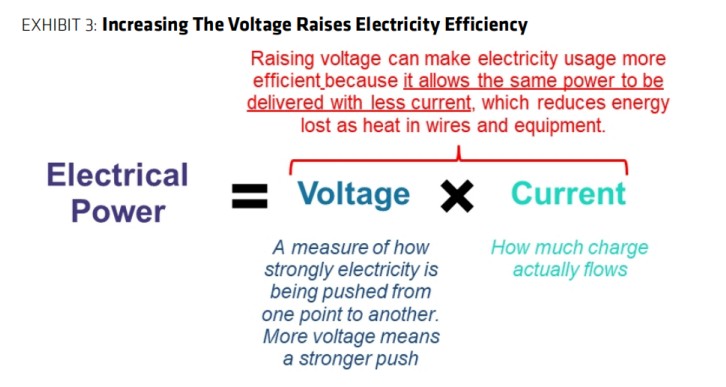
The Bernstein report indicates that the 800-volt data center architecture and 765-kilovolt transmission lines, each of which can improve power efficiency by up to 5%. This figure may seem modest, but it can effectively fill the supply-demand gap without adding new generation capacity.
As the power cycle transitions from the first stage of "capacity expansion" to the second stage of "efficiency improvement," previously undervalued distribution and power management companies are expected to recover lost ground and reshape the market landscape.
Cognitive Bias Under Demand Explosion and Supply Bottlenecks
The driving logic of the power supercycle is essentially a dual pressure of explosive demand and supply bottlenecks. The explosive growth of the AI industry has become a core driver: each new generation of chips from NVIDIA continues to increase server rack density, and after the launch of the Rubin Ultra GPU in 2027, rack density will exceed 600 kilowatts, far surpassing current levels.
Grid operators predict that the annual growth rate of electricity demand will reach 3.5%, while this growth rate has been nearly flat over the past 20 years. More critically, for every 1% increase in electricity demand, a 2.5% increase in transmission capacity is required, and the speed at which the supply-demand gap is widening far exceeds market expectations. Schneider Electric has warned that the U.S. will face a power supply gap of 50 gigawatts by 2030, equivalent to 10% of current U.S. electricity demand, and the gap is expected to further expand to 100 gigawatts by 2033.
On the supply side, traditional power generation expansion faces multiple constraints: new power plants not only have long cycles and high capital expenditures but are also subject to land, environmental protection, and other policy restrictions, making it difficult to quickly fill the gap. However, the market remains obsessed with the "brute-force expansion" path, allowing power generation stocks to enjoy valuation premiums Bernstein defines this phase as the "first stage" of the power cycle, which addresses supply shortages through new capacity. However, the "second stage" of the cycle is already on the horizon: with the large-scale application of high-voltage technology, improvements in power efficiency will replace mere capacity expansion as the core means of addressing shortages.
800V Architecture: The Efficiency Revolution of AI Data Centers
The upgrade of rack density in AI data centers has directly spurred the iterative demand for power architecture. The current mainstream 54V architecture will face three irreconcilable issues once rack density exceeds 200 kilowatts: spatial constraints, a surge in material consumption, and low conversion efficiency.
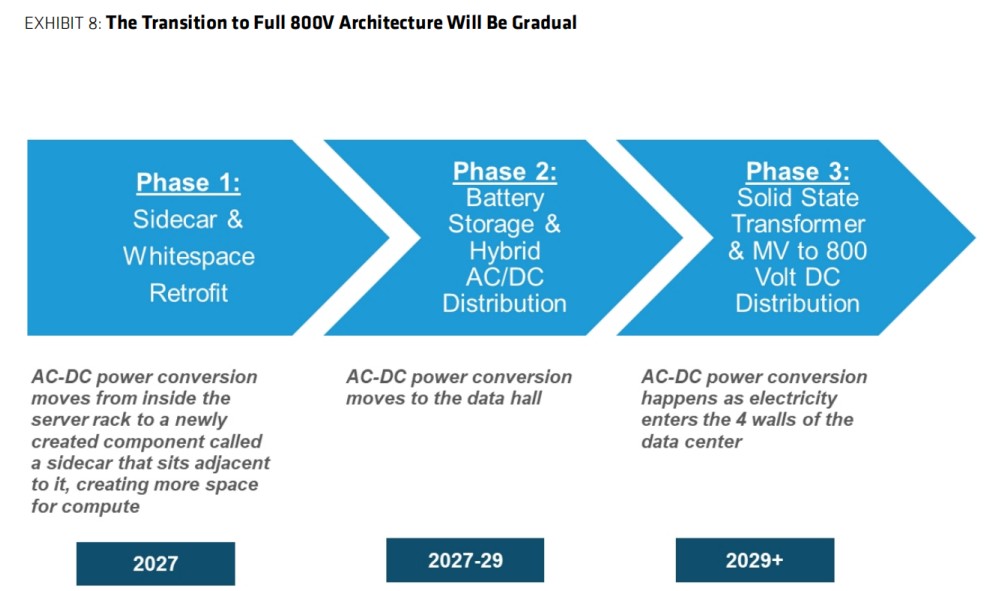
The 800V direct current architecture fundamentally addresses these pain points. Unlike the 54V architecture, where power enters the data center as 14 kV alternating current and is delivered to chips after multiple voltage reductions, in the 800V architecture, power enters the data center in the form of 800V direct current and maintains that voltage within the facility until it is reduced to 0.8V direct current just before reaching the servers.
This transformation brings three core values: first, efficiency improvement, as reducing conversion steps lowers power loss by 5%, potentially saving nearly $1.2 billion in electricity costs annually for a 1-gigawatt data center, with cumulative savings of $35 billion over a 30-year lifecycle; second, cost optimization, as the simplified architecture reduces component and material requirements; third, space release, as AC-DC conversion equipment is moved out of the rack, freeing up more usable space for computing equipment.
Technological transformation will inevitably drive equipment iteration: traditional AC equipment will be fully replaced, while new products such as solid-state transformers, DC busbars, energy storage modules, DC switchgear, and rack-level DC power supplies will see explosive demand. This also explains Eaton's strategic intent in acquiring Resilient Power Systems—to seize the core track of solid-state transformers.
NVIDIA has taken the lead in building an industrial ecosystem for the 800V architecture, establishing official collaborations with leading original equipment manufacturers such as Eaton, Schneider, ABB, Vertiv, Hitachi, and Navitas. Eaton has calculated that the overall potential market for power-related services in AI data centers is $2.1 million per megawatt, and the efficiency improvements brought by the 800V architecture are expected to allow original equipment manufacturers to capture an additional $100,000 in value per megawatt, equivalent to 6% of the overall potential market.
765kV Transmission: The Capacity Revolution of Grid Upgrades
The last time the United States built a 765 kV transmission line was 20 years ago. Over the past 20 years, electricity demand has nearly stagnated, and the expansion of 345 kV and 500 kV lines has been sufficient to meet demand. However, with the turning point of electricity demand approaching, the conditions for restarting 765 kV transmission lines are now fully mature.
Compared to traditional transmission lines, 765 kV lines have overwhelming advantages: a single line can transmit 2 to 2.5 gigawatts of power, equivalent to the capacity of 4 to 6 345 kV lines, sufficient to meet half of New York City's electricity demand; the cost per mile is 50% to 60% lower than that of 345 kV lines, occupying 55% to 75% less land area, and reducing power loss by over 50%
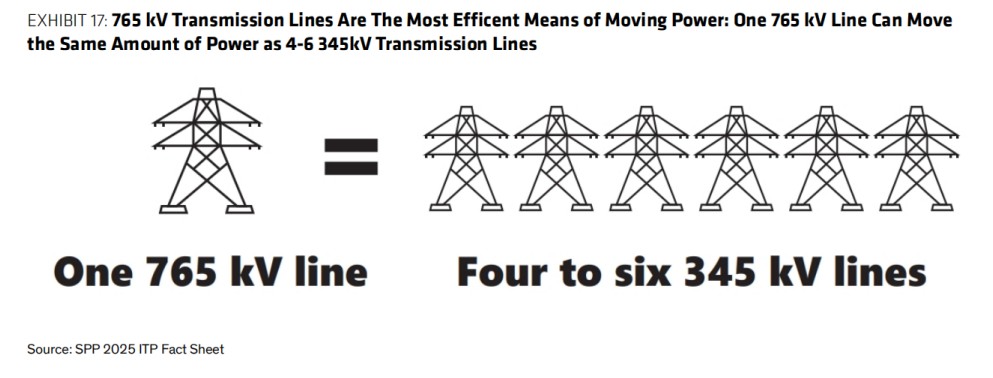
In the current context of tight land resources and strict environmental protection requirements, this advantage is particularly crucial. The centralized distribution of large loads such as data centers and industrial facilities requires long-distance, high-capacity transmission channels, and 765 kV lines precisely match this demand.
In terms of market structure, Quanta Services holds an absolute dominant position, having constructed 75% of the 765 kV lines in the United States. Recently, it established a partnership with the American Electric Power Company, which operates 90% of the 765 kV lines nationwide, creating an unshakeable competitive barrier in this niche market.
Although some data centers may choose on-site power generation, considering that no new 765 kV lines have been built in the U.S. for 20 years, the gap in transmission capacity remains significant, and the long-term opportunities for high-voltage transmission have not diminished.
The above exciting content comes from the Wind Chaser Trading Platform.
For more detailed interpretations, including real-time analysis and frontline research, please join the【 **Wind Chaser Trading Platform ▪ Annual Membership**】

Risk Warning and Disclaimer
The market has risks, and investment requires caution. This article does not constitute personal investment advice and does not take into account the specific investment goals, financial conditions, or needs of individual users. Users should consider whether any opinions, views, or conclusions in this article align with their specific circumstances. Investing based on this is at your own risk.
