


HSBC closes its network, HANG SENG BANK officially bids farewell to the Hong Kong Stock Exchange

On January 27th, HANG SENG BANK announced that it has withdrawn its listing status on the Hong Kong Stock Exchange. After completing the relevant legal procedures and privatization plan, this…
On January 27th, HANG SENG BANK announced that it has withdrawn its listing status on the Hong Kong Stock Exchange.
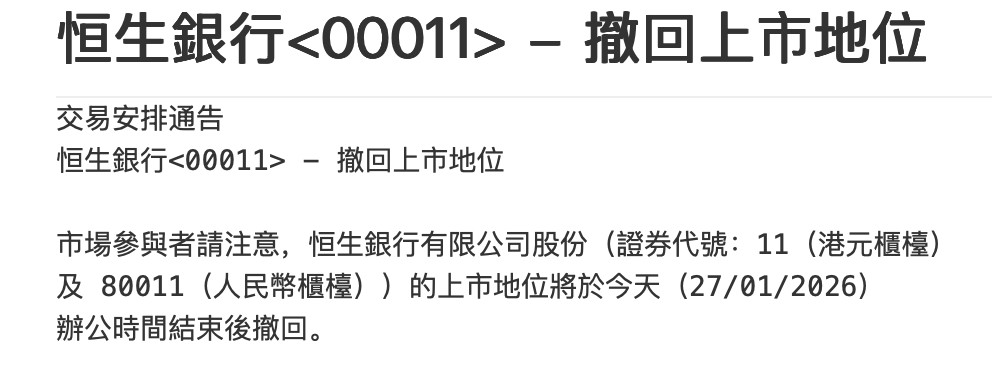
After completing the relevant legal procedures and privatization plan, this 93-year-old local bank in Hong Kong will become a wholly-owned subsidiary of HSBC HOLDINGS.
According to the arrangement, the delisted HANG SENG BANK will retain its independent brand, existing branch network, and original management team;
For ordinary depositors, the green and white sign on the street remains, but for the capital market, the code "00011.HK" will be completely archived in history.
This farewell is subtle yet profound.
Previously, HSBC already held more than 60% of HANG SENG BANK's shares, and speculation about whether HSBC would privatize HANG SENG has never ceased in recent years.
The shoe has finally dropped today.
From the perspective of the delisting motivation, for the parent company HSBC, full control means being able to allocate internal capital more flexibly and eliminate the "friction costs" caused by minority shareholder rights.
More critically, in the current environment of the Hong Kong stock market, bank stock valuations have long been at low levels;
Through privatization, HSBC can fully consolidate the profits generated by HANG SENG BANK, which is a calculable benefit for HSBC, which urgently needs to boost its long-term ROE (Return on Equity).
For HANG SENG BANK itself, delisting may also be a form of liberation.
As a benchmark for local banks in Hong Kong, HANG SENG has faced multiple challenges in recent years: weak local credit demand, pressure to clean up risks related to mainland property stocks, and competition in retail business brought by virtual banks.
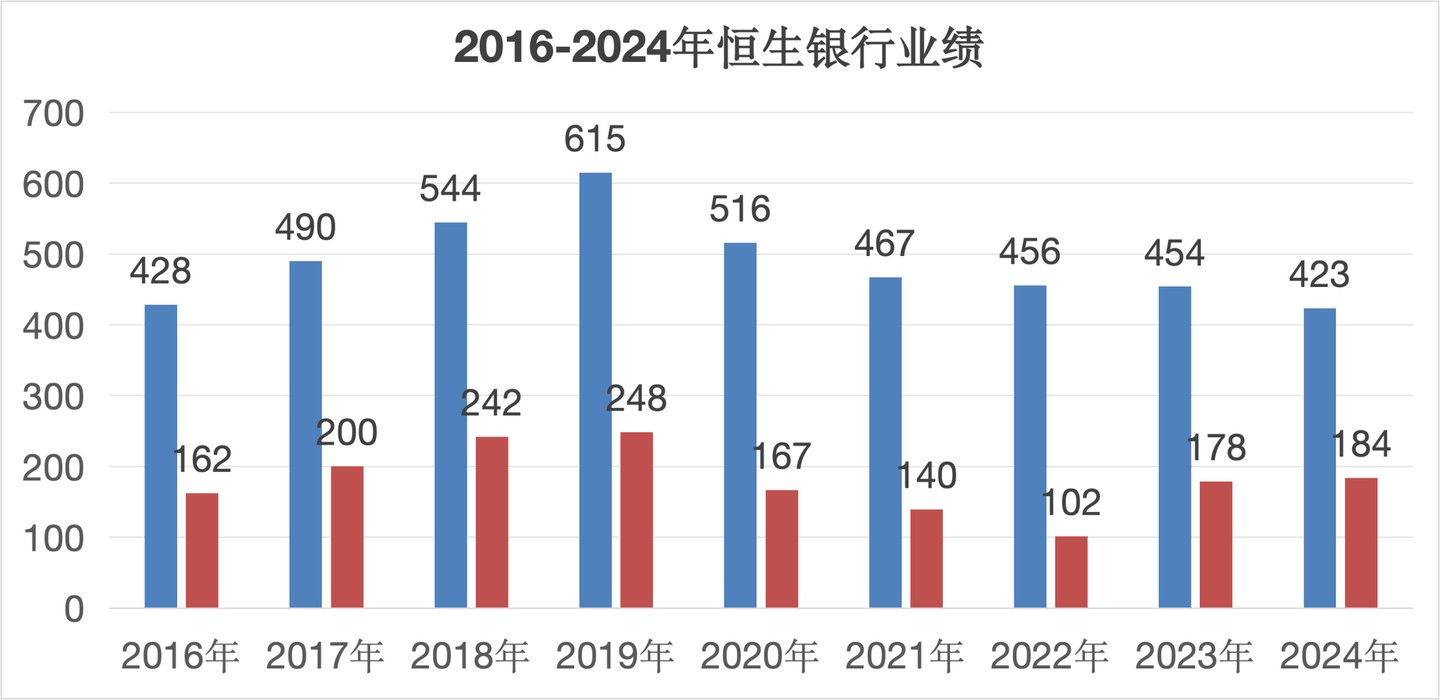

Losing its listing status means that HANG SENG no longer needs to explain to public shareholders for every quarterly fluctuation in short-term financial reports; management can focus more on long-term business transformation and risk control, especially in the deep layout of cross-border wealth management business in the Greater Bay Area, allowing for more seamless strategic collaboration with the HSBC parent.
Delisting does not mean the fading of the "HANG SENG" name.
HSBC's clear decision to retain HANG SENG's independent brand and management team is a pragmatic choice;
In the local Hong Kong market, the goodwill and community penetration accumulated by the name "HANG SENG" are difficult for the HSBC brand to fully replace. Retaining independent operations not only soothes local customers' sentiments but also maintains the stability of frontline operations.
It is worth noting that HANG SENG BANK's exit also reflects the changes in the banking ecosystem in Hong Kong.
Once upon a time, the Hong Kong stock market was active with several locally owned family banks or small to medium-sized banks with distinct characteristics; With the successive acquisitions or privatizations of Chuangxing Bank and Wing Hang Bank, the delisting of HANG SENG BANK today further announces the end of the era of "feudal lords' fragmentation."
From today onwards, there will be no more 00011 in Central, replaced by the larger and more unified financial landscape of HSBC HOLDINGS
