


Why is "digital gold" Bitcoin not a safe haven despite the craziness of gold?

Rodrigues believes that Bitcoin's characteristics of 24-hour continuous trading, deep liquidity, and instant settlement make it the most liquid asset. During times of economic uncertainty, Bitcoin acts more like an "ATM," where investors quickly sell Bitcoin to raise cash. Bitcoin is more suitable for hedging long-term concerns, such as large-scale devaluation of fiat currency or sovereign debt crises, while the current market turmoil is seen as "transitional."
CoinDesk recently published an analysis article written by Francisco Rodrigues, exploring a phenomenon that confuses cryptocurrency supporters: why Bitcoin has failed to serve as a safe haven like gold during market turmoil?
The author Rodrigues points out in the article that, theoretically, Bitcoin should perform well during uncertain times as it is a censorship-resistant "sound money." However, the reality is quite the opposite—when market panic occurs, Bitcoin is often the first asset investors sell off.
From the recent market performance, this divergence is particularly evident. Since January 18, when Trump first threatened to impose tariffs on NATO allies over Greenland issues, Bitcoin has dropped by 6.6%, while gold has risen by 8.6%, approaching a historic high of nearly $5,000.
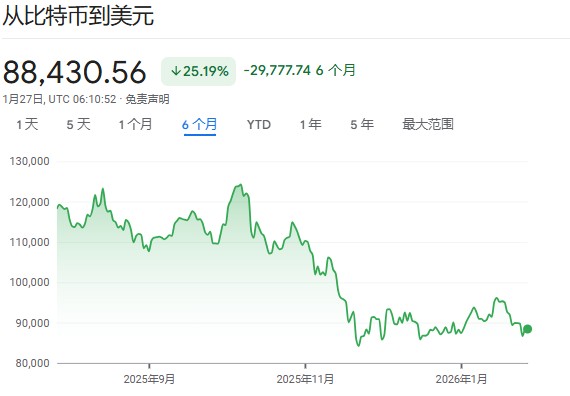
Rodrigues believes that during uncertain economic times, Bitcoin acts more like an "ATM," with investors quickly selling off Bitcoin to raise cash.
Bitcoin has become the market's "cash machine"
Why is Bitcoin sold off during crises? Rodrigues cites the views of Greg Cipolaro, Global Research Director at the New York Digital Investment Group (NYDIG), to explain this phenomenon. Cipolaro believes that Bitcoin's characteristics have become its "Achilles' heel."
"During periods of stress and uncertainty, liquidity preference dominates, and this dynamic harms Bitcoin far more than gold," Cipolaro wrote in the report. The 24/7 trading, deep liquidity, and instant settlement features of Bitcoin make it the easiest asset to liquidate when investors need to quickly raise cash. In contrast, while gold has poorer liquidity, holders tend to prefer to continue holding rather than selling.
This creates an interesting paradox: Bitcoin's advantages make it behave more like an "ATM" during crises. Cipolaro further points out: "Although Bitcoin has liquidity relative to its size, it is still more volatile and is reflexively sold off during deleveraging processes.
Therefore, in a risk-averse environment, regardless of its long-term narrative, it is often used to raise cash, reduce value-at-risk (VaR), and lower portfolio risk, while gold continues to serve as a true liquidity reservoir."
Behavior of large holders exacerbates the divergence
In addition to the characteristics of the assets themselves, the behavior of large holders is also exacerbating this divergence. The author notes that central banks around the world have been purchasing gold at record levels, creating strong structural demand for the gold market. This sustained buying from institutional levels provides solid support for gold prices.
In stark contrast, according to the NYDIG report, long-term holders of Bitcoin have been continuously selling off. On-chain data shows that "old coins" held for a long time are flowing to exchanges, indicating a stable selling pressure Rodrigues refers to this phenomenon as "seller suspension," which undermines the price support for Bitcoin.
"In the gold market, a completely opposite dynamic is unfolding. Large holders, particularly central banks, continue to accumulate this metal," Cipolaro added. This difference in institutional behavior actually reflects the distinct status and recognition of the two assets within the traditional financial system.
Different Hedging Scenarios, Different Choices
So, has Bitcoin lost its hedging value? The author believes the answer is not so simple. The key issue lies in how the market prices the current types of risks.
Rodrigues explains that the current market turmoil is viewed as "transitional"—driven by tariff threats, policy uncertainty, and short-term shocks. Gold has long been a hedging tool against such uncertainties, performing well during moments of immediate loss of confidence, war risks, and fiat currency devaluation that do not involve systemic collapse.
In contrast, Bitcoin is more suited for hedging long-term concerns, such as massive devaluation of fiat currencies or sovereign debt crises. "Bitcoin is better suited for hedging against long-term monetary and geopolitical turmoil, as well as the slow erosion of trust that takes years rather than weeks to manifest," Cipolaro stated.
It's like preparing different medicines for different diseases. If you are concerned about short-term market fluctuations and policy risks, gold is the better choice; but if you are worried about the long-term stability of the entire monetary system, Bitcoin may be the real "insurance." The author points out: "As long as the market believes that the current risks, while dangerous, have not yet touched the fundamentals, gold will remain the preferred hedging tool."
