


Next week's Federal Reserve decision preview: "Pause" is certain, but what is uncertain is "hawkish or dovish pause"

Morgan Stanley believes that the Federal Reserve will maintain interest rates at next week's meeting while releasing a "dovish" signal, reflected in the statement that it will retain the wording "considering the range and timing for further adjustments to the target range" to imply that the tendency for easing remains. This means acknowledging the robustness of the economy while keeping the option for future rate cuts
Morgan Stanley pointed out that the upcoming January FOMC meeting next week will undoubtedly keep interest rates unchanged, but the key lies in the tone.
According to the Wind Trading Desk, on January 23, Morgan Stanley's latest report predicts that the Federal Reserve will soothe the market through a "dovish pause," meaning that while it will pause interest rate cuts due to the recent stabilization of the labor market, it still retains a tendency for further easing.
For investors, the key to this meeting lies in the forward guidance. According to Morgan Stanley's forecast, the Federal Reserve will maintain the federal funds rate target range at 3.50%-3.75% during the January meeting. This is not a return to the tightening cycle, but a tactical adjustment based on recent data.
Subtle changes in statement wording: Morgan Stanley expects the FOMC statement to upgrade its assessment of economic growth from "moderate" to "robust." More importantly, it is expected that the Federal Reserve will remove the wording about "increased risks to employment"—since they have chosen to pause interest rate cuts, it logically implies that their concerns about the labor market have eased.
Retaining easing tendency: The key lies in the forward guidance. Morgan Stanley expects the statement to retain the wording "considering the scope and timing of further adjustments to the target range" (
Voting situation: It is expected that there will be dissenting votes. Morgan Stanley predicts that Governor Miran will cast a dissenting vote, advocating for a 50 basis point rate cut.
Morgan Stanley expects the Federal Reserve to implement a "dovish pause," with the key being the statement retaining the wording "consider additional adjustments" rather than "any adjustments," to imply that the tendency for easing remains.
Powell's Press Conference Preview: Acknowledging Growth but Not Abandoning Inflation Targets
Powell's task at the press conference is to explain why they are pausing. Morgan Stanley believes that Powell will rely on recent strong growth data, stable hiring, and a declining unemployment rate (to 4.375%) to defend the "pause."
Qualitative analysis: The core question for the market is: is this a "dovish pause" to allow for future rate cuts, or is it the end of the cycle? Morgan Stanley believes Powell will convey the former. Although activity data is stronger than expected, inflation data has not shown the transmission effects from tariffs, and the Federal Reserve remains confident that inflation will decline later this year.
Productivity puzzle: Powell is expected to hold an optimistic view on productivity prospects (whether from automation or AI), which provides theoretical support for the "high growth, low inflation" soft landing scenario.
Market Strategy: Ample Liquidity, Long on Swap Spreads
Despite the Federal Reserve pausing interest rate cuts, the short-term financing market environment remains loose. Morgan Stanley points out that the repo rate has quickly normalized below the IORB (Interest on Reserve Balances), indicating that cash in the system is "more than ample."
Reserve Management Purchases (RMP): The Federal Reserve maintains reserve levels by purchasing $40 billion in Treasury bills (T-bills) each month. Morgan Stanley expects the holdings of bills in the SOMA account to exceed $600 billion by the end of 2026. This mechanism effectively absorbs market supply and maintains stability in the financing market
Trade Recommendation: Based on the easing financing environment and expectations of a steepening front-end curve, Morgan Stanley's interest rate strategy team maintains the recommendation to go long on the 2-year UST SOFR swap spread, with a target set at -14bp.
Forex Outlook: Dollar's Decline Stalls, but Remains Bearish
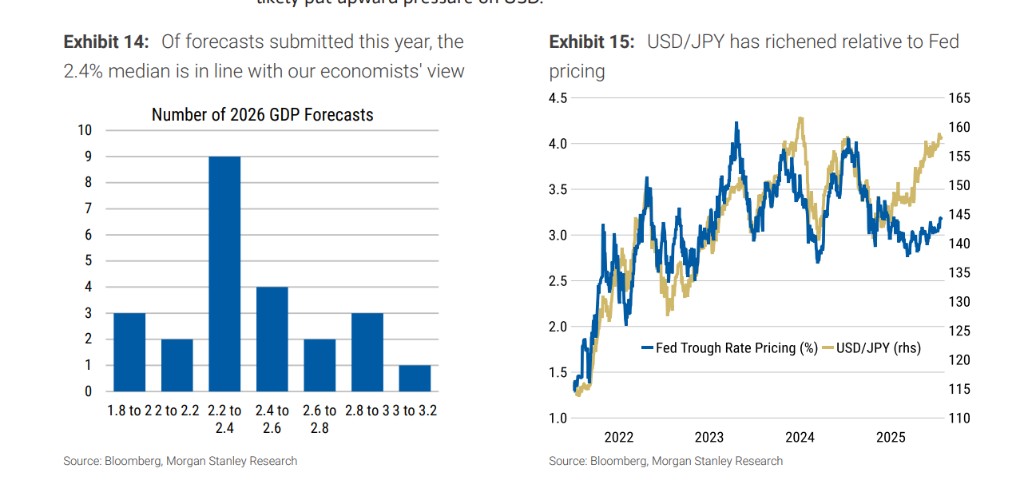
Morgan Stanley's view on the forex market has been revised. Previously, they believed the U.S. economy would weaken in early 2026, dragging down the dollar, but current economic data shows strong U.S. growth (2026 GDP growth forecast revised up to 2.4%), and the Federal Reserve's rate cut timeline has been delayed (from January to June and September).
Nevertheless, Morgan Stanley maintains a moderately bearish outlook on the dollar for the following reasons:
Global Growth Synchronization: Strong data from the Eurozone, Canada, and Australia also limits the one-sided support of interest rate differentials for the dollar.
Yen Valuation: The yen is still undervalued by about 10% relative to Federal Reserve pricing. Morgan Stanley believes the Bank of Japan is not lagging behind the curve, and concerns over Japan's fiscal risks are exaggerated, expecting the yen's negative premium to converge.
Renminbi Factor: USD/CNY is expected to reach 6.85 by the end of Q1 2026, which also constitutes downward pressure on the dollar.
Asset Class Focus: Valuation Dilemma of MBS and Municipal Bonds
Agency MBS (Mortgage-Backed Securities): After the GSE (Government-Sponsored Enterprises) announced a $200 billion purchase plan, MBS spreads have narrowed significantly, even surpassing the average levels during past Federal Reserve reinvestment periods. Morgan Stanley strategists have thus shifted their stance to neutral. Although a delayed rate cut by the Federal Reserve is typically unfavorable for MBS, the net demand generated by the massive purchase plan is sufficient to offset this negative impact.
Municipal Bonds: Fundamentals are solid, but valuations are expensive. The yield ratio of 1-5 year municipal bonds to corporate bonds is at an extremely low level. Morgan Stanley warns that if the Federal Reserve merely provides a "vague pause" rather than a clear dovish signal, the compression of front-end municipal bond spreads may not be sustainable and could even lead SMA (Separately Managed Accounts) buyers to shift towards corporate bonds or government bonds
