


Qingshan Group: The global "nickel and stainless steel leader" ventures into the aluminum and battery industries

Bank of America stated that Qingshan Group is rapidly expanding its business footprint into the aluminum and new energy battery sectors by relying on Indonesia's mature park model. The group is not only collaborating with Xinfeng Group to promote the construction of a million-ton aluminum production capacity, but its subsidiary REPT BATTERO has also entered the top ten globally in battery installations. At the same time, Qingshan continues to consolidate its dominant position in the core fields of nickel and stainless steel through measures such as acquiring POSCO assets, building a full industry chain empire
The world's largest stainless steel and nickel producer, Tsingshan Holding Group, is rapidly expanding its vast industrial footprint from its core nickel and stainless steel business into the aluminum and new energy battery sectors.
On January 24th, according to the Wind Trading Platform, Bank of America stated in its latest research report that as a giant with an annual revenue of $56.5 billion, ranked 247th on the Fortune Global 500 list, Tsingshan Group is attempting to replicate its successful path in the nickel industry by leveraging its established industrial park model in Indonesia.
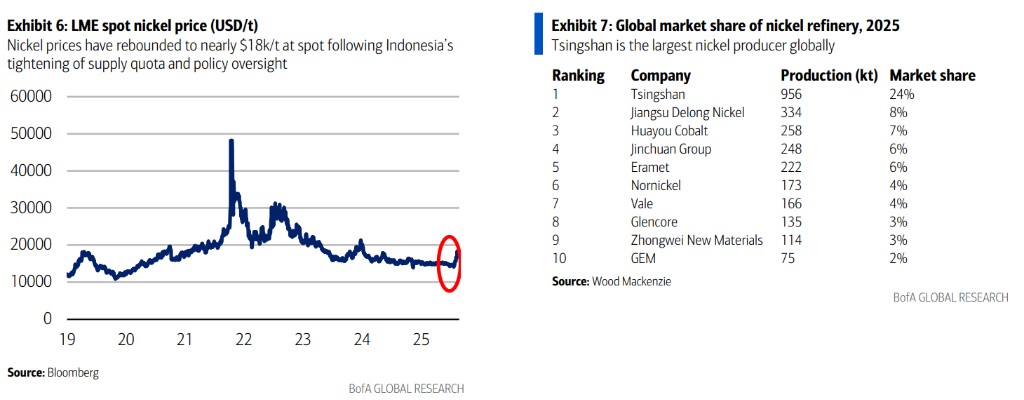
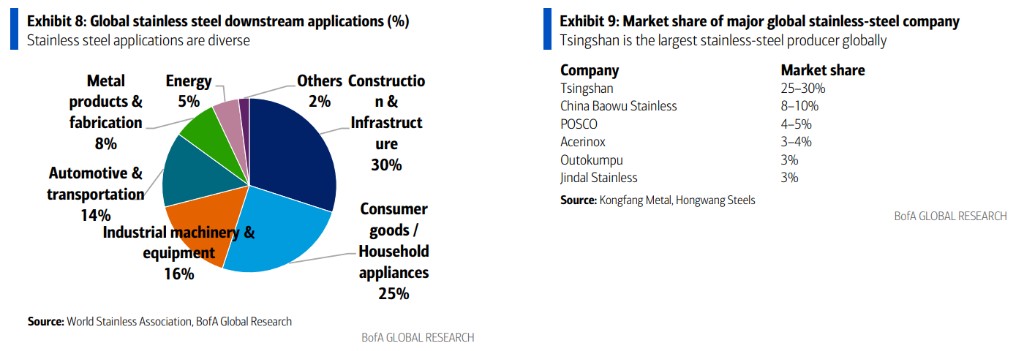
The report pointed out that as Indonesia tightens supply quotas and strengthens policy regulation, spot nickel prices have recently rebounded to nearly $18,000 per ton. As a dominant player in the nickel industry with a 25%-30% market share, every move by Tsingshan Group will have a critical impact on price trends.
At the same time, Tsingshan Group's joint venture project with Xinfeng Group in Indonesia is currently in the capacity ramp-up phase, which not only serves as an important reference for the recent expansion of Indonesia's aluminum industry but also marks a substantial step forward in Tsingshan's diversified metal strategy.
In addition to maintaining an absolute leading advantage in the stainless steel and nickel sectors, Tsingshan Group's subsidiary REPT Battero has entered the global top ten in battery installation capacity, with its energy storage battery shipments ranking among the top five worldwide.
Analysts pointed out that this series of initiatives indicates that Tsingshan Group is attempting to leverage its resource advantages to build a full industrial chain empire covering everything from mines to end materials.
Replicating the Success Path of the Nickel Industry: Entering the Aluminum Sector
According to the research report, Tsingshan Group is replicating its "mine-park-smelting" model, validated in the nickel industry, into the aluminum sector. Currently, Tsingshan has approximately 500,000 tons/year of primary aluminum production capacity in Indonesia, mainly operated through the Huachin project, a joint venture with Huafon Group.
Bank of America noted that what is garnering more market attention is that Tsingshan is advancing large-scale joint venture projects with Xinfeng Group in Indonesia, including the Taijing project located in Tsingshan's Indonesia Morowali Industrial Park (IMIP) and the Juwan project located in Indonesia Weda Bay Industrial Park (IWIP), with a combined construction and planned capacity exceeding 1 million tons/year.
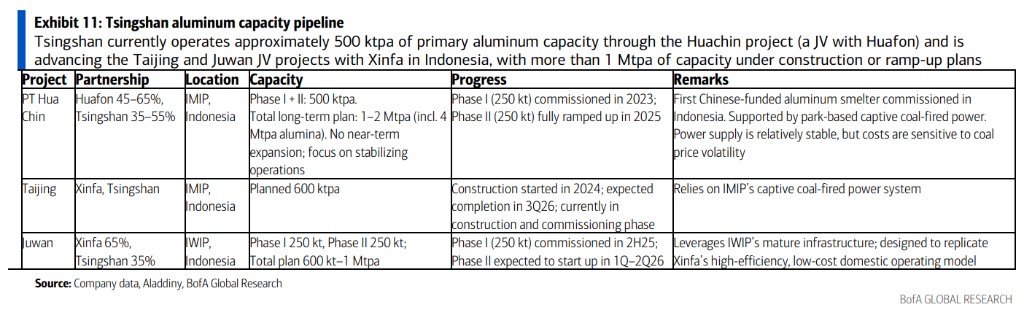
Power supply is a key bottleneck for the successful production of these aluminum projects. According to Aladdiny data, the power supply from self-built power plants may currently be insufficient to support all new aluminum production capacity, with the remaining capacity highly dependent on the construction of new self-built power plants The research report points out that Bank of America expects these new power facilities to be completed by mid-2027, which means that the actual production contribution may lag behind the nominal capacity planning. Nevertheless, with the recovery of aluminum profit margins, this layout demonstrates Qingshan's ambition for expansion in the basic materials sector.
New Energy Landscape: From Resources to Batteries
Qingshan's ambition extends beyond metal raw materials to the battery manufacturing end.
According to the research report, in addition to controlling battery raw materials such as nickel and cobalt through its Indonesian project, its flagship new energy business—REPT Battero—has established a market position.
In the first three quarters of 2025, REPT Battero ranked first globally in the shipment volume of household and commercial energy storage batteries, and ranked second in China for heavy truck battery shipments in the first half of 2025.
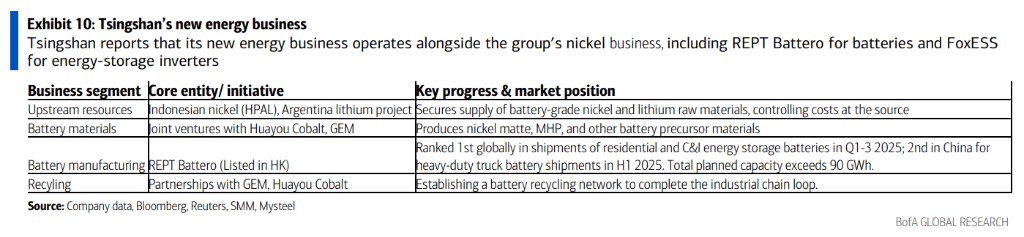
Additionally, the Volkswagen Group signed a memorandum of understanding with Huayou Cobalt and Qingshan Group in 2022, aiming to establish upstream raw material joint ventures in Indonesia and China, as well as downstream precursor and cathode material joint ventures, to ensure supply chain security and reduce costs.
Consolidating Core: Dominance in Stainless Steel and Nickel
Qingshan's business foundation remains stainless steel and nickel, with its "mine-materials" integration strategy being highly effective. The research report states:
Stainless Steel Business: Production exceeded 16 million tons in 2023. In addition to maintaining the largest scale, Qingshan is shifting towards high-profit areas through acquisitions and collaborations.
For example, in 2025, it plans to acquire POSCO's core stainless steel assets in China (such as Zhangjiagang POSCO) and deepen its joint venture cooperation in Indonesia, focusing on high value-added products such as cold-rolled and automotive sheets.
Nickel Business: The metal production capacity is approximately 1.1 million tons in 2023. It has a large ecological park in Indonesia, with the IMIP park having about 53 RKEF production lines, producing approximately 4.2 million tons of NPI (nickel pig iron) annually.
To cope with fluctuations in the LME nickel market, Qingshan has registered the nickel cathodes produced at its Dingxin factory as an LME delivery brand and plans to apply for an additional approximately 50,000 tons of LME registered capacity to strengthen its hedging capabilities
