


How far have domestic surgical robots come?

Zhejiang Merchants Securities research report states that with the implementation of the medical insurance bureau's charging catalog policy and the accelerated expansion of overseas markets, the industry is expected to transition from the early development stage to a rapid growth phase. The medical insurance bureau's charging catalog policy will be implemented in 2026, clearly defining the charging framework for four types of robots, which will significantly lower the admission threshold. Leading companies such as MicroPort and EDGE MEDICAL are experiencing rapid growth in overseas orders, making overseas expansion a new engine for growth. It is expected that by 2032, the market size of surgical robots in China will surge from 7.2 billion yuan in 2024 to 76.7 billion yuan, with a compound annual growth rate of 34%
The domestic surgical robot industry is at a critical turning point from "concept validation" to "scale profitability."
On January 21, Zheshang Securities stated in its latest research report that with the implementation of the medical insurance bureau's charging catalog policy and the accelerated expansion into overseas markets, the industry is expected to transition from the early development stage to a rapid growth phase. If the past five years were a period of technological catch-up, the next five years will be a period of commercialization realization.
Zheshang Securities stated that the market size of surgical robots in China is expected to be approximately 7.2 billion yuan in 2024. According to forecasts, this figure will skyrocket to 76.7 billion yuan by 2032. This means that over the next eight years, the compound annual growth rate (CAGR) will reach about 34%. Such growth rates are extremely rare in the current macro environment.
The research report noted that on January 20, 2026, the National Medical Insurance Administration released the "Guidelines for Project Approval of Surgical and Treatment Auxiliary Operations (Trial)," which clarifies the charging framework for surgical robots, significantly lowering the entry threshold for products. At the same time, leading companies are experiencing rapid growth in overseas orders, with MicroPort Medbot's global orders exceeding 160 units and EDGE MEDICAL's overseas orders reaching 72 units, making overseas expansion a new growth engine.
Market Space: Over 70 Billion Scale, Annual Growth of 34%
The research report pointed out that according to Frost & Sullivan data, the market size of surgical robots in China will grow from 7.2 billion yuan in 2024 to 76.7 billion yuan by 2032, with a compound annual growth rate of about 34%.
In contrast, the global market is expected to grow from 21.2 billion USD to 75 billion USD during the same period, with a compound annual growth rate of about 17%, indicating that the growth rate of the Chinese market is significantly higher than the global average.
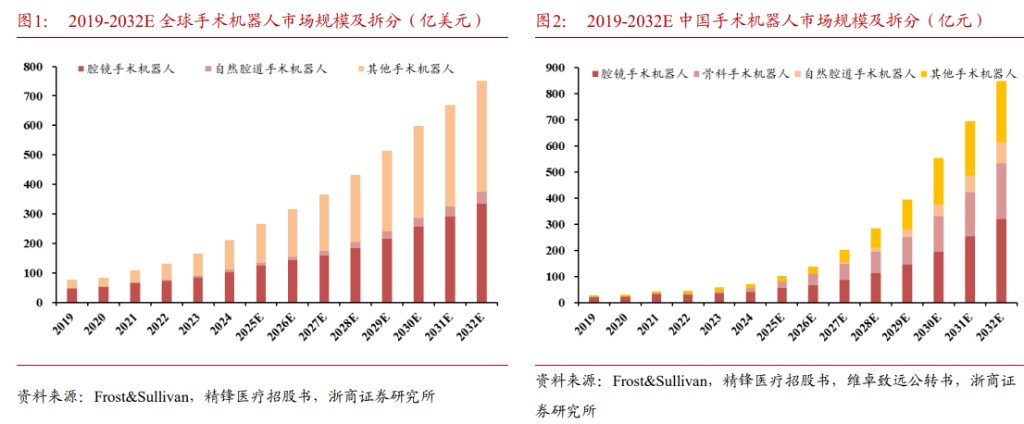
The research report pointed out that laparoscopic surgical robots occupy a significant share, with laparoscopic surgical robots accounting for 58% of the overall market size in 2024, making it the largest segment.
The relaxation of configuration certificates and the implementation of the charging catalog will become important driving forces. Zheshang Securities expects the compound annual growth rate of the market size from 2024 to 2032 to be about 29%, reaching 32.1 billion yuan by 2032.
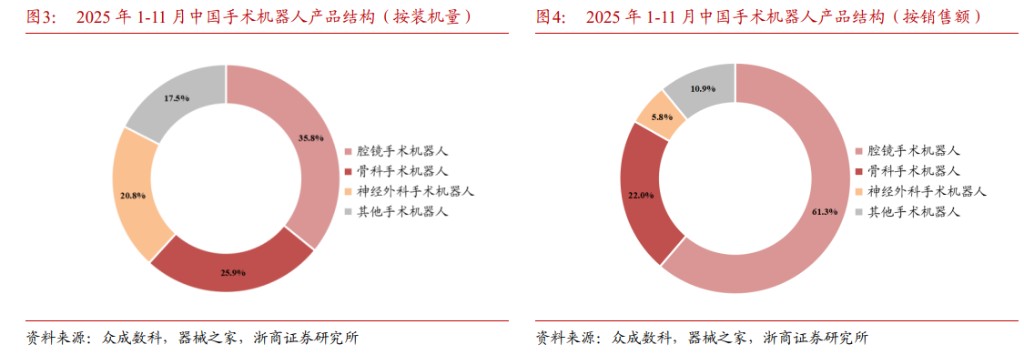
Additionally, the orthopedic surgical robot market size is second only to laparoscopic robots. According to statistics from Zhongcheng Shuke, from January to November 2025, orthopedic robots accounted for 26% of the overall installed capacity and 22% of sales revenue.
The research report stated that with the improvement of domestic products and the implementation of the charging catalog, the compound annual growth rate of the market size from 2024 to 2032 is expected to reach 41%, reaching 21.3 billion yuan by 2032.
2026 Key Catalyst: Charging Policy Resolves Admission Challenges
The research report stated that 2026 is a decisive moment for policy implementation, as the question of "who will pay" is about to be systematically resolved According to research reports, the promotion of domestic robots has been difficult in the past, with the core pain point being that hospitals do not "calculate the economic account." Only by clarifying the charging catalog and medical insurance reimbursement ratio can social benefits be converted into economic benefits for hospitals. The "Guidelines for Project Approval of Surgical and Treatment Auxiliary Operations (Trial)" released by the Medical Insurance Bureau on January 20, 2026, is a key signal.
The development of domestic surgical robots can be divided into three stages:
- Early Development Stage: Weak product capability, low market acceptance, unclear clinical advantages, high pricing and admission difficulties, mainly deployed in leading hospitals, primarily bringing social benefits rather than economic benefits.
- Rapid Development Stage (Entering in 2026): Two major preconditions have been met:
First, product capability has significantly improved, with some manufacturers launching products with a complete gradient that have received clinical recognition;
Second, the charging catalog is clear.
The charging guidelines released by the Medical Insurance Bureau on January 20, 2026, categorize surgical robots into four types: navigation, auxiliary execution, precise execution, and remote surgery, with additional charges based on a certain coefficient of the main surgery price, which will significantly accelerate product admission.
- Comparison of Charging Policies in Various Regions: In 2021, Shanghai included four types of surgical procedures in Category B of medical insurance, with patients paying 20%; in 2021, Beijing included orthopedic robotic surgeries in Category A with full reimbursement, with supporting consumables reimbursed at 70%; in 2022, Hunan added charges of 40%-300% based on surgery prices but did not include them in medical insurance. The establishment of a national charging framework will provide guidance for local implementation.
Accelerating Overseas Expansion: New Growth Engine Activated
According to research reports, in 2024, China's surgical robot market accounted for only about 5% of the global market, with vast overseas market potential. Leading domestic companies are rapidly expanding into overseas markets:
MicroPort Medbot: The laparoscopic surgical robot TUMAI is expected to receive CE certification in May 2024, and by December 2025, global commercial orders will exceed 160 units, covering more than 40 countries.
The orthopedic robot HONGHU has received certifications from China's NMPA, the US FDA, and the EU CE, with cumulative global orders exceeding 55 units in the first half of 2025. The proportion of overseas revenue has been continuously increasing from a relatively low level in 2022.
EDGE MEDICAL: The laparoscopic surgical robot MP1000 received CE certification in March 2025, and SP1000 received CE certification in October 2025.
As of the end of October 2025, 72 overseas orders have been signed, accounting for 61% of the total global orders of 118 units. The proportion of overseas revenue is rapidly rising.
Zhejiang Securities believes that domestic companies are opening up overseas markets relying on product capability, cost-effectiveness, and unique innovative capabilities such as 5G remote surgery. Overseas growth is expected in 2026, and it is anticipated to form a continuous new growth driver.
Profit Model: Mimicking Intuitive Surgical's Operations, Earning Money from Consumables
The research report states that surgical robots essentially follow a "razor + blades" business model. Specifically:
Benchmarking Intuitive Surgical: This giant, with a market value of over $187 billion, provides the standard answer. Selling equipment (systems) is just making friends; the real profit comes from the continuous supply of consumables and services afterward. In 2024, consumables and service revenue accounted for 76% of Intuitive Surgical's income Zhejiang Securities believes that domestic companies must follow this logic - first lay down equipment to secure a position, and then rely on consumables to generate cash flow. At this stage, the install base is the core leading indicator. Whoever can first deliver machines to the operating room will control the cash flow valve for the next decade.
At the same time, the research report points out that, referencing overseas giants like Stryker, the ultimate goal for orthopedic robots is the synergy of "equipment + implants." The precise positioning of robots can drive the sales of high-value orthopedic consumables, which will be key to the profit recovery of domestic orthopedic giants
