Intel Earnings Preview: CPU Shortages May Boost Performance, But This Could Be a "Double-Edged Sword"

Morgan Stanley believes that the current supply shortage will help Intel exceed market expectations in terms of data, and the company may bring some surprises in earnings per share (EPS). However, the shortage of server CPUs caused by insufficient capacity could be a "double-edged sword," which will harm the company's long-term prospects: AMD is seizing the opportunity to capture incremental market share, while Intel's own capacity bottlenecks have weakened external confidence in its foundry business
As the earnings season for U.S. stocks kicks off, chip giant Intel is set to release its latest quarterly earnings report after the market closes on Thursday, January 22.
According to Wind Trading Desk, Morgan Stanley released a report on January 20, indicating that Intel is facing a particularly unique situation in the current complex semiconductor cycle: while the supply shortage in the server CPU market has temporarily boosted stock prices and may lead to better-than-expected performance, this phenomenon of supply exceeding demand hides deeper concerns about limited production capacity and loss of market share, which may be difficult to support its long-term valuation reassessment.
The direct impact of this situation on investors is that while the supply tightness has supported Intel's stock performance in the short term and may help it deliver better-than-expected results in the earnings report to be released this week, the other side of this "double-edged sword" is stabbing at its future growth potential. Analysts are concerned that as Intel struggles with insufficient production capacity and weak growth, competitor AMD will seize the opportunity to capture most of the incremental growth in this segment. Additionally, Intel's internal capacity constraints serve as a poor "advertisement" for potential foundry customers who are already worried about competing for resources with Intel's internal demand, which may further undermine market confidence in its foundry business.
Therefore, although the market generally expects Intel to emphasize long-term supply agreements with hyperscale cloud providers, during the upcoming earnings call, investors' focus will not be limited to short-term revenue figures. The market will be eager to seek answers from management: how will Intel address the capacity bottleneck in the context of continued pressure on profit margins and weak growth expectations for the first quarter? How will it respond to AMD's increasingly leading advantage in the server market? Currently, Morgan Stanley maintains a "neutral" rating on Intel.
The Game of Short-Term Benefits and Long-Term Concerns
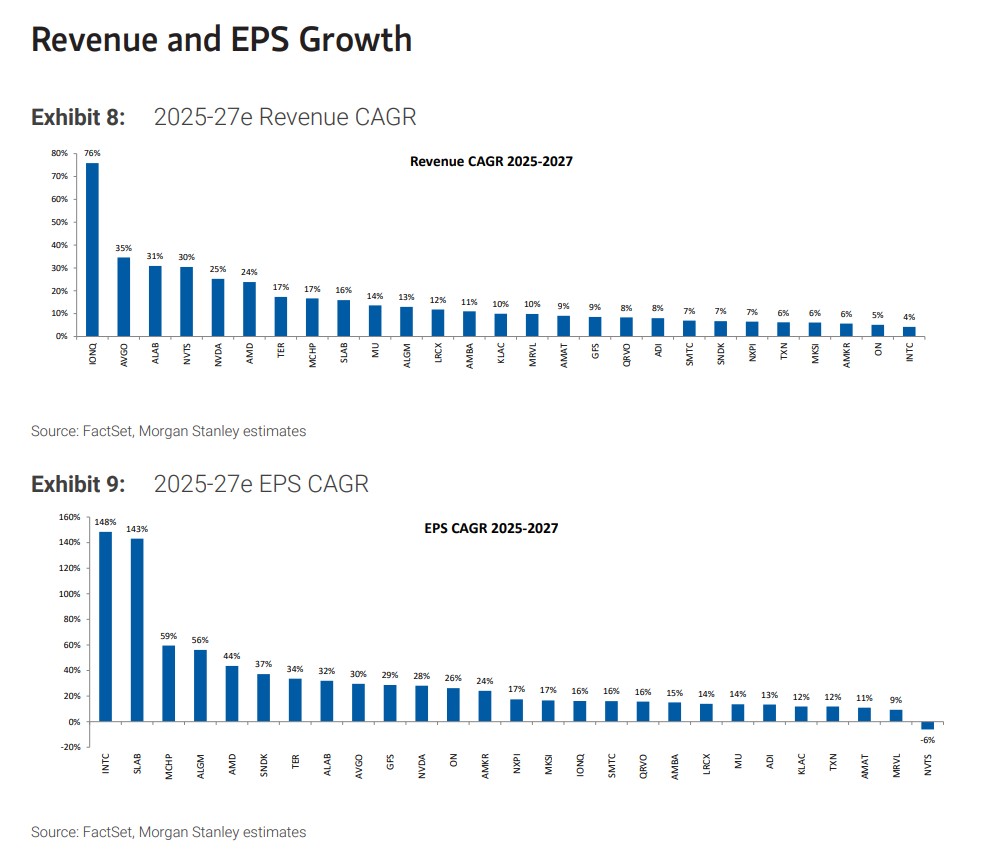
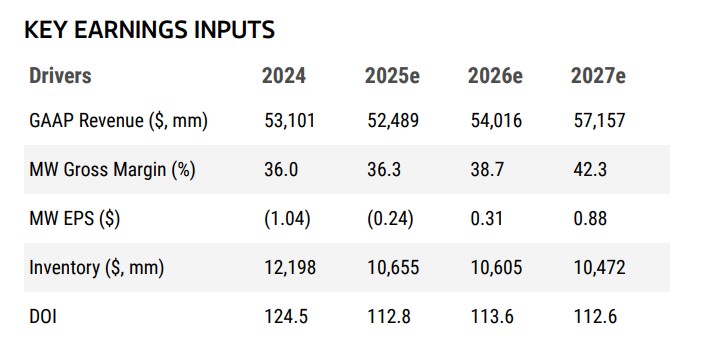
For the earnings report to be announced on Thursday, Morgan Stanley predicts that Intel may bring some surprises in earnings per share (EPS). Analysts expect that the current supply shortage will help Intel exceed market expectations in terms of data. Specifically, Morgan Stanley forecasts Intel's non-GAAP revenue for the December quarter to be $13.31 billion, which, although a 6.7% year-over-year decline and slightly below Wall Street's expectation of $13.407 billion, is expected to achieve an 11.5% quarter-over-quarter growth in the data center and artificial intelligence (DCAI) business.
However, this short-term performance support cannot hide long-term structural issues. Morgan Stanley analyst Joseph Moore pointed out in the report that while supply tightness helps enhance short-term performance visibility, "even with minimal growth, internal capacity remains sold out," which is concerning. This not only means that Intel has missed out on the benefits of the current demand rebound but has also handed over most of the incremental market to competitors. AMD has clearly stated that its Venice series products will further expand their leading advantage in the server market this year, while Intel's current products still struggle to compete with them in performance
The Gap in the Product Roadmap
In terms of product competitiveness, Intel is in an awkward transitional period. Although the Panther Lake based on the 18A process has shown some potential in the notebook sector, proving the feasibility of the company's new process, Intel still needs to wait in the critical server and high-performance desktop markets.
The report indicates that Intel will not regain competitiveness in the high-performance desktop sector until the Nova Lake is launched later in 2026. The situation may be even more severe in the server sector. Management has hinted that Diamond Rapids may lack simultaneous multithreading (SMT) technology, which means Intel may have to wait until the Coral Rapids is launched later in 2027 to truly catch up with competitors in terms of performance. For an extended period, the current product line cannot fully capitalize on the surge in market demand, which will continue to suppress its stock price's upward potential.
Trust Crisis in the Foundry Business
The core pillar of Intel's transformation—the foundry business—has also been overshadowed by the current shortage situation. Morgan Stanley has always been skeptical about Intel's foundry story, and the current capacity dilemma has intensified these concerns.
For external customers evaluating whether to place orders with Intel, seeing that Intel struggles to meet even its modest growth in capacity undoubtedly creates a significant sense of distrust. Customers are already worried about the issue of competing for capacity with Intel's internal products, and the current situation only confirms the existence of this risk. While the narrative of the foundry business has somewhat supported the stock price, in the context where Intel's product division struggles to leverage the surge in demand, the foundry business still faces significant challenges in truly winning customers and boosting valuation.
Financial Forecast and Valuation Outlook
Looking ahead to the first quarter of next year (March quarter), Morgan Stanley forecasts Intel's revenue to be $12.552 billion, slightly above Wall Street's expectation of $12.525 billion. However, in terms of gross margin, Morgan Stanley's forecast is only 34.9%, below the market expectation of 36.1%, reflecting the lower gross margin of Lunar Lake and the ongoing pressure from the startup costs of the 18A process.
Currently, Intel's stock price corresponds to a valuation of about 35 times the expected earnings per share for 2027, which is higher than the average level of large logic semiconductor peers. This somewhat reflects the market's high-leverage potential for its future recovery and bets on the foundry business options. However, considering the current lack of competitiveness in server products, the majority of incremental demand flowing to AMD, and the reality of pressured gross margins, analysts believe that the current profitability is insufficient to support further revaluation of the stock price. Unless Intel can convincingly demonstrate a rebound in its market share in the server sector, it will be difficult to upgrade the investment rating.