


Citigroup lowers Apple’s target price: Chip price increases may lead to a 100 basis point decline in gross margin this year

Citigroup's latest report has lowered Apple's target price from $330 to $315, primarily due to a significant increase in storage chip prices. The bank predicts that by 2026, the average prices of DRAM and NAND flash memory will soar by 88% and 74%, respectively. If the procurement price of DRAM rises by 50%, Apple's gross margin may face downward pressure of about 100 basis points. Nevertheless, its high-end market positioning and supply chain advantages are expected to mitigate the impact. Coupled with the upgrade of Siri AI and the launch of a foldable iPhone in 2026, the long-term growth momentum remains resilient
Citigroup's latest report has lowered Apple's target stock price from $330 to $315, stating that the surge in storage prices will directly squeeze Apple's profit margins, with a significant downward pressure expected on its gross margin in 2026.
According to the Wind Trading Desk, the bank's model shows that the average selling prices of DRAM and NAND flash memory are expected to rise by 88% and 74% year-on-year in 2026, respectively. If Apple faces a 50% increase in DRAM procurement prices, its gross margin in 2026 is expected to experience a downward pressure of about 100 basis points.
The report notes that although the rise in storage chip prices will directly squeeze profits, Apple's high-end market positioning and supply chain bargaining power will result in a smaller impact compared to most Android manufacturers. In the long term, the AI upgrade of Siri and the anticipated launch of the first foldable iPhone in the second half of 2026 are expected to become new growth drivers for the company.
iPhone demand remains resilient, high-end positioning provides a buffer
Citigroup's research report indicates that collaboration with its internal research innovation lab shows that demand for the iPhone 17 has remained strong at the end of 2025, and a normal seasonal adjustment is expected in the March quarter. According to the bank's model, Apple's iPhone shipments in the December and March quarters are expected to be 82 million and 56 million units, respectively, representing a year-on-year increase of 45% and a year-on-year decrease of 32%, outperforming market expectations of a 41% increase and a 34% decrease.
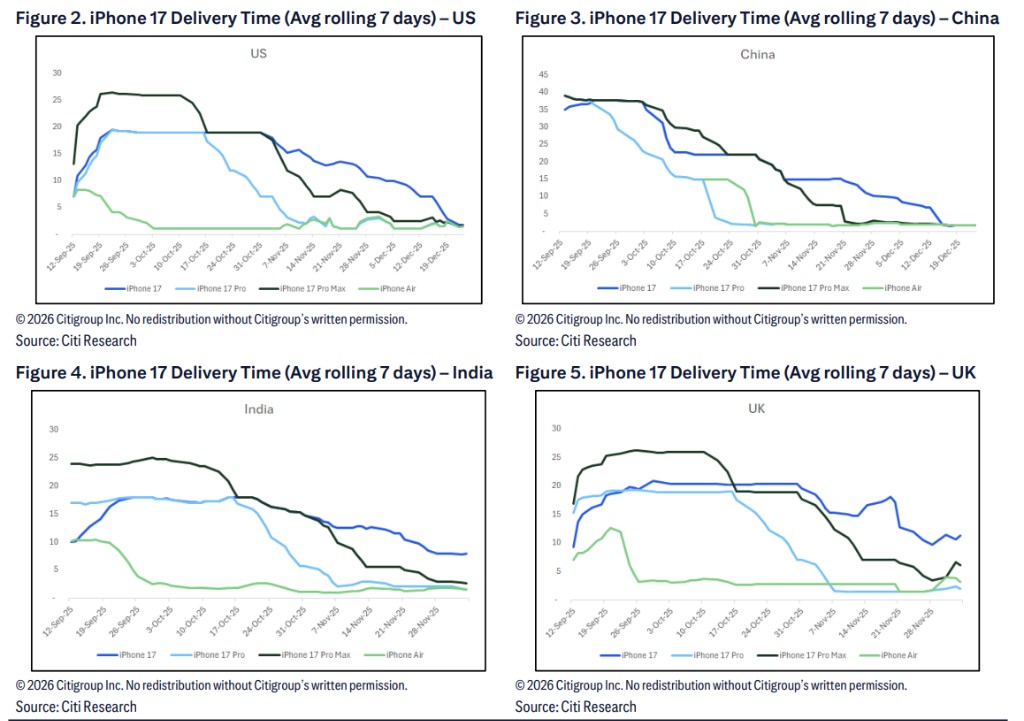
In the current environment of significant memory price increases, Apple is expected to have strong cost pass-through capability due to its high-end market positioning and supply chain influence. Citigroup analysts believe that despite rising component costs, Apple's iPhone shipments in 2026 can still achieve a growth of 1.2%, significantly better than the expected overall decline of 5% in the global smartphone market. Historical data shows that during the last memory price increase cycle from 2017 to 2018, Apple's gross margin faced pressures of about 110 basis points and 70 basis points in September 2017 and March 2018, respectively.
Data from third-party institutions also confirms Apple's market performance. IDC's preliminary statistics show that Apple shipped 81 million phones in the fourth quarter of 2025, a year-on-year increase of 5%, with market share rising to 19.7%, and an annual shipment growth of 6.3%. Counterpoint's report indicates that iPhone shipments are expected to grow by 10% in 2025, with market share reaching 20%, further consolidating its dominance in the high-end market.
Memory price increases bring significant cost pressure
The surge in storage chip prices has become the most concerning supply chain risk for investors. Citigroup's research model predicts that the average selling prices of DRAM and NAND flash memory will soar by 88% and 74% year-on-year in 2026, with increases far exceeding any previous memory price increase cycle. Based on the analysis of material cost structure, Citigroup estimates that the cost proportions of iPhone, PC, and iPad are approximately 9%, 15%, and 15%, respectively. If Apple faces a 50% increase in DRAM procurement prices in 2026, it is expected to exert about 100 basis points of downward pressure on its overall gross margin. Research information from the supply chain indicates that Apple has basically completed price negotiations for NAND flash memory in 2026, but there is still uncertainty regarding DRAM pricing.
Service Business Growth and Confirmation of Gemini Partnership
According to the latest data from Sensor Tower, Apple's App Store revenue in the December quarter grew by 7% year-on-year, lower than the company's previous guidance of approximately 14% growth in total service revenue. Notably, there has been a trend divergence between the App Store revenue growth rate reported by Sensor Tower in recent quarters and Apple's overall service revenue growth.
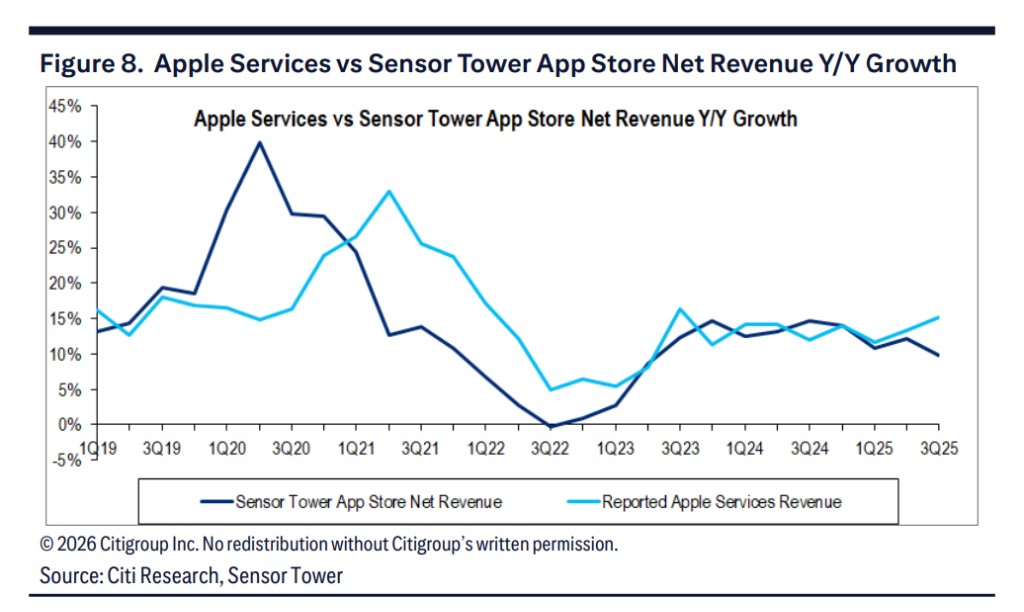
In addition to the App Store (which accounts for over 30% of total service revenue), advertising business (approximately 30%) and cloud services (about 10%) are also important engines driving growth in the services segment. Apple has an active device installation base of about 2.5 billion, and over 50% of users have not yet opened trading accounts, which lays a structural foundation for the company to capture incremental opportunities in high-margin service areas.
On January 12, Apple and Google issued a joint statement confirming that Apple has chosen Google Gemini as a long-term partner to support its next-generation foundational model. According to the plan, a personalized Siri equipped with more advanced AI capabilities is expected to be officially launched in the spring of 2026. Bloomberg previously reported that Apple may pay Google approximately $1 billion annually for this partnership. This collaboration will enable Apple to deploy a more powerful smart assistant more quickly while securing a critical time window for the continued development of its self-developed models.
iPhone 18 Foldable Phone to Kick Off New Product Cycle
Industry news indicates that Apple is expected to launch its first foldable iPhone in the second half of 2026, likely debuting alongside the iPhone 18 Pro/Pro Max models at the fall launch event. This product, referred to as the "iPhone Fold," will adopt a book-style folding design (not a flip design), with a screen size of approximately 7.8 inches when unfolded (5.5 inches when folded) and a thickness of about 9-9.5 mm (approximately 4.5-4.8 mm when unfolded).
Analysts predict that this model will use a liquid metal hinge and a metal plate structure that disperses stress to achieve an almost crease-free display effect. In terms of the imaging system, the device is expected to be equipped with dual rear cameras and one front camera, and may integrate Touch ID on the side to replace Face ID Due to the expected pricing in the high-end range of around $2,000, combined with the timing of the release, Citigroup estimates that the shipment volume of the foldable iPhone will be approximately 8 million units in 2026, accounting for 3% of the total iPhone shipments that year; by 2027, this number is expected to increase to 20 million units. IDC previously predicted that the foldable phone market will maintain an average annual growth rate of about 17% until 2029, while Citigroup believes that with its brand and technological advantages, Apple is likely to quickly capture over 30% of the market share in this segment, significantly outperforming the industry average
