


Morgan Stanley 2026 Global Outlook: Strong U.S. economy delays interest rate cuts, Bank of Japan remains steady throughout the year, China's exports continue to expand

Morgan Stanley pointed out in its Global Economic Brief that the global economy is in a highly differentiated stage, and market expectations for liquidity easing may deviate from reality. The Federal Reserve's interest rate cut expectations have been postponed to mid-2024 due to strong consumer data and inflationary pressures from tariffs in the United States. The Bank of Japan is expected to maintain interest rates unchanged for the entire year, which may trigger repricing risks in the yen and Japanese government bond markets. Overall, global capital markets will continue to fluctuate in an environment of high interest rates and a strong dollar
Morgan Stanley pointed out that the global economy is at a highly differentiated crossroads, and the market's expectations for liquidity easing may once again deviate from reality.
According to the Chase Wind Trading Desk, Morgan Stanley issued a warning on January 15 in its global economic briefing for investors betting that global central banks will synchronously and rapidly shift to easing policies. The institution emphasized that the market's widespread expectation of a Federal Reserve rate cut at the beginning of the year has largely fallen through—strong U.S. consumption data has forced Morgan Stanley to significantly delay its first rate cut expectation to mid-year.
This means that in the first half of 2024, global capital markets will continue to operate in a monetary environment of "high interest rates and a strong dollar," relying on fluctuations in economic data to find direction. In this context, asset price volatility may rise again, reminiscent of the severe turbulence seen in the fourth quarter of 2023.
For investors, the most critical risk lies in repricing. On one hand, the resilience of the U.S. economy makes inflation (especially inflation driven by tariffs) a more pressing threat than recession; on the other hand, the growth pressures faced by non-U.S. economies such as the Eurozone and China make global monetary policy difficult to coordinate.
Notably, Morgan Stanley's assessment of the Bank of Japan is in stark contrast to mainstream market expectations—while the market is still betting on interest rate hikes, Morgan Stanley believes the Bank of Japan will remain on hold throughout the year. This significant deviation in expectations is likely to trigger severe repricing risks in the yen and Japanese government bond markets.
U.S. Economy: Strong Consumption and Tariff Inflation Force the Fed to Stay Put
The U.S. economy currently presents a confusing yet resilient divergence.
Despite signs of weakness in the labor market, with the unemployment rate slightly dropping to 4.4% and new job growth slowing, this has not deterred American consumers. The GDP report for the third quarter of 2025 shows that real consumer spending grew robustly at an annualized rate of 3.5%, supported by a continuous increase in household net worth. More importantly, although inflation is eroding real income, the total growth of income in the labor market is still outpacing inflation.
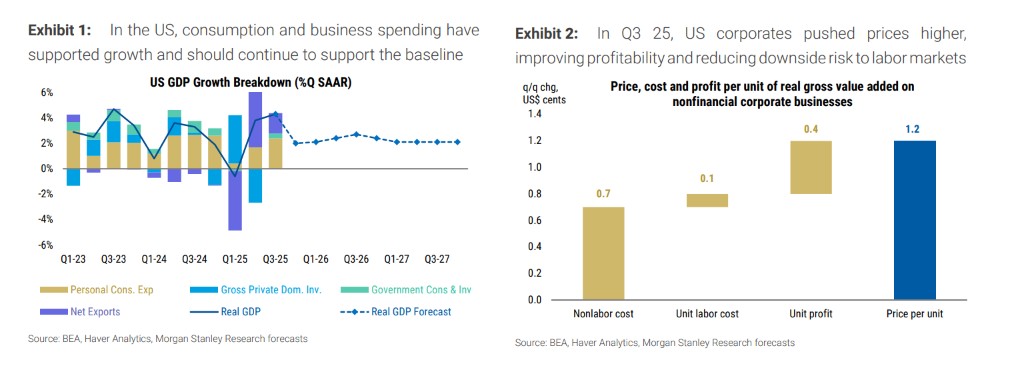
This strong demand-side performance, combined with cost transmission from tariff policies, has completely altered the Federal Reserve's policy path. Data indicates that companies began passing on tariff costs to consumers in the third quarter of 2025, with Morgan Stanley estimating that of the 70 basis points of tariff transmission effect, only about 40 basis points have been realized so far. Therefore, based on the judgment that inflation will only begin to materially soften by mid-year, Morgan Stanley has significantly delayed its expectation for the Fed's rate cut timing in 2026 from January and April to June and September. This means that throughout the first half of the year, the Federal Reserve will maintain restrictive interest rates until it confirms a solid downward trend in inflation.
Eurozone and UK: Inevitable Easing Amidst Weak Growth
Unlike the heated situation across the Atlantic, the European economy is mired in stagnation.
The Eurozone composite PMI fell from 52.8 to 51.9, indicating a loss of growth momentum, with both manufacturing and services weakening. Although the labor market remains robust, the growth forecast for the Eurozone, excluding Ireland, is only 1.0% for 2026.
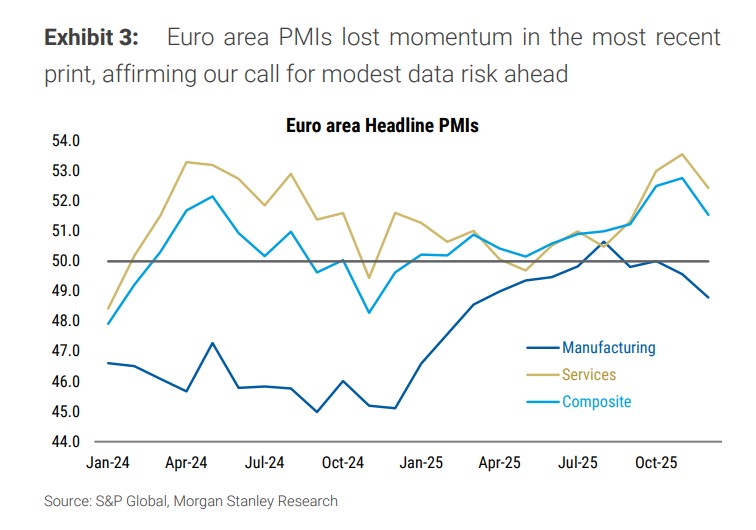
More critically, inflation data shows that the core inflation rate has dropped to 2.3%, confirming the trend of disinflation. Due to the reset of service sector inflation and declining energy prices, Morgan Stanley expects inflation to slow further in the coming months, potentially falling below the European Central Bank's target. This "weak growth + low inflation" combination provides ample data support for the European Central Bank to cut interest rates in June and September this year.
A similar situation is occurring in the UK. Although GDP unexpectedly rose in November, overall growth remains weak, and labor demand is extremely sluggish. With inflation expected to return to target levels starting in April 2026, the probability of the Bank of England cutting rates in February is very high, and Morgan Stanley maintains its forecast that the terminal rate will drop to 3%, which is much lower than market consensus.
Japan: Inflation Retreat and Political Turmoil Freeze Rate Hikes
This is one of the most contrarian judgments in Morgan Stanley's report. Although the Bank of Japan is expected to raise rates to 0.75% in December 2025, and the market generally anticipates further rate hikes in 2026, Morgan Stanley firmly believes that the Bank of Japan will keep rates unchanged throughout 2026. The core logic behind this is the renewed decline in inflation—Japan's core CPI is expected to fall from 3% to 2% in the coming months, mainly influenced by base effects and energy subsidies. In the context of inflation targets facing downward pressure again, the central bank lacks the motivation to continue tightening.
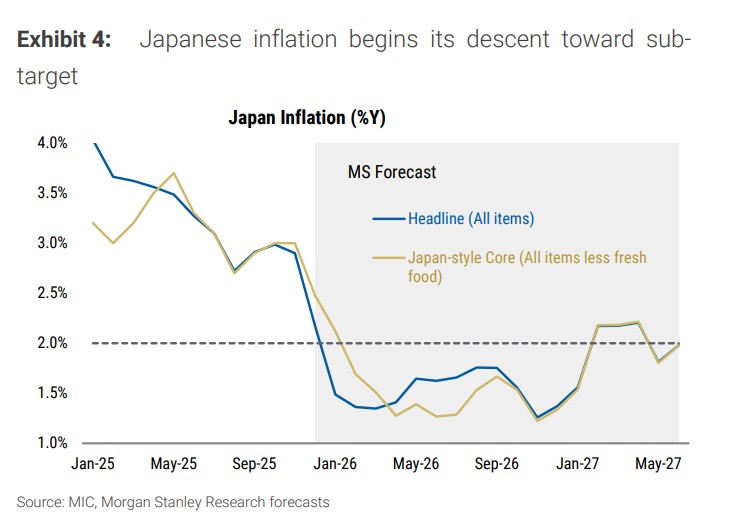
Moreover, political uncertainty has also become a significant obstacle. Prime Minister Kishi Sanae not only faces a test of support rates but is also preparing to dissolve the House of Representatives for early elections. This political vacuum, combined with weak economic data, makes any tightening measures extremely sensitive. Investors need to be cautious that if the Bank of Japan indeed remains "inactive" as Morgan Stanley predicts, the risk of a weak yen will rise again.
China: Continuous Expansion of Export Share and Fiscal Policy Continuity
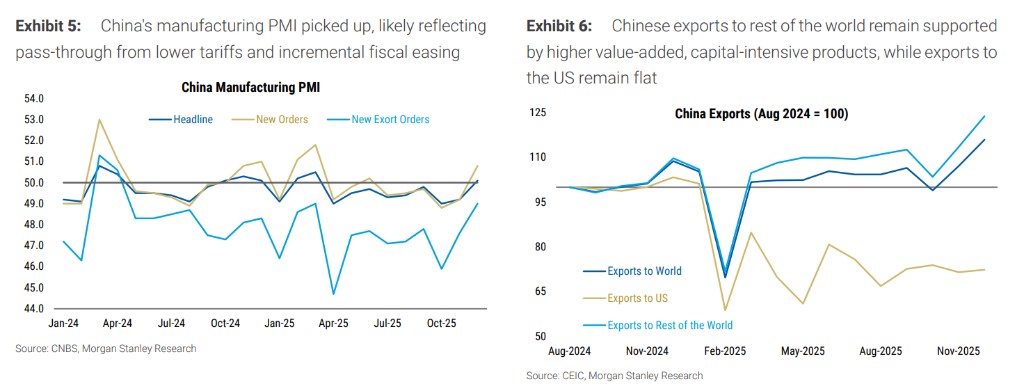
Morgan Stanley expects that by 2030, China's share in the global export market will further expand from the current 15% to 16.5%.At the policy level, the rebound in December's PMI data indicates that the effects of previous fiscal expansion are beginning to show. Morgan Stanley expects that China will maintain policy continuity in 2026, with fiscal support remaining at the same level as in 2025 and will also adopt a "front-loaded" strategy. Although the process of inflation moving out of deflation will be slow and more reliant on commodity prices rather than widespread demand recovery, the resilience of manufacturing and exports will continue to serve as the ballast for the economy.
Emerging Markets: India's Strength and Latin America's Turning Point
In emerging markets, India continues to play the role of a growth engine. Driven by policy easing and strong urban and rural demand, India's growth forecast for the fiscal year 2026 is as high as 7.4%. Although the Reserve Bank of India has lowered interest rates to 5.25%, Morgan Stanley believes this marks the end of the current easing cycle, and it will enter a wait-and-see mode in the future.
The Latin American region is set to welcome a policy shift in 2026. Elections in Chile, Colombia, and Brazil may drive policies toward a more market-friendly orthodox direction. Although Brazil's economy faces a mild slowdown, the tight monetary policy (with interest rates as high as 15%) is effectively controlling inflation, and the Brazilian central bank is expected to cut rates by a total of 350 basis points this year. Meanwhile, Mexico is under the shadow of the USMCA (United States-Mexico-Canada Agreement) review, and the uncertainty in trade policy will continue to suppress its growth prospects.
The above exciting content comes from the Wind Trading Platform.For more detailed interpretations, including real-time analysis and frontline research, please join the【 **Wind Trading Platform ▪ Annual Membership**】Risk Warning and DisclaimerThe market has risks, and investment requires caution. This article does not constitute personal investment advice and does not take into account the specific investment objectives, financial situation, or needs of individual users. Users should consider whether any opinions, views, or conclusions in this article are suitable for their specific circumstances. Investment based on this is at your own risk.