


Old Huang "takes the lead," while everyone is competing for Taiwan Semiconductor's capacity, NVIDIA is "seizing land."

While tech giants are still competing for TSMC's production capacity, NVIDIA CEO Jensen Huang has already laid out plans to "secure land." Guo Mingqi from Tianfeng International revealed that during Jensen Huang's visit to Tainan last November, he expressed a willingness to pay to ensure the reservation of the P10 and P11 plots next to Fab 18, with goals even including the P12 plot. Meanwhile, NVIDIA may surpass Apple in some quarters of 2025, becoming TSMC's largest customer
As technology giants are fiercely competing for TSMC's wafer production capacity, NVIDIA CEO Jensen Huang has already set his sights on a longer-term goal—directly securing land for TSMC's future factories. This strategy highlights NVIDIA's attempt to fundamentally ensure its supply chain security amid the explosive demand for AI chips.
On January 15, Tianfeng International Securities analyst Ming-Chi Kuo tweeted, "Most customers are negotiating for guaranteed capacity, while Jensen Huang is negotiating for land." Kuo pointed out that during his visit to Tainan last November, Huang expressed a willingness to pay TSMC to secure the reserved P10 and P11 plots next to the Fab 18 site, with the ultimate goal of also acquiring the P12 plot. At that time, the planning for Fab 18 only clearly defined plots P1 to P9.
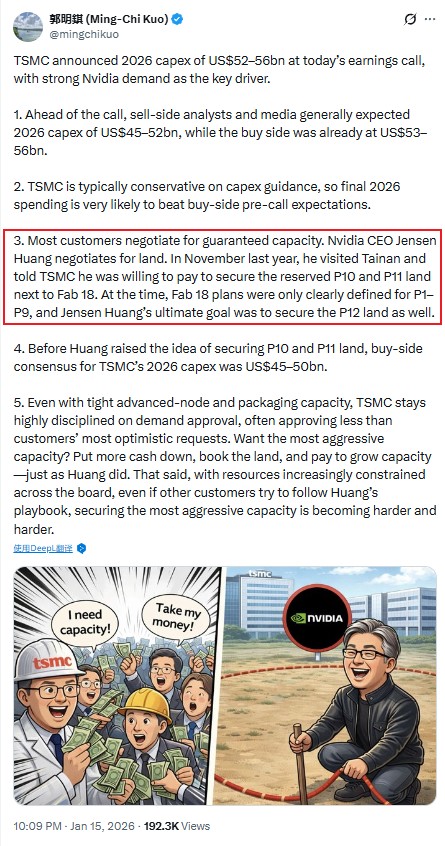
This move comes as TSMC announced that its capital expenditure will reach a record level of $52 billion to $56 billion in 2026, far exceeding the market's previous expectations of $45 billion to $52 billion. TSMC clearly stated in its earnings call that NVIDIA's strong demand is a key driver of this expenditure growth.
Meanwhile, traditional major customers like Apple are facing pressure to secure production capacity, and NVIDIA may surpass Apple to become TSMC's largest customer in some quarters of 2025.
Strategic Layout Behind Intensive Visits to Taiwan
Jensen Huang's three visits to Taiwan in the second half of 2025 have drawn market attention due to their frequency.
According to Digitimes, after discussing the production plan for the next-generation Rubin GPU architecture with TSMC on August 22, Huang arrived at Tainan Airport on November 7 via private jet, toured TSMC's 3-nanometer wafer plant in the Southern Science Park, and dined with TSMC Chairman Mark Liu and other executives. The next day, he also participated in TSMC's annual sports meeting.
During the Thanksgiving holiday in the United States on November 27, Huang made another appearance in Taipei, visiting the Siping Street and Dazhi areas. Although he publicly stated that he was just "visiting friends," sources revealed that the main purpose of this trip was to engage with Quanta Computer. There are concerns in the market regarding Quanta's assembly yield and whether it can secure more orders amid NVIDIA tightening its procurement controls. Given Huang's close relationship with Quanta Chairman Barry Lam, this visit is seen as a discussion on ongoing cooperation strategies.
This marks Huang's fifth visit to Taiwan since the beginning of 2025. NVIDIA's plans for a new office in the Beitou Shilin Technology Park T17 and T18 plots in Taipei have been finalized, demonstrating the company's long-term commitment to the Taiwanese supply chain.
Capacity Competition Reshaping Customer Landscape
According to analysis from Culpium and supply chain sources, NVIDIA may surpass Apple to become TSMC's largest customer in at least one or two quarters in 2025. Although TSMC CFO Wendell Huang declined to comment on changes in customer rankings, public data has already made the situation clear In 2025, Taiwan Semiconductor Manufacturing Company (TSMC) expects revenue to grow by 36% to $122 billion, while NVIDIA anticipates a 62% increase in sales for the fiscal year ending January 2026. Apple's product revenue is expected to grow by only 3.6% in the 12 months ending December 2025. TSMC's high-performance computing business grew by 48% last year, down from 58% the previous year; meanwhile, the smartphone business grew by only 11%, lower than the previous year's 23%.
According to Culpium, when C.C. Wei visited Cupertino last August, he conveyed the largest price increase message to Apple executives in years. Worse still, Apple, which once dominated TSMC's client list, now has to fight for production capacity. As the AI boom continues, customers like NVIDIA and AMD are occupying more wafer space with each GPU, and Apple's chip designs can no longer guarantee priority at TSMC's nearly twenty fabs.
Technology Roadmap Determines Short-Term Competitive Landscape
TSMC is currently mass-producing chips at the 2-nanometer node (N2), with Apple as a major buyer. However, in the second half of this year, TSMC will simultaneously mass-produce a new variant called N2P and a new node named A16. C.C. Wei stated that the A16, equipped with super power rail technology, is "most suitable for high-performance computing with complex signal routing." This technology is TSMC's version of backside power delivery, designed to separate the chip's signals and power.
This technology roadmap will benefit companies like NVIDIA and AMD in the next one to two years. However, according to SemiAnalysis, the A14 node expected to be mass-produced in 2028 "was designed from the start for mobile and high-performance computing," at which point the balance will shift back in favor of Apple.
TSMC's revenue is expected to grow by nearly 30% in 2026, but capital expenditures will increase by about 32%. In the long term, growth will average 25% over the five years ending in 2029, but the AI business will average growth of 55% or higher during the same period, exceeding the previously forecasted 40%. TSMC's gross margin reached an astonishing 62.3% in the December quarter last year, up 280 basis points from the previous quarter.
Despite facing capacity expansion pressures, C.C. Wei expressed caution at an investor meeting: "I am also very nervous; if we are not careful, it will definitely bring a huge disaster to TSMC." TSMC's capital intensity exceeds 33%, with depreciation accounting for 45% of revenue costs, far higher than clients like Alphabet and NVIDIA. This means that if demand declines, TSMC will bear the primary risk, which also explains why the company must weigh speed against risk when expanding capacity
