


"Tactical bullish" on crude oil and precious metals, "structural bullish" on aluminum, copper prices "may peak within a month" – this investment bank's "latest commodity judgment"

Citigroup's research report points out that the commodity market is at a turning point. Crude oil is driven by geopolitical factors in the short term with a target of $70, but faces oversupply pressure in the long term. Precious metals are bullish, with silver targeting $100 and gold $5,000. Among industrial metals, aluminum has the most opportunity due to supply shortages, with a target of $3,400-$3,500. Although copper prices are expected to reach $14,000, January may become the annual peak
Under the intertwining of geopolitical clouds and supply shortages, the commodity market is at a critical turning point.
According to the news from the trading desk, on January 14, the Citigroup research team published a report forecasting commodities for 2026.
Citigroup pointed out that the oil market is driven by geopolitical premiums in the short term, with a price target set at $70, but faces dual headwinds of oversupply and policy pressure in the long term.
Precious metals are entering a highlight moment, with silver expected to outperform gold, targeting prices of $100 and $5000 respectively.
Aluminum is seen as the most structurally opportunistic variety, on the brink of the most severe supply shortage in twenty years. Although copper prices may reach $14,000 mid-year, Citigroup warns that January could be the price peak for the entire year.
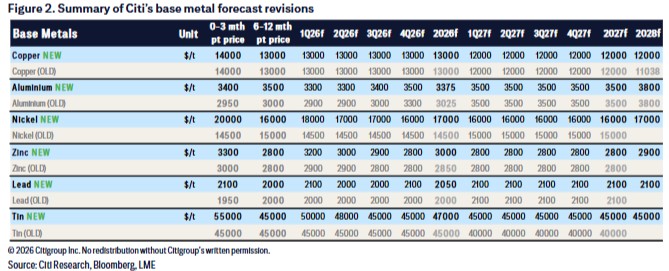 (Summary of Citigroup's adjustments to base metal price forecasts)
Geopolitical Premium Supports Short-Term Surge in Oil
The current trend in the oil market largely depends on the evolution of geopolitical risks.
Citigroup believes that the recent escalation of the Iran and Russia-Ukraine situations, combined with export disruptions in places like Kazakhstan and Libya, is pushing Brent crude oil towards the $70 per barrel price level.
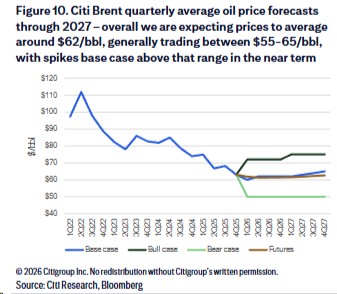 (Citigroup's forecast for Brent crude oil prices)
This is seen as a tactical rebound opportunity, providing producers with a window to hedge against future downside risks.
However, this upward momentum lacks long-term sustainability. Citigroup expects geopolitical risks to ease in the second half of 2026, while the global market remains in a fundamentally oversupplied state.
More importantly, the Trump administration's pursuit of low oil prices and the approaching November 2026 U.S. midterm elections will exert significant policy pressure on oil prices.
The Frenzy in the Precious Metals Market, Silver May Be the Biggest Winner
In the precious metals sector, Citigroup also takes a tactical bullish stance.
The report predicts that silver will continue to outperform gold, with a recent target of $100 per ounce, while gold will reach $5000. This forecast is based on the current market momentum and capital flows.
However, similar to the logic of oil, Citigroup believes that these extreme high price levels themselves will trigger producers and central banks to hedge against downside risks.
The report suggests that when prices reach these target levels, rational participants should consider taking protective measures.
The narrative of rising precious metals is related to broader "hard asset" allocations and concerns about currency devaluation, but the sustainability of this trend carries implicit risks.
The Divergence of Fate for Industrial Metals Aluminum and Copper
Industrial metals have shown two distinctly different narratives.
Aluminum has been classified by Citigroup as the preferred structural bullish commodity, citing that it is facing the largest supply deficit in twenty years.
The supply constraints caused by rising global electricity costs give the aluminum bull market strong resilience, with a short-term target of $3,400 per ton and a mid-term outlook of $3,500.
In stark contrast is the outlook for copper. Citigroup is tactically bullish on copper prices to $14,000 per ton but clearly states that its conviction has "significantly weakened" since last December.
Investor net long positions are at historical highs, and this rally driven by financial inflows and macro sentiment is heavily reliant on the continued injection of liquidity.
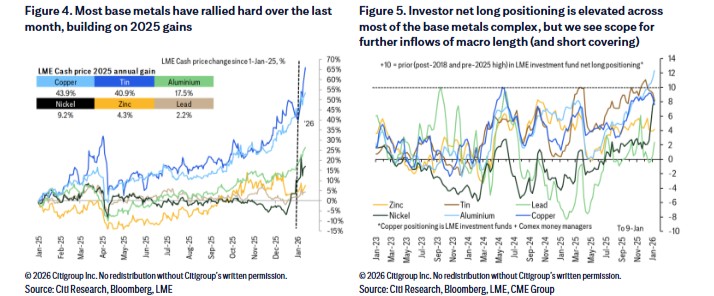 (For most base metal varieties, investor net long positions are at high levels)
Citigroup believes that unless there are unexpected macro positives, the current price increase has already exhausted most of the potential upsides, and January is likely to become the peak price for the year.
Citigroup's baseline forecast is that copper prices will eventually fall back to around $13,000 per ton, a more sustainable level, as this price point has balanced the global market on paper for 2026.
However, Citigroup has raised the probability of a bull market scenario (including copper prices reaching $15,000 per ton and aluminum prices reaching $4,000 per ton) from the usual level to 30%, reflecting a higher likelihood of upside.
Short-term Breather and Long-term Caution for Lithium Battery Materials
The lithium market has recently experienced a rebound of over 50%, mainly due to delays in the restart of mines by CATL and short-term shortages caused by policy tightening.
Citigroup has raised its three-month target price for lithium carbonate to $25,000 per ton, primarily reflecting the advance stocking demand from downstream battery companies and the current inventory tightness.
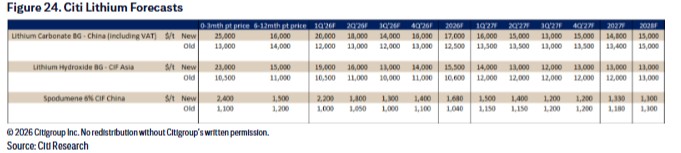 (Citigroup's forecast for the lithium battery market)
Although short-term data looks very strong, Citigroup maintains a cautious outlook on the long-term trend of lithium prices.
The bank believes that the current price level is sufficient to stimulate potential supply restarts, with incremental production from mines in Africa and other regions gradually being released over the next six months. Once the seasonal demand peak in the first quarter passes, lithium prices will face downward pressure returning to fundamentals.
Bull-Bear Standoff in Natural Gas and Agricultural Products
The natural gas market, under the backdrop of energy transition, is facing the challenge of long-term supply surplus.
Citigroup holds a bearish stance on LNG and European TTF natural gas, believing that a significant supply surplus cycle will begin globally from 2027.
As new capacities from the Haynesville and Permian basins in the U.S. are released, Henry Hub prices are expected to fall back to around $3.60 by 2027 European TTF natural gas will also face a similar situation. Although the supply and demand are tight in the short term during winter, in the long run, the market must lower prices to induce more demand conversion to digest the upcoming supply surge.
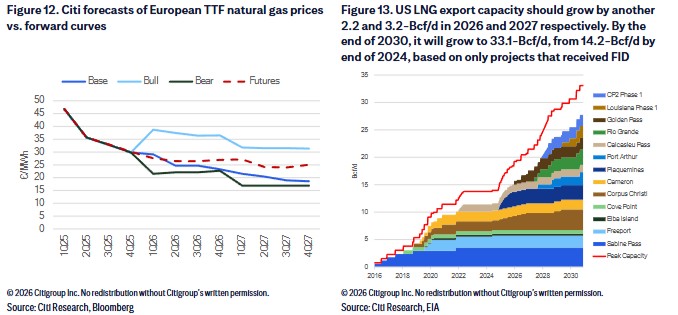
(Left image: European TTF natural gas price forecast; Right image: U.S. LNG export capacity expected to increase by 2.2 billion cubic feet per day by 2026)
In the agricultural sector, Citigroup holds a bullish outlook on most varieties.
Coffee prices are under adjustment pressure due to inventory backlog and changes in tariff policies, but sugar prices have approached the bottom after a year of sharp decline.
With the increase in China's import demand and Brazil's sugarcane shifting to fuel ethanol production, sugar prices are expected to rebound in 2026.
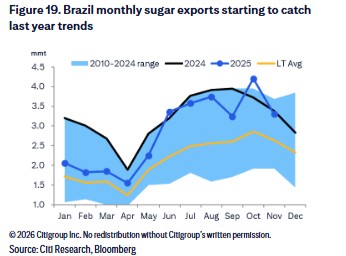 (Brazil's monthly sugar export volume has begun to continue last year's growth trend)
Overall, Citigroup's report provides a wake-up call for the currently booming commodity market. It advises clients to manage risks by taking advantage of short-term emotion and event-driven rallies while focusing long-term bets on varieties like aluminum that have solid structural gaps
