


China's steel exports hit a record high in December, rare earth exports increased by 32% year-on-year, and imports of soybeans, iron ore, and crude oil all set new records for the year, while coal imports saw the largest decline in a decade

Data shows that in 2025, soybean imports will reach 112 million tons, while iron ore and crude oil imports will both hit record highs, reaching 1.26 billion tons and 578 million tons respectively, marking three consecutive years of growth. Coal imports, on the other hand, will see a significant decline of 9.6%, the largest drop in ten years. In December, rare earth exports surged by 32% year-on-year, with total annual exports reaching 62,585 tons, the highest level in at least 11 years
In 2025, China's soybean imports reached a historical high for the third consecutive year, totaling 112 million tons. Iron ore imports also achieved a historical high for the third consecutive year. Coal imports saw the largest decline in a decade. Meanwhile, in December, China's rare earth exports surged by 32% year-on-year, and steel product exports surpassed the peak in 2015.
On Wednesday, January 14, the General Administration of Customs released the latest data showing that in December, China's exports in RMB terms grew by 5.2% year-on-year, while imports increased by 4.4%.
In terms of bulk commodity exports, in December, steel product exports rose to 11.3 million tons, surpassing the previous peak set in 2015, with total annual exports increasing by 7.5% to a record 119 million tons. China's rare earth exports in December surged by 32% to 4,392 tons.
On the import side, soybean imports in December amounted to 8 million tons, a modest increase of 1.3%. However, the total purchase for the year reached 111.8 million tons, a 6.5% increase compared to 2024, marking a historical high for the third consecutive year. Iron ore and copper ore imports also reached record highs. In 2025, coal imports significantly fell by 9.6% from the previous year's historical high, marking the largest decline in a decade.
Additionally, crude oil imports in December totaled 55.97 million tons, with an annual import volume of 577.73 million tons, both setting historical highs.
In 2025, steel product exports reached a historical high, and rare earth export volumes surged
Data from the General Administration of Customs showed that in December last year, steel product exports rose to 11.3 million tons, surpassing the previous peak set in 2015. This drove the total annual export volume up by 7.5% to a record 119 million tons.
The data also indicated that China's rare earth export volume in December surged by 32% year-on-year to 4,392 tons, with the total shipment of this key mineral for the year increasing by 12.9% compared to the previous year, reaching 62,585 tons, setting the highest level in at least 11 years.
It is noteworthy that although the rare earth export volume in December decreased by 20%, this was mainly due to overseas buyers stocking up ahead of the Christmas holiday, leading to a drop in demand.
Analysts believe that this stocking behavior resulted in weakened overseas purchasing willingness after the Christmas holiday, causing a decline in December's export volume. However, from a year-on-year perspective, the 32% increase still indicates a solid demand foundation.
In 2025, imports of soybeans, copper ore, iron ore, and crude oil all reached historical highs
Soybeans: In December, imports grew by 1.3% year-on-year to 8.04 million tons, in line with market expectations. Last year's soybean import volume reached 111.83 million tons, a year-on-year increase of 6.5%, marking a historical high for the third consecutive year.
Liu Jinlu, an agricultural researcher at Guoyuan Futures, stated that concentrated shipments from major producing countries such as Brazil and Argentina drove a sharp increase in imports in the first half of the year, contributing to the record high annual total.
Crude Oil: China imported 55.97 million tons in December, equivalent to an average of 13.18 million barrels per day, a year-on-year increase of 17% and a month-on-month increase of 10%. The total annual crude oil import volume reached 577.73 million tons, a year-on-year increase of 4.4% Consulting firm Kpler attributes the increase in crude oil imports to stronger crude oil processing volumes and more solid stockpiling demand, predicting that China's oil processing volume will reach 15.38 million barrels per day in 2025, a year-on-year increase of 0.7%.
Kpler analyst Muyu Xu stated that lower oil prices encourage refiners to increase purchases, and strategic petroleum reserve stockpiling may also have played a role. Independent refiners were able to purchase more spot cargoes after receiving import quota allocations in November.
Both Kpler and shipping tracking company Vortexa estimate that December's seaborne crude oil imports reached a record of over 12 million barrels per day.
Iron Ore: As a primary raw material for steelmaking, iron ore also recorded record trade data last year. Data shows that China's iron ore imports increased by 1.8% to a historical high of 1.26 billion tons, marking the third consecutive year of growth.
Unrefined Copper and Products: Last year's imports decreased by 6.4% to 5.3 million tons, the lowest level in this decade. High prices and economic slowdown were a drag, but significant demand shifted towards copper ore and concentrate procurement, with total imports increasing by 7.9% to a record 30 million tons.
Coal: Despite a nearly 12% year-on-year increase in coal imports in December, last year's coal import volume fell by 9.6% to 49 million tons, marking the first decline since 2022 and the largest drop in a decade.
Analysts believe that sustained domestic production growth has pressured coal prices to a four-year low, reducing the attractiveness of higher-priced imported coal. Meanwhile, the rapid adoption of clean energy in China is eroding coal demand.
Natural Gas: Data shows that in December, imports including pipeline gas and liquefied natural gas surged by 16.3% year-on-year to 13.45 million tons. However, the total natural gas import volume for the entire year of 2025 is projected to be 127.87 million tons, a year-on-year decrease of 2.8%, the first decline in three years.
In December, imports of crude oil, refined oil, natural gas, coal, and integrated circuits increased, while imports of unrefined copper and copper products, steel, and soybeans decreased.
In terms of volume, in December last year, the import volumes of refined oil, crude oil, and natural gas were 3.987 million, 55.973 million, and 1.3448 million tons, representing year-on-year increases of 21.04%, 17%, and 16.35%, respectively.
Imports of unrefined copper and copper products, steel, and soybeans were 437,000, 517,000, and 8.044 million tons, respectively, showing year-on-year declines of 21.82%, 16.75%, and an increase of 1.3%.
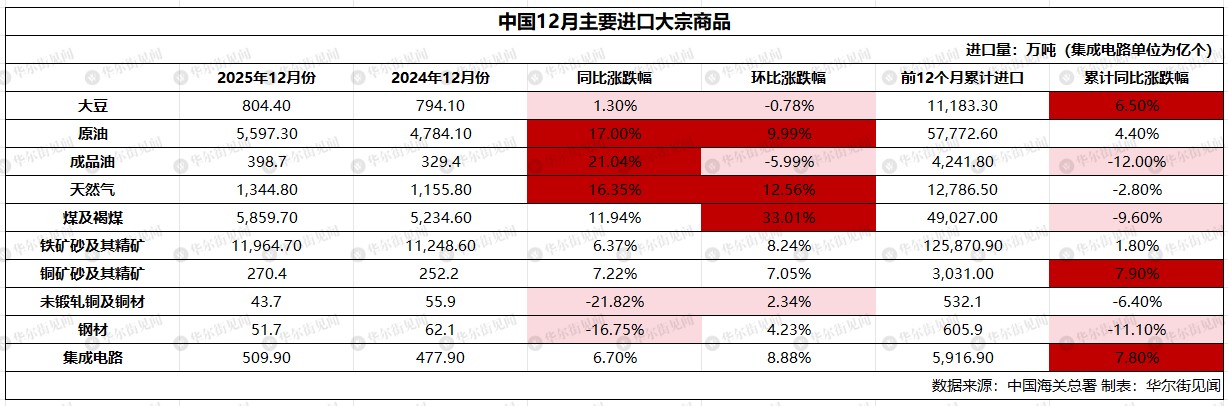
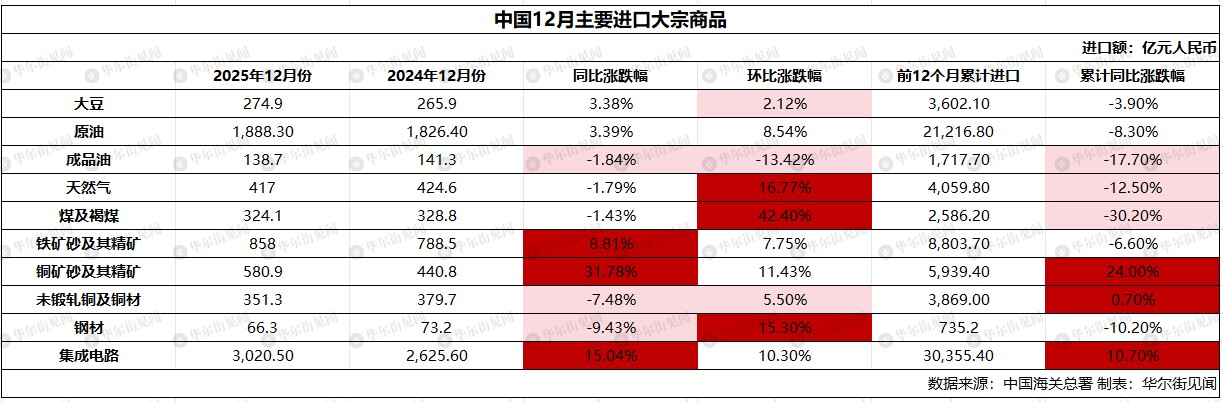
In terms of value, in December last year, the import values of copper ore and its concentrates, integrated circuits, and iron ore and its concentrates were 58.09 billion, 302.05 billion, and 85.8 billion, representing year-on-year increases of 31.78%, 15.004%, and 8.81%, respectively.
The import values of steel, unrefined copper and copper products, and refined oil were 6.63 billion, 35.13 billion, and 13.87 billion, showing year-on-year declines of 9.43%, 7.48%, and 1.84%, respectively
Data released by the General Administration of Customs shows:
China's crude oil imports in December were 55.973 million tons; total crude oil imports for the year reached 577.726 million tons, an increase of 4.4% year-on-year.
December refined oil exports were 5.367 million tons; total refined oil exports for the year reached 58.020 million tons, a decrease of 0.2% year-on-year.
December refined oil imports were 3.987 million tons; total refined oil imports for the year reached 42.418 million tons, a decrease of 12% year-on-year.
December coal and lignite imports were 58.597 million tons; total coal and lignite imports for the year reached 490.270 million tons, a decrease of 9.6% year-on-year.
December natural gas imports were 13.448 million tons; total natural gas imports for the year reached 127.865 million tons, a decrease of 2.8% year-on-year.
December soybean imports were 8.044 million tons; total soybean imports for the year reached 111.833 million tons, an increase of 6.5% year-on-year.
December edible vegetable oil imports were 667,000 tons; total edible vegetable oil imports for the year reached 6.936 million tons, a decrease of 3.2% year-on-year.
December natural and synthetic rubber (including latex) imports were 950,000 tons; total natural and synthetic rubber (including latex) imports for the year reached 8.525 million tons, an increase of 16.7% year-on-year.
December meat (including offal) imports were 418,000 tons; total meat (including offal) imports for the year reached 6.087 million tons, a decrease of 8.7% year-on-year
