


Copper price divergence intensifies! UBS bets on "supply collapse," Goldman Sachs warns of "overheating correction," has the turning point arrived?

UBS sees a shortage in 2027, while Goldman Sachs sees a surplus in 2026. UBS warns that the efficiency of mining capital investment has plummeted, which may lead to a severe shortage in the copper market in 2026/27, requiring USD 17.5 billion to fill a 7 million ton gap; Goldman Sachs and Citigroup believe that the current surge in copper prices is mainly driven by "U.S. tariff panic," representing a short-term overheating. Citigroup even stated that January could be the peak for the entire year
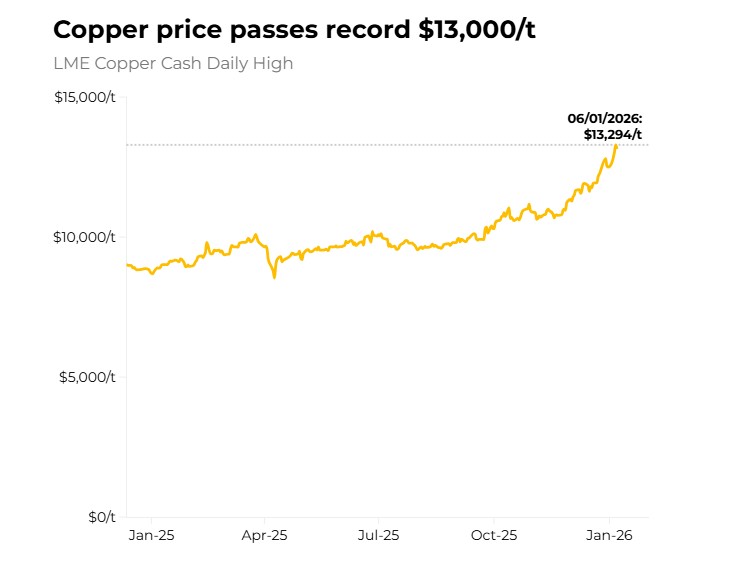
At a critical moment when copper prices have surged 22% in a month and surpassed $13,000 per ton, Wall Street has developed serious divisions regarding the future trend of this most important industrial metal globally.
According to news from the Wind Trading Desk, a report released by UBS analyst Daniel Major's team on January 12 warned that despite the recent spike in copper prices, project approvals (FID) for mining companies remain at extremely low levels during the 2023-2025 period. Moreover, the shift in the capital expenditure cycle has lagged, indicating a severe structural shortage in the copper concentrate market in 2026/27.
This structurally bullish view sharply contrasts with the short-term warnings from Goldman Sachs and Citigroup. Although both Goldman Sachs and Citigroup have recently raised their short-term target prices, they warned that current prices are driven by a "stockpiling frenzy" triggered by expectations of U.S. tariffs. Goldman Sachs believes that once the tariff policy is clarified in the second quarter and stockpiling ends, the market will face the reality of global oversupply again; Citigroup bluntly stated that "January may be the price peak for the entire year."
The intense clash of these bullish and bearish views has shifted investors' focus from short-term macro games back to the most fundamental question in the industry: In the context of surging demand for energy transition, does the global mining industry have the capacity to provide enough copper? UBS's data provides a pessimistic answer—capital efficiency is sharply declining, while new supply has yet to catch up.
The "Illusion" of Capital Expenditure: More Money Spent, But No More Copper
In its report titled "Copper: Capital Expenditure Cycle Intensifies Supply Challenges," UBS reveals a fact that excites long-term bulls but terrifies downstream players: Mining companies are spending money, but efficiency is plummeting.
UBS points out that for the past decade, the market consensus on copper's medium-term outlook has been bullish, but the supply side has always been able to "squeeze out" enough copper to avoid shortages. However, this time is different. Despite large miners becoming increasingly optimistic about copper's long-term outlook and the returns on new projects being quite robust, the number of final investment decisions (FID) for projects in 2023-2025 remains low.
Core data is staggering:
-
Actual Investment Shrinks: Global copper industry capital expenditure has nominally remained stable at around $40 billion, but when adjusted for inflation, the actual capital expenditure in 2025 is only about 30% of the peak level in 2013, and has shown a declining trend over the past three years.
-
Capital Intensity Soars: Money is worth less now. After reviewing the project pipeline, UBS found that potential projects likely to be approved between 2025-2030 (approximately 11 million tons of capacity) have an average capital intensity of about $25,000 per ton. In contrast, projects approved/finished from 2021-2025 (approximately 3.8 million tons) had a capital intensity of only $17,000 per ton.
-
This Means: Capital intensity has increased by 50%. In other words, $1 billion spent in the past could yield about 60,000 tons of copper, while the same $1 billion in the future will only yield about 40,000 tons.
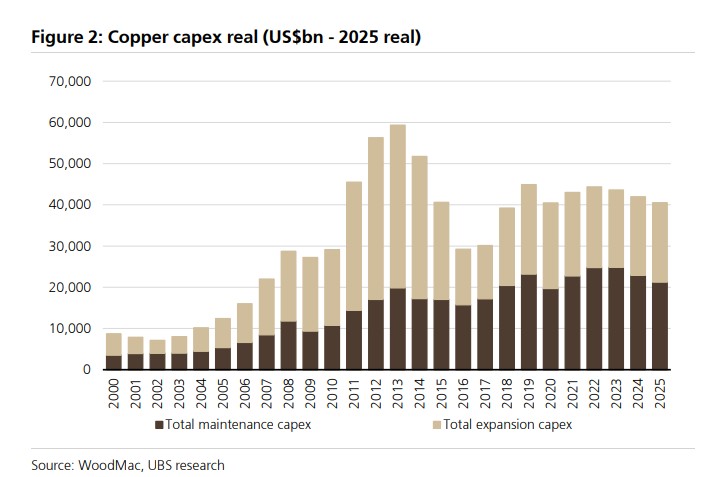
UBS analyst Daniel Major's team stated: "Despite the mixed outlook for demand, analyzing the capital expenditure cycle convinces us that the copper market will enter a shortage state in 2026/27, and the consumption of inventory will support further price increases."
Filling the Gap Requires $175 Billion, Approval Speed Severely Lagging
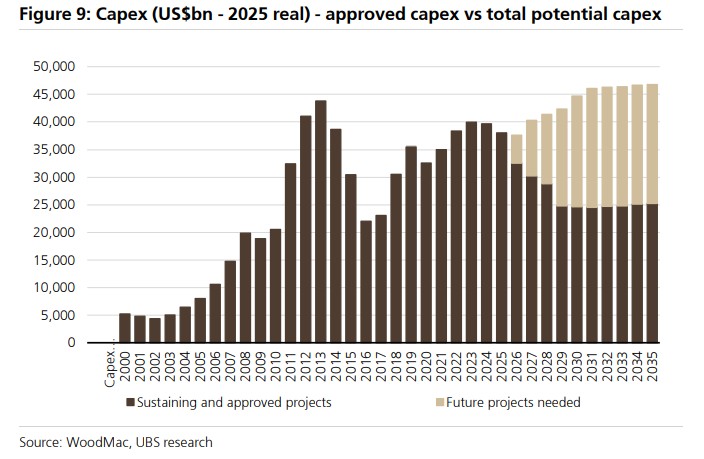
To quantify the severity of the supply crisis, UBS established a long-term model. The model shows that if only currently approved or highly likely to be approved "baseline scenario" projects are considered, global mine supply will peak between 2028-2030 and then begin to decline. By 2035, the supply-demand gap will widen to an astonishing 7 million tons.
UBS estimates that to fill this gap, the industry needs to take immediate action:
-
Capital expenditure for new projects needs to increase to $5 billion by 2026;
-
By 2030, it needs to grow to $20 billion annually and maintain that level until 2035;
-
A cumulative expenditure of over $175 billion for new projects is required.
However, the reality is not optimistic. The approval volume for new projects in 2023-2024 is still close to cyclical lows. Although the approval volume is expected to rebound to about 800,000 tons in 2025, considering the 3-4 year construction cycle, this pace is still insufficient to meet demand growth.
Prices Have Reached the "Incentive Line," but Giants Prefer Mergers and Acquisitions
UBS believes that current spot prices are at or above levels that can incentivize new project investments. The bank estimates that based on a 15% internal rate of return (IRR) threshold, long-term copper prices need to reach $5.0 per pound (approximately $11,000 per ton) to incentivize most new projects.
Although prices have met the criteria, the supply response remains sluggish. UBS points out that while the capital allocation priorities of giants like BHP and Rio Tinto have shifted towards growth, it is more through mergers and acquisitions (M&A) to acquire existing resources rather than taking on high-risk development of new mines.
The report lists key projects that may make final investment decisions (FID) in the next 2-3 years, including the expansions of Escondida and Spence in Chile, the Vicuna and Mara projects in Argentina, and the Bagdad and Resolution projects in the United States.
UBS believes that with the implementation of Argentina's RIGI Act (Large Investment Incentive System) and the potential improvement of the regulatory environment in the United States, some projects are expected to accelerate. However, overall, "the speed of capital deployment will still struggle to avoid a slowdown in supply growth in the next 2-3 years."
Therefore, the market needs a longer period of high prices to stimulate alternative demand or reduce consumption
Goldman Sachs and Citigroup's Warning: "False Prosperity" Under Tariff Panic
Unlike UBS, which focuses on long-term supply bottlenecks, Goldman Sachs and Citigroup's attention is on short-term demand-side anomalies. Their conclusions are remarkably consistent: Short-term increases are too rapid, beware of a pullback.
According to a Goldman Sachs research report cited by the Wind Trading Desk, the analyst team led by Eoin Dinsmore pointed out that the recent surge in copper prices is primarily driven by "U.S. stockpiling." The market is concerned that the U.S. will impose tariffs on refined copper, leading to a massive influx of metal into the U.S. market. Goldman Sachs warns that once the tariff policy for the second quarter becomes clear (whether delayed or implemented), the stockpiling momentum will disappear, and the market focus will return to the expected surplus of 300,000 tons globally in 2026. Goldman Sachs maintains its judgment that prices will fall to $11,200 per ton in the fourth quarter of 2026.
Citigroup's view is more aggressive. The team led by Tom Mulqueen pointed out in a report on January 6 that while they raised the short-term target to $14,000 per ton, "January may be the price peak for 2026." Citigroup warns that prices above $13,000 will stimulate a surge in scrap copper supply, thus balancing the market. Unless new macro catalysts emerge, prices will eventually fall back to the level of $13,000 per ton.
UBS, on the other hand, refuted the limitations of this short-term perspective in its report. UBS acknowledged that the recent price surge is driven by investor positioning and that short-term prices may face consolidation, but emphasized that "the contrast between supply challenges and resilient demand creates a compelling fundamental case." UBS firmly believes that 2026 will be the year when the market truly feels "physical scarcity," and the continuous decline in inventories will support further price increases.
In summary, the current copper market presents an extremely divided state:
-
Long-term logic (UBS): Insufficient mining investment and soaring costs are irreversible physical constraints, and shortages in 2026/27 are inevitable; current prices are merely the prologue to a long-term bull market.
-
Short-term logic (Goldman Sachs/Citigroup): The current surge is based on a fragile balance built on "tariff panic" and "U.S. stockpiling," and once policy uncertainty is eliminated, the surplus fundamentals will pull prices back down.
The above exciting content comes from [Wind Trading Desk](https://mp.weixin.qq.com/s/uua05g5qk-N2J7h91pyqxQ).
For more detailed interpretations, including real-time analysis and frontline research, please join the【 [Wind Trading Desk ▪ Annual Membership](https://wallstreetcn.com/shop/item/1000309)】
