It's Non-Farm Payroll night again! Employment may "moderately rebound," is there still hope for a rate cut in January?

Wallstreetcn
2026.01.09 07:44
portai
I'm PortAI, I can summarize articles.

Tonight at 21:30, Wall Street holds its breath for the December non-farm payroll report. The current market consensus expects an increase of about 70,000 jobs, with the unemployment rate likely to slightly decrease to 4.5%. If the data reflects a "slowdown in hiring but no wave of layoffs," it will support expectations for a "soft landing" of the economy and strengthen the pricing for a pause in interest rate cuts in January; if the unemployment rate unexpectedly rises, expectations for rate cuts will reignite. Pricing indicates that the probability of maintaining the interest rate in January is about 80%, while the probability of a further 25 basis point rate cut by March is about 48%

Wall Street is holding its breath for the U.S. December non-farm payroll report to be released at 21:30 Beijing time tonight. The market is eager to find clues about future policy paths from this data, especially whether the "moderate recovery" in the job market is sufficient to support the Federal Reserve in pausing interest rate cuts in January.

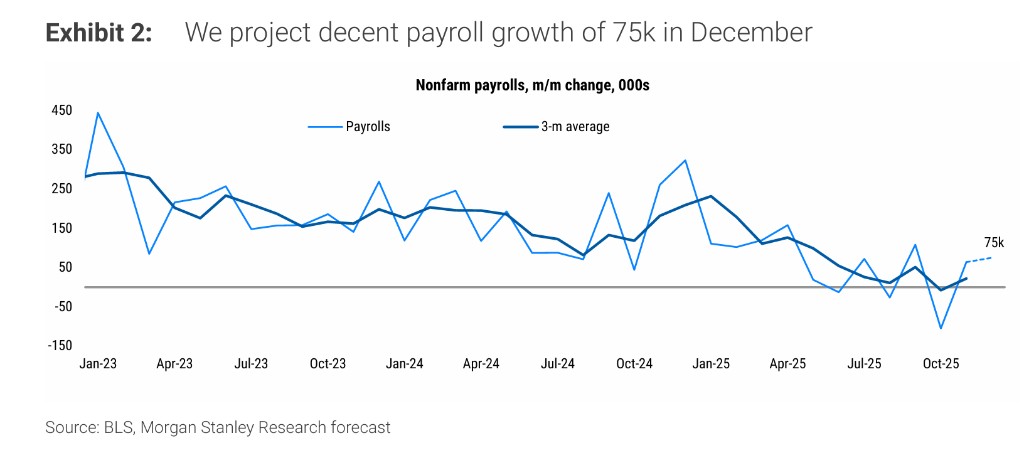
Current market consensus expectations show that the number of new non-farm jobs in December is expected to be between 70,000 and 75,000, a slight increase from November's 64,000. Although the number of new jobs is not strong, it is enough to alleviate market concerns about a sharp economic downturn. This "moderate recovery" situation has resulted in a labor market characterized by "slowing hiring but no wave of layoffs."

However, for investors most concerned about the prospects of interest rate cuts in January, the unemployment rate reading will play a decisive role. According to the latest research reports from Morgan Stanley and Goldman Sachs, there is a possibility that the unemployment rate could fall to 4.5%. If this prediction comes true, it may increase the probability of the Federal Reserve maintaining interest rates in January. Conversely, if the unemployment rate remains at 4.6% or higher, it will support a rate cut in January. Currently, the pricing in the money market shows that the probability of the Federal Reserve maintaining interest rates in January is about 80%, while the probability of a further 25 basis point cut in March is about 48%.

The release of this data comes at a politically sensitive time. Although the data shows that GDP growth remains strong, hiring activity has lagged. Market analysis indicates that if the number of new jobs falls within the range of 0 to 105,000, the stock market may react positively, viewing it as evidence of an economic "soft landing"; however, if the data unexpectedly turns negative or significantly exceeds expectations, it could trigger severe market volatility. Tonight's report will not only correct the market's perception of the resilience of the U.S. economy but will also directly determine investors' expectations for the monetary policy environment at the beginning of 2026.

Employment Data Preview: Moderate Rebound and Potential Disruptions

According to consensus forecasts compiled by Bloomberg and other media, the number of non-farm jobs in December is expected to increase by 70,000, with private sector employment expected to increase by 75,000, slightly higher than the previous value of 69,000. The forecast range varies from a low of 23,000 to a high of 155,000, and it is worth noting that no institution predicts negative growth.

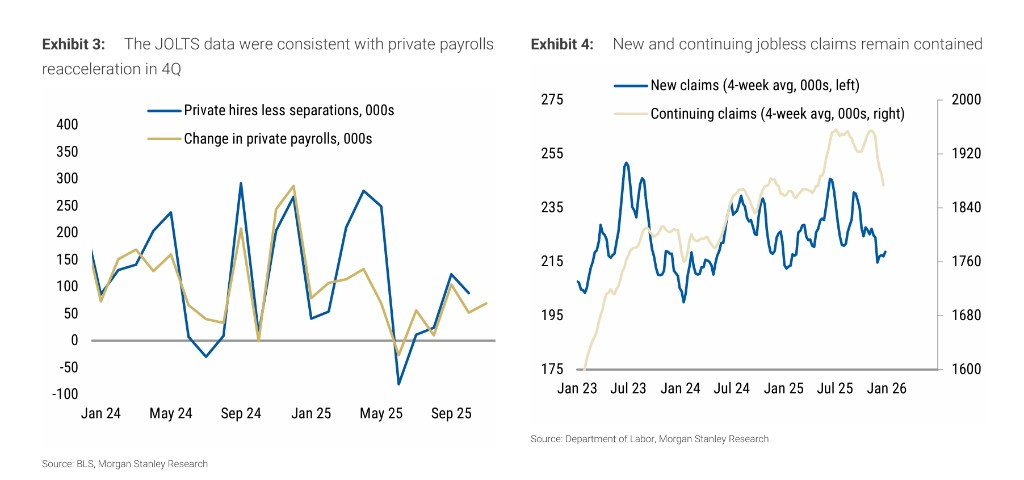
Goldman Sachs' Ronnie Walker team predicted in a report released on the 8th that the number of new jobs would be 70,000, consistent with market consensus. The analysis pointed out that big data indicators show that private sector job growth is moderate, and the shift of holiday retail hiring to December may bring a boost of about 15,000 jobs. However, negative factors still exist: the ongoing hiring freeze by the federal government is expected to lead to a reduction of 5,000 jobs in government sectors; additionally, cold weather and snowfall during the initial survey period may drag down construction and leisure hotel industries by about 20,000 jobs Morgan Stanley's Michael T Gapen team provided a slightly optimistic forecast of 75,000 in their report on the 7th. The economists believe that although the hiring pace has slowed compared to last year, there are no signs of accelerated layoffs, and the current labor market is characterized by "slow hiring but no layoffs." Additionally, the earlier released ADP Employment Report showed that 41,000 jobs were added in the private sector in December, slightly below expectations, but small businesses have resumed hiring after experiencing layoffs in November.

Unemployment Rate and Labor Market "Perception" Discrepancy

The market generally expects the unemployment rate in December to fall from 4.6% to 4.5%. Goldman Sachs stated that the actual unemployment rate in November was 4.56%, and the downward revision to the 4.5% threshold is not high. Furthermore, with temporarily laid-off federal workers returning to their positions and a slight decrease in the number of ongoing unemployment claims, the unemployment rate is expected to stabilize.

Citigroup's Andrew Hollenhorst team predicts that the U.S. unemployment rate may rise to 4.7% in December, prompting the Federal Reserve to cut interest rates by 25 basis points this month. With the balance of risks between a weakening labor market and cooling inflation, the baseline forecast for actual rate cuts this year is 75 basis points, with the possibility of exceeding 100 basis points not ruled out.

However, beneath the surface of the unemployment rate data, there are undercurrents. Pantheon Macroeconomics warns that broader labor market slack is becoming evident. New graduates are struggling to find jobs, and former federal employees accepting voluntary buyouts, while raising the unemployment rate, often do not qualify for unemployment benefits, leading to the possibility that the ongoing claims for unemployment benefits may be underestimated.

Consumer confidence surveys also corroborate the weakness in the labor market. The Conference Board's December survey showed that the proportion of respondents who believe "job opportunities are plentiful" fell from 28.2% to 26.7%, while the proportion who believe "jobs are hard to find" increased. This indicates that although the overall data appears stable, the general public's "perception" of the job market is cooling.

Policy Game: Pause or Continue in January?

The Federal Reserve lowered interest rates by 25 basis points to a range of 3.50-3.75% in December last year, with Powell stating that although the layoff rate is low, labor demand is clearly weak. The latest FOMC meeting minutes show significant internal disagreements among decision-makers: most participants support rate cuts to address employment downside risks, but some members prefer to maintain rates to assess the lagging effects of policy.

For the January policy meeting, this non-farm report will play a decisive role. Barclays analysis suggests that the meeting minutes indicate the Federal Reserve may pause rate cuts in January to observe the effects of previous rate cuts Morgan Stanley holds a different view, with its economists believing that if the unemployment rate remains at 4.6% (rather than the consensus expectation of 4.5%), there is still sufficient reason for the Federal Reserve to continue cutting interest rates in January.

Current market pricing leans more towards a "pause." If employment data is unexpectedly strong, it will further reduce the likelihood of recent rate cuts and may reignite concerns about inflationary pressures; conversely, if the data is significantly weak, it may force the Federal Reserve to reconsider its hawkish stance.

Market Reaction and Strategic Views

In anticipation of tonight's data release, major trading desks on Wall Street are on high alert. Options market pricing indicates that the potential volatility of the S&P 500 index on the day of the data release is approximately 1.2%.

J.P. Morgan's market intelligence team, through scenario analysis, points out that the most favorable outcome for the stock market is if the number of new jobs falls between 0 and 105,000, which is considered the "Goldilocks" range. The specific projections are as follows:

  • 75,000-100,000: S&P 500 index rises by 0.25%-1%;
  • 35,000-75,000: S&P 500 index rises by 0.25%-0.75%;
  • Above 105,000: The stock market may decline by 0.5%-1%, as strong data could push up bond yields, dampening rate cut expectations;
  • Below 0: The stock market may decline by 0.5%-1.25%, as recession fears intensify.

Goldman's trading department believes that as long as the labor market remains stable, combined with economic growth above consensus and the Federal Reserve's easing bias, it will create a favorable macro environment for U.S. stocks. However, the firm also warns that given the current high stock valuations, the market remains vulnerable to extremely weak labor data. Defensive sectors such as healthcare and consumer staples currently have relatively low valuations and may become safe havens for funds.

In the foreign exchange market, Goldman strategist Karen Fishman points out that if the data meets expectations and the unemployment rate falls to 4.5%, it will be an ideal combination for pro-cyclical assets, potentially benefiting high-beta currencies like the Australian dollar, while the Japanese yen may perform poorly due to rising yields