Featured Analysis|Why did Trump focus on Greenland? Beyond its strategic location, this frozen island is buried with "key resources"

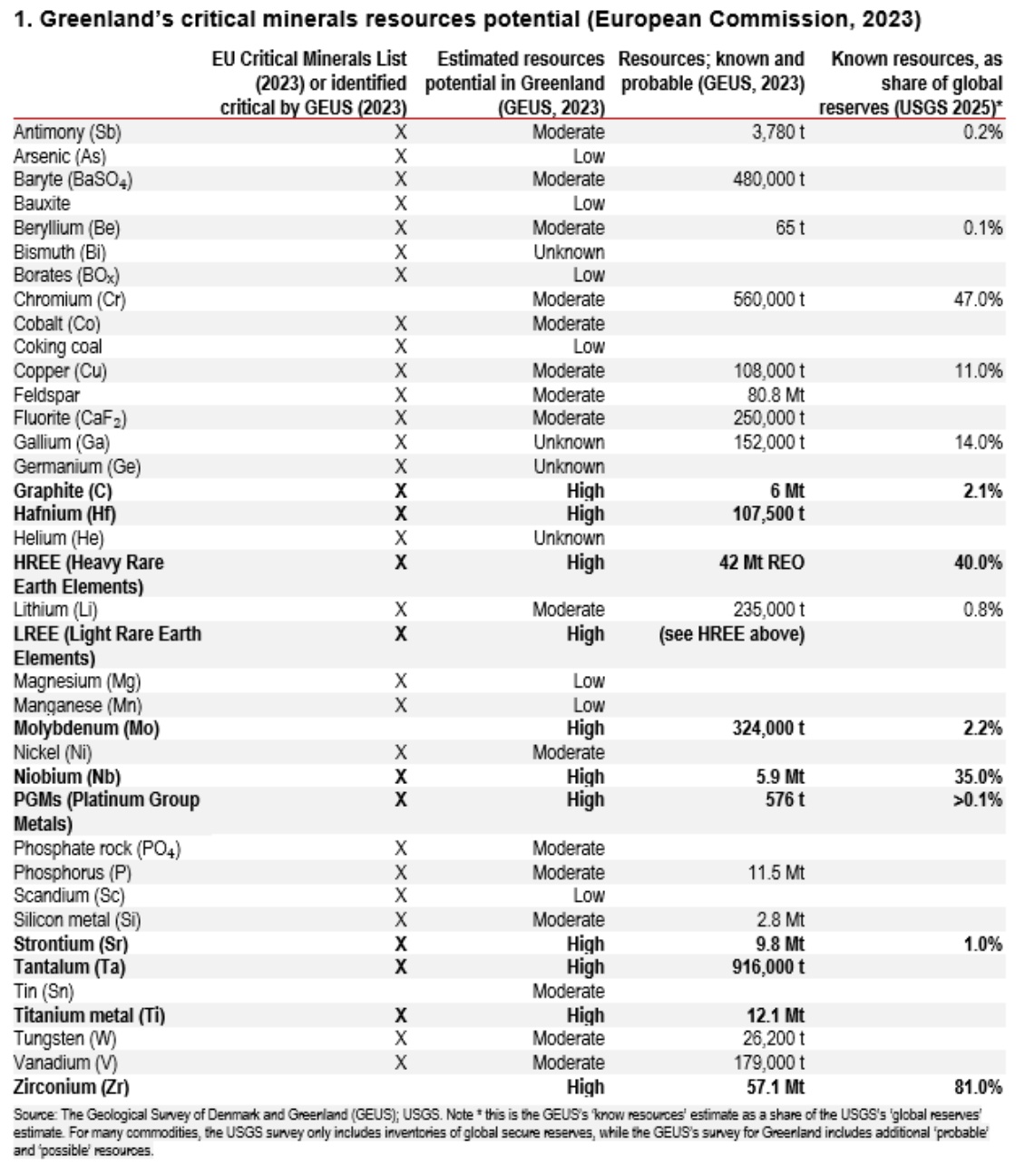
HSBC stated that Greenland not only has significant military value and important shipping potential due to its geographical location, but its natural resources are the core focus. Greenland possesses the 8th largest rare earth reserves in the world, and if potential reserves are included, it could rise to the second largest globally, with a notable proportion of heavy rare earths. Greenland also has moderate reserve potential for minerals such as nickel, copper, lithium, and tin, as well as oil and gas resources. The island has mineral resources among the 29 materials classified as critical or moderately important by the European Commission
On January 8 local time, U.S. President Donald Trump said that the United States must “own” all of Greenland, a remark that has once again thrust the island into the spotlight of geopolitical and geo-economic debate.
According to a recent research report by HSBC, the world’s largest island is not only of strategic geographic importance but also hosts abundant reserves of rare earths and other critical minerals.
Greenland holds the world’s eighth-largest proven rare earth reserves (approximately 1.5 million metric tons). When potential resources are included, its total rare earth endowment could rise to 36.1 million metric tons, which would rank second globally. In addition, Greenland possesses mineral resources corresponding to 29 of the 38 raw materials classified by the European Commission as critical or moderately critical.
However, the key issue is that while Greenland has the world’s eighth-largest rare earth reserves, these resources are unlikely to be economically viable for near-term development at current prices and extraction costs. Roughly 80% of the island is covered by ice, more than half of its mineral deposits lie north of the Arctic Circle, and strict environmental regulations significantly raise production costs. As a result, Greenland is unlikely to become a major supplier of critical minerals in the short term unless commodity prices rise substantially.
Geopolitics Brings Greenland Back Into Focus, With Three Layers of Strategic Value
U.S. interest in Greenland is not new. As early as the 19th century, the United States proposed purchasing the island. Since the Trump administration took office, the issue has resurfaced multiple times—in 2019, 2025, and again in 2026—shifting from an initial emphasis on “economic security” toward a stronger focus on “national security.”
Greenland is a semi-autonomous territory within the Kingdom of Denmark, with a population of just 57,000 and a GDP ranking 189th globally, making its economic scale negligible. Its geopolitical significance, however, is outsized. As the world’s largest island, its land area would rank 13th among global economies, and its strategic position—roughly 80% ice-covered and situated between the United States, Europe, and Russia—makes it uniquely important.
HSBC notes that Greenland’s renewed prominence reflects the convergence of three key factors.
First is security considerations. Greenland is located at a strategic juncture between the U.S., Europe, and Russia, making its geographical position highly valuable militarily.
Second,Shipping potential. As climate change accelerates Arctic ice melt, northern sea routes may become more navigable and economically important, positioning Greenland as a critical node in future global shipping networks.
Third is natural resources—which represent the core focus of the current debate.
Rare Earth Reserves Rank Among the World’s Largest, With a High Share of Heavy Rare Earths and 29 Critical Minerals
According to the report, data from the U.S. Geological Survey (USGS) in 2025 show that Greenland holds approximately 1.5 million metric tons of rare earth reserves, ranking eighth globally. More optimistic estimates from the Geological Survey of Denmark and Greenland (GEUS) suggest total rare earth resources could reach 36.1 million metric tons. If accurate, this would place Greenland second worldwide.
More importantly, Greenland’s deposits contain an unusually high concentration of heavy rare earth elements—including terbium, dysprosium, and yttrium. In most rare earth deposits, heavy rare earths typically account for less than 10% of total content, yet they are essential for permanent magnets used in wind turbines, electric vehicles, and defense systems.
Beyond rare earths, Greenland also has moderate resource potential in minerals such as nickel, copper, lithium, and tin, as well as oil and gas resources. The USGS estimates that the Arctic region may contain roughly 30% of the world’s undiscovered natural gas reserves.
In total, Greenland possesses 29 of the 38 raw materials identified by the European Commission (2023) as highly or moderately critical. These same materials are also classified by GEUS (2023) as strategically or economically important.
This broad portfolio of mineral resources gives Greenland potentially significant importance within global critical-mineral supply chains—especially at a time when countries are increasingly seeking to diversify supply amid rising geopolitical tensions.
Extraction Faces Major Economic Constraints
However, there is a wide gap between theoretical reserves and actual extractable supply, and developing Greenland’s resources faces significant challenges.
Severe geographic constraints:
According to GEUS, more than half of Greenland’s confirmed mineral potential sites are located north of the Arctic Circle. Roughly 80% of the island is covered by ice, and the extreme climate substantially increases both the technical difficulty and the cost of extraction.
Slow project progress:
Taking rare earths as an example, while deposits such as Kvanefjeld and Tanbreez in southern Greenland are considered promising—Tanbreez has set a preliminary target of producing around 85,000 tonnes of rare earth oxides annually starting in 2026—there are currently no large-scale mines in active operation.
Questionable economic viability:
At current commodity prices and production costs, and given the added complexity of an ice-covered geography alongside relatively strict environmental regulations, Greenland’s rare earth resources are unlikely to be economically viable in the near term. GEUS explicitly notes that higher future commodity prices would be required for Greenland’s deposits to become commercially feasible.
HSBC’s report draws a parallel with Venezuela’s oil predicament. Despite holding the world’s largest proven oil reserves, only a small portion of Venezuela’s resources can be extracted economically.
For Greenland, the story is strikingly similar: vast reserves, but uncertain economic viability. The key issue is not simply whether a country possesses commodity resources, but whether those resources can be extracted at an economically viable cost. This distinction is becoming increasingly important in an era of intensifying geo-economic competition, where trade and access to commodities are more frequently used as geopolitical tools.