


Deutsche Bank Deep Dive: The U.S. is Targeting Venezuela, Not Just for Oil, But Also to "Save the Dollar"

Deutsche Bank AG's research report points out that the U.S. intervention in Venezuela is not only about energy but also about maintaining the dollar's status as the global reserve currency. Controlling the world's largest oil reserves will enhance the U.S.'s influence over oil prices and ensure that oil is priced in dollars. Historically, countries that control core energy resources can gain economic, industrial, and military advantages, thereby maintaining global dominance. Venezuela's oil reserves are six times that of the U.S., and although its production capacity is low, it complements the U.S.'s overcapacity
Deutsche Bank pointed out that the United States' competition for Venezuelan oil is superficially about energy, but in reality, it is a covert war for dollar hegemony.
According to news from the trading desk, on January 8, Deutsche Bank strategist Mallika Sachdeva published a research report indicating that the U.S. involvement in Venezuela goes far beyond mere energy considerations. While controlling the world's largest oil reserves can enhance the U.S.'s influence over global oil prices, the deeper strategic goal is to maintain the dollar's status as the global reserve currency.
Sachdeva believes that the irreplaceability of oil for military power directly affects a country's chances of success in conflicts, which is a core consideration for central banks holding reserve currencies. Furthermore, controlling oil pricing is crucial for maintaining the petrodollar system.
As the U.S. is no longer the world's largest oil importer, it may lose the ability to control pricing through demand and instead seek to dominate the supply side to ensure oil continues to be priced in dollars.
If the U.S. successfully controls the entire oil supply of the Western Hemisphere, its share of reserves will surpass OPEC, thereby consolidating the dollar's special status in the global financial system.
Energy Hegemony: The Inevitable Logic of History
The research report reviews history and points out that a country that controls the world's most critical energy resources can not only gain economic and industrial advantages but also transform them into unchallengeable military advantages and global financial hegemony, thereby establishing and maintaining its dominant position in the world.
Britain, with the largest coal reserves in Europe, was the first to ignite the Industrial Revolution, becoming the world's factory and hegemon in the 19th century. The United States, after discovering large-scale oil, leveraged its high energy density and convenience to drive revolutions in automobiles, aviation, and chemicals, becoming the center of the global economy and industry after World War II.
Therefore, the report emphasizes that the cheapest and most abundant energy is the cornerstone of industrial production and economic growth; whoever controls it holds the engine that drives the global economy.
Deutsche Bank analysts point out that today, over 70% of U.S. energy consumption relies on oil and gas. If the U.S. bets on fossil fuels as its future energy choice, it must ensure a sufficient and low-cost supply to maintain global competitiveness.
Venezuela's oil reserves are six times that of the U.S. Although Venezuela's production capacity is low, its vast underground reserves form a "perfect complement" to the overcapacity of the U.S.
The report cites recent remarks by U.S. President Trump, indicating that controlling Venezuelan oil is not only to prevent competitors from accessing resources but also to restore a Monroe Doctrine-style hegemony in the Western Hemisphere.
Military Hegemony as the "Hard Currency" of Dollar Credit
Deutsche Bank analyzes the reasons why central banks around the world are willing to hold dollars as reserve currencies. Beyond economic factors, military success rates are a key hidden variable.
Deutsche Bank emphasizes that the truly irreplaceable area for oil is military use. While passenger vehicles can be electrified and AI can be powered by nuclear energy, U.S. military tanks, ships, and aircraft will still rely on oil for a long time.
The U.S. Department of Defense is the world's largest oil institutional user, with 75% of the federal government's energy consumption coming from the Department of Defense, most of which is jet fuel
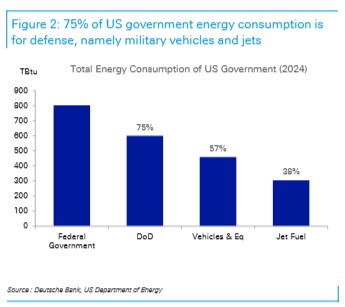 (75% of the U.S. government's energy consumption is used for defense)
Research reports cite academic studies indicating that countries with a higher probability of winning in conflicts are less likely to see their currencies collapse or depreciate, making them more favored by central banks. Historical experiences from World War II show that cutting off oil supplies was a key factor leading to the defeat of Germany and Japan.
Therefore, U.S. military hegemony has always been a key factor in the dollar's dominant position in the global reserve portfolio. If the probability of military success depends on access to oil, then the U.S. can enhance its relative winning probability by ensuring control over the world's largest oil reserves while preventing major rivals from accessing them, thereby supporting the dollar's reserve status.
However, Deutsche Bank also warns that if U.S. hardline actions stimulate Europe, Japan, or other regions to accelerate military rearmament and pursue strategic autonomy (such as increasing defense spending), it could lead to a diversification of global foreign exchange reserves away from the dollar towards the euro or yen, weakening the dollar's dominance.
From Controlling "Oil Prices" to Controlling "Pricing Power"
Market focus often centers on how the development speed of Venezuela's oil reserves affects long-term oil prices. However, Deutsche Bank believes that the U.S. aims to control the oil pricing system.
The research report points out that the foundation of petrodollars is shaking. The petrodollar agreement of 1974 was based on the U.S. being the world's largest oil buyer. As the largest buyer, it naturally had the ability to demand transactions be conducted in dollars. However, after the shale oil revolution, the U.S. achieved energy self-sufficiency and is no longer the world's largest oil importer.
This means that the traditional leverage of maintaining dollar pricing power through the "demand side" has been significantly weakened. Since it can no longer "demand" the use of dollars as the largest buyer, the U.S. must find new ways to "ensure" that the dollar continues to be used.
The new path proposed in the report is to enforce dollar settlement from the "supply side" by becoming one of the world's largest oil suppliers. The U.S. controls vast oil reserves in the Western Hemisphere (especially Venezuela), which will surpass OPEC in reserve share.
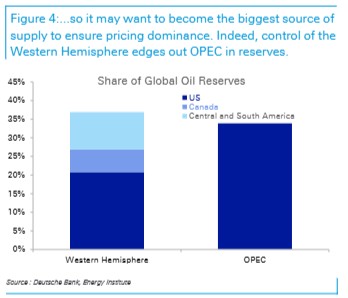 (Proportion of global oil reserves)
The report adds that Europe and BRICS countries are now promoting non-dollar settlements, and South American crude oil exports are relatively balanced among the world's top three economies.
If the U.S. can control Venezuela's oil sales channels, even if this oil ultimately does not flow to the U.S., as long as it is settled through the U.S. banking system, it can ensure that this massive trade flow remains locked within the dollar system, thereby maintaining global demand for dollar reserves and continuing to enjoy the "arrogant privilege" of low financing costs.
The above wonderful content comes from the Wind Trading Platform.
For more detailed interpretations, including real-time interpretations and frontline research, please join the【 **Wind Trading Platform ▪ Annual Membership**】

Risk Warning and Disclaimer
The market has risks, and investment requires caution. This article does not constitute personal investment advice and does not take into account the specific investment goals, financial situation, or needs of individual users. Users should consider whether any opinions, views, or conclusions in this article are suitable for their specific circumstances. Investment based on this is at your own risk